
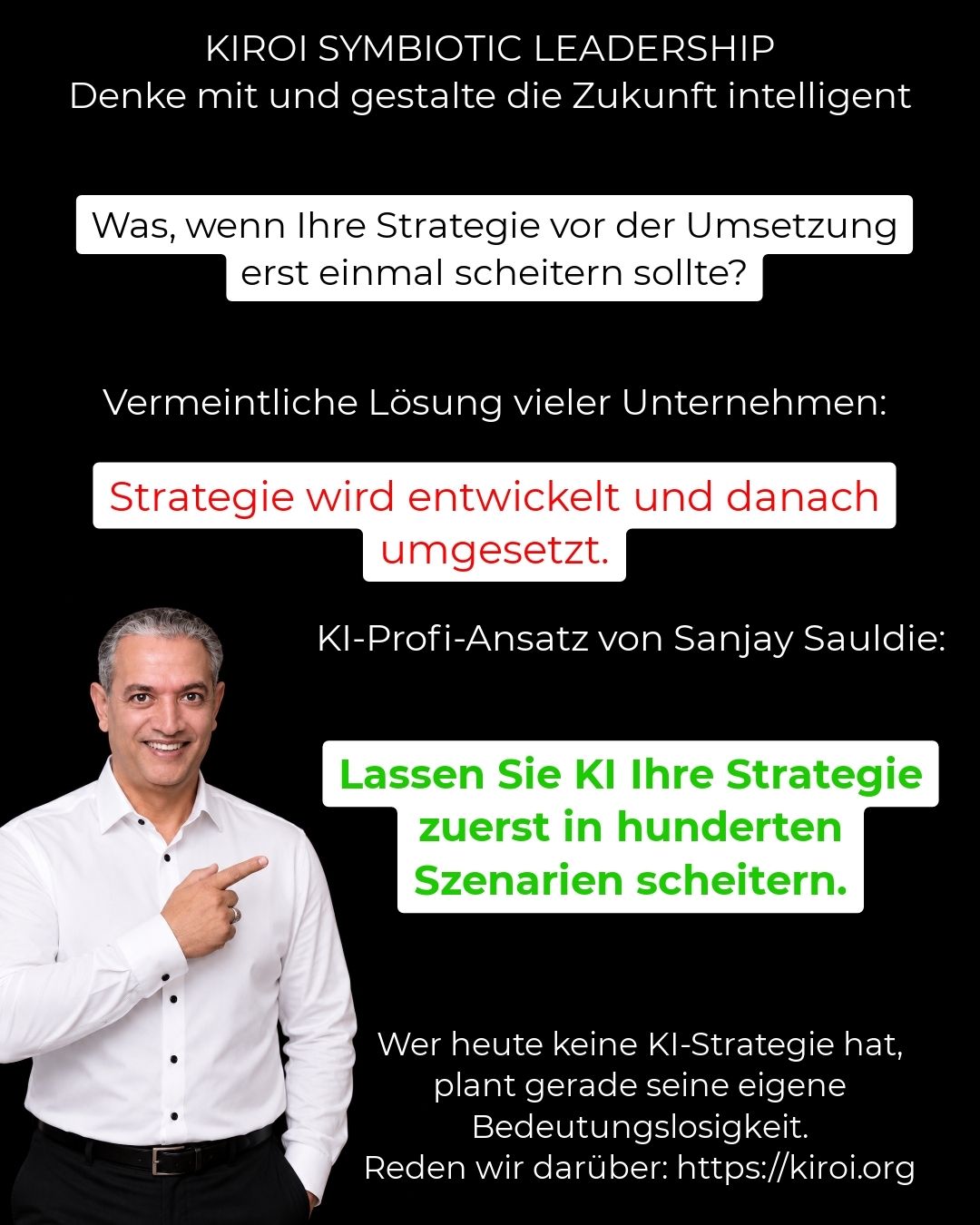
What actually happens when your carefully developed corporate strategy collapses on its first day of implementation? This question concerns executives worldwide, because reality repeatedly shows that even brilliant concepts can fail in practice. The truth is uncomfortable: Traditional planning methods rarely take into account the full complexity of dynamic markets and unpredictable events. Here, innovative approaches around AI strategies are simulated an approach that does not view failure as an endpoint but as a valuable learning process. In this article, you will learn why controlled failure can be the key to sustainable business success before actual implementation.
The traditional approach: Develop, Hope, Implement
Most organizations follow an established pattern in strategic planning. First, teams analyze the market and the competitive situation. Subsequently, they develop a strategy based on these findings. After that, implementation takes place in the real business world. However, this linear approach carries significant risks because it leaves little room for error.
A medium-sized manufacturing company, for example, invested significant resources in an expansion strategy for new markets. The analysis was thorough and the figures looked promising. However, the project failed because cultural peculiarities of the target markets were underestimated. A financial services provider, on the other hand, developed an ambitious digitalization strategy that was technically well-designed. However, employee acceptance remained far below expectations, resulting in the project stalling. A retail conglomerate experienced a similar situation with its omnichannel approach: The strategy worked theoretically excellently, but failed due to the lack of integration of existing systems.
These examples highlight a fundamental problem for average companies. They treat strategy development and implementation as two separate phases. However, there is a dangerous blind spot between these phases. Unforeseen obstacles and hidden risks lurk in this area. The traditional approach offers little protection against such surprises.
Why controlled failure becomes a factor of success
The idea seems at first paradoxical: using failure as a strategy for success. However, upon closer examination, the logic behind this approach becomes apparent. Each failure in the protected simulation environment saves a potentially costly failure in reality. Modern technology today enables, AI strategies are simulated to let it happen and at the same time to play through hundreds of scenarios.
Imagine a logistics company could first test its new route optimization virtually. Artificial intelligence simulates traffic jams, vehicle breakdowns, and staffing shortages simultaneously. It takes into account seasonal fluctuations and unexpected large orders. All these factors are factored into the evaluation of the strategy before even a single truck takes the new route. An energy provider could, in turn, have its investment strategy for renewable energy tested in advance. The simulation takes into account fluctuating raw material prices, political changes, and technological breakthroughs. A healthcare provider could have its expansion plans run through virtual market scenarios that incorporate demographic developments and regulatory changes.
The AIROI-approach: Intelligent failure with a system
The AIROI-methodology revolutionizes the way companies make strategic decisions. Instead of directly implementing strategies and hoping for the best, this approach uses artificial intelligence as a critical benchmark. The technology deliberately fails your strategy in numerous simulated environments. From each virtual failure, the system draws valuable insights. These insights are incorporated into the optimization of the original strategy.
For a pharmaceutical company, this meant that the planned market launch strategy for a new product initially ran through 347 different scenarios. The simulation revealed vulnerabilities in pricing in certain regions. It identified potential bottlenecks in the supply chain. Furthermore, it revealed unexpected competitive reactions that had not been factored into the original concept. A telecommunications provider used the approach to review its tariff structure, simulating customer churn scenarios using AI. An automotive supplier tested its diversification strategy against different economic cycles and technological breakthroughs.
Best practice with a AIROI customer
An internationally operating machine manufacturer faced the challenge of fundamentally reorienting its service strategy. The company wanted to move from reactive repair services to a proactive maintenance model. The traditional approach would have meant a gradual implementation with corresponding risks. Instead, the management decided on an AIROI accompanied simulation process that comprehensively tested the new strategy. Artificial intelligence generated over 500 different scenarios ranging from optimistic to extremely pessimistic market developments. Particularly enlightening was the finding that the original pricing strategy had led to customer losses in three of five main markets. The simulation also showed that certain customer segments would respond much more quickly to the new model than others. Based on these findings, the company adjusted its launch plan and prioritized the most promising segments. The implementation subsequently proceeded much more smoothly than in comparable projects in the past. Executives often report that this proactive approach saved significant resources and increased acceptance among employees and customers alike.
How to have AI strategies simulated and benefit from them
The practical application of this technology requires a systematic approach. First, teams define the strategy to be tested using all relevant parameters. Next, they identify the critical variables and uncertainties. Then, experts configure the simulation environment according to the specific business and market situation. The AI then begins the systematic examination of various scenarios.
A retail company used this process to review its location strategy. The simulation took into account changes in purchasing behavior, demographic shifts, and the development of online shopping. It showed which locations would remain profitable under different conditions. An insurance company ran its product innovation strategy through the AI test, simulating regulatory changes and competitive reactions. A construction company tested its sustainability strategy against various scenarios of raw material price developments and regulatory requirements.
The results of such simulations provide valuable recommendations for action. They not only show where weaknesses lie, but also how they can be addressed. Teams receive concrete guidance on how to optimize their strategy. They better understand which factors have the greatest impact on success. These insights enable informed decisions before actual implementation.
Transruptions coaching as a support for the transformation process
However, the technological component alone is not sufficient for sustainable success. Leaders need guidance in integrating this new mindset into their organization. Transruptive coaching helps translate the insights from simulations into concrete actions. It helps teams cope with the complexity of the results and draw the right conclusions.
Clients often report initial skepticism towards controlled failure. The idea contradicts the natural tendency to avoid mistakes at all costs. Coaching provides the impetus to expand this perspective and to understand failure as a learning opportunity. It accompanies leaders in introducing a new culture of failure in their organizations. A logistics company benefited particularly from this support in reorienting its warehouse strategy. A financial institution used coaching to refine its digitalization strategy using simulations. A manufacturing company sought support from coaching to implement agile adaptation strategies based on AI insights.
The practical implementation: From simulation to reality
The transition from the virtual testing environment to the real implementation requires careful planning. The insights from the simulation process must systematically feed into the strategy adjustment [1]. Teams prioritize the identified risks and develop corresponding countermeasures. They define early warning indicators that could indicate impending problems.
A chemical company implemented this approach in its internationalization strategy. Simulation had shown that certain country risks had been underestimated. Management then adjusted its market entry priorities and developed country-specific risk plans. A media company used the insights to optimize its content strategy, with AI simulating various usage scenarios and technology trends. An industrial conglomerate improved its M&A strategy based on simulations of various integration and market scenarios.
Best practice with a AIROI customer
A mid-sized plant builder wanted to expand its business model with digital service components, but faced significant internal uncertainty. The management feared that a flawed implementation could endanger existing customer trust. As part of the AIROI approach, the planned strategy was initially subjected to intensive simulations that depicted various customer reactions and competitive scenarios. The artificial intelligence identified a critical weakness in the planned pricing structure that would likely have been noticed only after market launch without this preliminary review. Furthermore, the simulation showed that certain customer groups would prefer a hybrid approach of traditional and digital services. This insight led to a more differentiated offer strategy that targeted different customer segments more specifically. Transruptions coaching accompanied the leadership team in interpreting the simulation results and implementing them into concrete actions. Particularly valuable was the support in internal communication of the strategic adjustments. Executives report that the previous simulation significantly strengthened their confidence in the new strategy and accelerated its implementation.
Why the time has now come to simulate AI strategies
The increasing complexity of the business world makes traditional planning approaches increasingly vulnerable to errors. Global supply chains, technological disruptions, and changing customer expectations significantly increase uncertainty. At the same time, advances in artificial intelligence have opened up new possibilities [2]. Companies can now simulate scenarios that would have been unthinkable just a few years ago.
A textile manufacturer recognized this opportunity and used AI simulations for its sustainability strategy. The technology helped evaluate different scenarios of the supply chain transition. A food company implemented the approach to optimize its product portfolio strategy, simulating trends in consumer behavior. A technology company tested its platform strategy against various developments in the regulatory environment.
The investment in such simulation processes often pays off quickly. Avoided errors in strategy implementation mean saved resources and protected market positions. Furthermore, the process strengthens the strategic competence of the entire organization. Teams develop a better understanding of relationships and risks.
My AIROI Analysis
The integration of AI-powered simulations into the strategic planning process marks a paradigm shift in corporate management. Where intuition and experience were once the main pillars of strategic decision-making, a data-based foresight is now emerging that anticipates errors before they can occur. My observations from numerous accompanying projects show that organizations that consistently adopt this approach develop significantly higher resilience against unforeseen market changes.
Particularly noteworthy is the cultural transformation that accompanies this approach. Leaders often report that their teams are more open to uncertainties and discuss potential weaknesses more constructively. The controlled failure in simulation takes the fear of real failure away and enables a more objective approach to risks. This development ultimately also supports the organization’s ability to innovate because new ideas can be tested without existential fears.
The AIROI-approach is not a substitute for human judgment, but a valuable addition. The technology provides data and scenarios, but the strategic decisions are still made by humans. Transruptive coaching accompanies this process and helps find the right balance between technological analysis and human intuition. For companies that want to survive in an increasingly uncertain world, this integrated approach offers a promising path to more robust and successful strategies.
Further links from the text above:
[1] Harvard Business Review – Strategy
[2] McKinsey – Strategy Insights
Are you a leader and would you like to learn how you can genuinely introduce AI into your company in a valuable and sustainable way, away from the hype? Take part Contact us or read more blog posts on the topic Artificial intelligence here.








 Deutsch
 English (UK)