
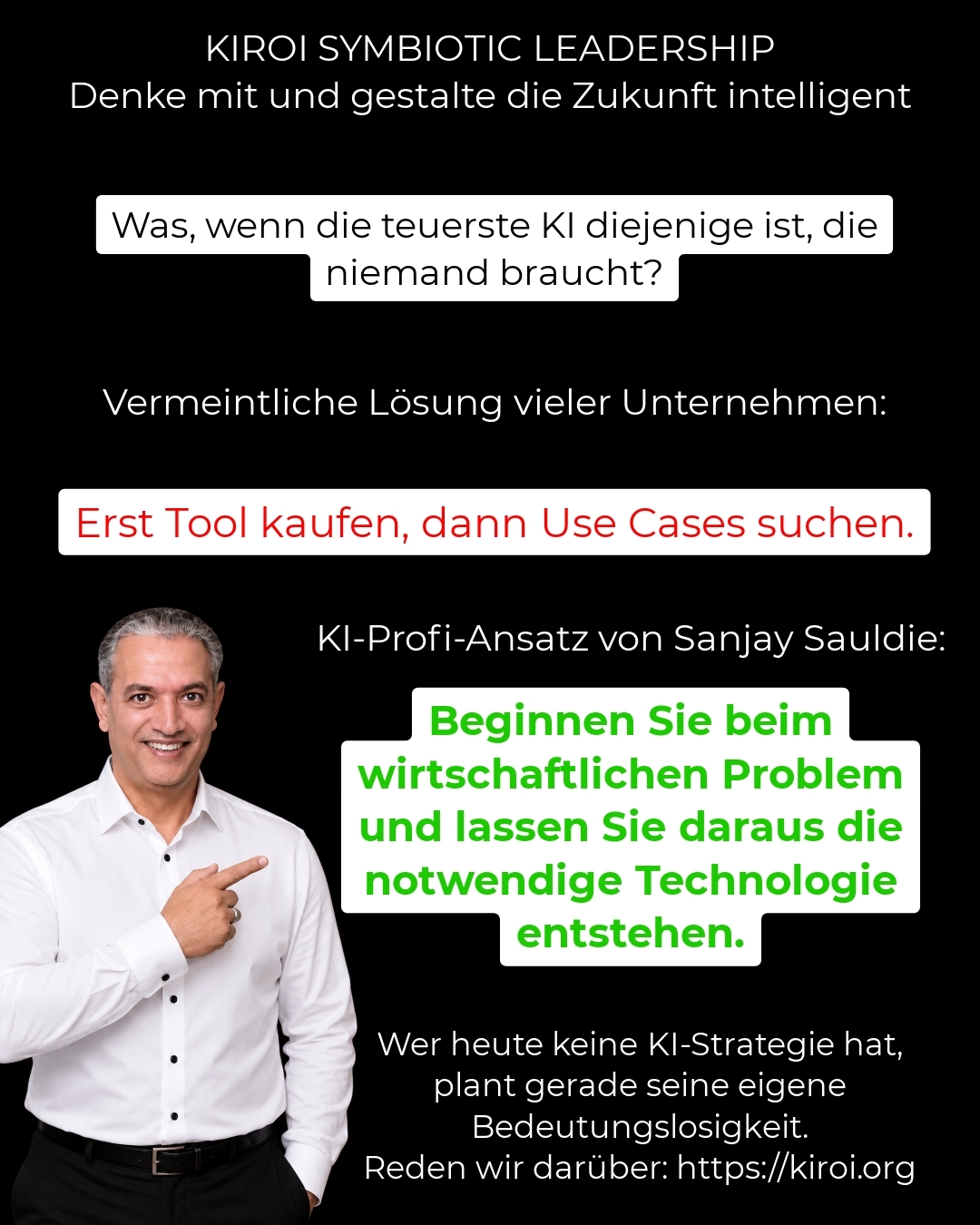
Have you ever wondered why some companies invest millions in digital technologies and still do not achieve measurable results? This question concerns executives and decision-makers in almost every industry, and the answer often lies not in the technology itself, but in the way companies approach implementation. The phenomenon of AI strategy for companies This reveals a recurring pattern: Organizations initially acquire impressive tools and only then look for suitable use cases, which ultimately leads to enormous misinvestments. This paper explores how decision-makers can avoid this costly and inefficient path and instead take an economically sensible approach.
The common pattern: Buy first, then look for
In numerous organizations, a remarkable pattern of behavior can be observed that, at first glance, appears paradoxical, but upon closer inspection reveals quite understandable psychological and structural causes. Executives read about impressive breakthroughs in professional journals, attend conferences where providers present revolutionary solutions, and feel a growing pressure not to lose the pace. This pressure leads to the allocation of budgets before a thorough analysis of the actual business requirements has been conducted. This creates situations where capable systems are implemented that function technically flawlessly but do not make any discernible contribution to value creation.
For example, a manufacturing company purchases an advanced image recognition platform because the demonstrations at a trade show were impressive. Only after implementation does it become apparent that the existing quality assurance processes are already working efficiently and that the new solution does not offer any significant added value. In another case, a logistics company invests in predictive analytics without first checking the data quality in its own systems. The result is predictions that remain unusable due to poor input data. A third example shows a service provider that introduces automated text generation, even though employees still have to completely revise every generated text.
Why average companies take this path
The reasons for this behavior are multifaceted and range from external competitive pressure, internal career ambitions, to fundamental misunderstandings about the nature of technological innovation. Many organizations are guided by what competitors appear to be doing or likely to do, rather than focusing on their own specific challenges. Furthermore, technology providers naturally have an interest in presenting their products as universally applicable, creating the impression among potential buyers that all they need to do is access them and the benefits will automatically ensue. This dynamic is amplified by consulting firms seeking to sell extensive implementation projects and by internal IT departments seeking to demonstrate their relevance through the introduction of modern technologies [1].
A mechanical engineering company decides to implement a digital twin because its competitor is advertising similar projects on LinkedIn. After significant investment, it turns out that the necessary sensors are missing in their own systems. A trading company implements a demand forecasting system, even though seasonal fluctuations are already reliably anticipated by experienced buyers. An energy provider invests in automated customer communication, while customers continue to seek personal contact and reject automated responses.
The AI strategy for companies begins with the economic problem
The AIROI-approach turns this widespread pattern on its head and begins by identifying concrete economic challenges, before even considering technological solutions. This approach may seem obvious at first glance, but in practice it requires a fundamental change in thinking and decision-making processes. Instead of asking which technology is available and how it could be used, the central question is: which measurable business problem do we want to solve, and what consequences does it have if we do not solve it? Only when this question is answered precisely will it be examined whether and what technological support could be useful.
For example, a food manufacturer identifies high rejection rates as a central problem and quantifies the associated costs precisely. Only then is it examined whether image-based quality control can make a commercially meaningful contribution. An insurance company notes that the processing time for claims leads to customer dissatisfaction, and subsequently investigates which process steps can be accelerated through automated document analysis. A construction company identifies planning errors as the cause of budget overruns and subsequently evaluates whether predictive models for risk assessment can remedy the situation.
Best practice with a AIROI customer
A medium-sized manufacturing company had already invested significant sums in various digital solutions without seeing measurable improvements in business KPIs. Management reported frustration among management and growing skepticism among employees towards further technology projects. As part of the transruptive coaching support, a systematic analysis of actual value-loss was initially conducted, which revealed that the biggest lever in reducing unplanned machine downtime lay in predictive maintenance. Instead of a comprehensive platform solution, a focused pilot project for predictive maintenance was launched on a critical asset. The investment amounted to a fraction of the originally planned technology budgets, and the results significantly exceeded expectations. Within a few months, unplanned downtime dropped by more than forty percent, leading to measurable cost savings and simultaneously restoring the organization’s confidence in data-driven approaches. Employees often reported a new understanding of how technological support can actually facilitate their work, rather than creating additional complexity.
How an AI strategy for companies becomes economically viable
Developing an economically viable approach requires a structured process that begins with the business strategy and not with the technology. In the first step, the essential drivers of value and cost drivers of the company are identified and quantified, so that a clear prioritization becomes possible. In the second step, the processes that have the greatest influence on these drivers are analyzed, and it is investigated which bottlenecks, inefficiencies, or quality issues exist there. Only in the third step is it examined whether technological solutions can make an economically meaningful contribution to solving these identified problems, and if so, what specific requirements should be placed on such a solution [2].
A pharmaceutical company recognizes through this analysis that it is not production efficiency but documentation requirements that represent the greatest bottleneck, and therefore focuses on automated compliance audits. An automotive supplier notes that the variance in supplier quality is the main cause of production disruptions, and implements a system for early warning of quality deviations specifically. A financial services provider identifies manual processing of standard requests as the biggest time-waster and develops a focused solution for this specific use case.
The role of accompaniment in transformation
The implementation of an economically oriented AI strategy for companies It requires not only methodological approach but also sensitive guidance of the affected people and teams. Technological changes often generate uncertainty in organizations, and this uncertainty can lead to resistance that can even make even sensible projects fail. Transruptive coaching offers impulses and support to appropriately address the human side of transformation and create the necessary acceptance. Clients often report that only by consciously involving employees in problem-solving and solution development can a sustainable willingness to change emerge.
A telecommunications company initially faces significant resistance to the introduction of automated processes in customer service, because employees see their jobs at risk. Through accompanying workshops, it is possible to address the fears and involve the employees as experts in designing the new processes. A healthcare provider faces skepticism towards data-driven decision-making tools because the professionals see their expertise being questioned. The accompanying support helps to shift the focus to relieving routine tasks and emphasizes professional autonomy. A educational institution experiences reluctance towards personalized learning paths until the teachers are involved in the development and their pedagogical expertise is valued.
Best practice with a AIROI customer
A service company with several thousand employees faced the challenge that previous technology projects had led to considerable frustration and that the workforce reacted with new initiatives with pronounced skepticism. The management reported a veritable allergic reaction as soon as the topic of digital transformation was brought up. As part of the follow-up, a participatory approach was chosen, in which the employees were initially invited to name their biggest daily annoyances and time-wasters. From this collection, those topics were jointly identified where technological support could actually bring relief. The employees no longer saw themselves as mere victims of technology decisions, but as active agents of change. A small pilot project for automated scheduling was proposed by the employees themselves and subsequently successfully implemented. The success of this first step created the foundation for further initiatives and permanently changed the organizational culture towards a constructive openness to meaningful technological support.
What an effective AI strategy for companies looks like
An effective approach can be recognized by several characteristics that distinguish it from the pattern described at the beginning. First, each project begins with a precise quantification of the economic problem and a clear success criterion that is defined before implementation. Second, the technology selection is determined by the requirements and not vice versa, ensuring that the chosen solution actually fits the problem. Third, the affected employees are involved early and valued as experts in their areas of work, which increases acceptance and the quality of the solutions. Fourth, pilot projects are deliberately kept small to learn quickly and adapt as needed before making larger investments [3].
Before introducing an optimization system, a chemical company precisely defines the savings to be achieved in a given period and measures success based on these pre-determined criteria. A retailer tests a personalization system initially in three branches before deciding on the rollout, systematically gathering insights for further development along the way. A mobility provider involves drivers in the development of route optimization and benefits from their practical knowledge of traffic patterns and customer needs.
My AIROI Analysis
Observations from numerous accompanying studies and projects reveal a consistent pattern: organizations that consistently derive their technological initiatives from economic problems achieve significantly better results than those that take the opposite approach. This observation may seem trivial, but in practice it is surprisingly often overlooked because the pressure of the market, the persuasiveness of the providers, and internal dynamics work in a different direction. The role of accompanying efforts is to create this countervailing pressure and to consistently focus attention on the economic substance.
What is particularly remarkable is that the most successful projects are often not the most technically ambitious ones, but those that elegantly solve a clearly defined problem. The temptation to shine with impressive technology is great, but it regularly leads to disappointment. The art lies in reducing complexity and sharpening the focus, rather than adding more functionalities and capabilities. The human component proves just as important as the technical one, because even the best solution remains worthless if it is not adopted and used.
For executives, this leads to a clear recommendation for action: Before investing in the next technology, make sure you understand and quantify the underlying economic problem. Don’t ask what the technology can do; ask what your company needs. Involve the people who will work with the results. Start small and learn quickly. This path is less spectacular but significantly more effective than trying to impress with the latest tool.
Further links from the text above:
[1] Harvard Business Review – Technology Management
[3] MIT Sloan – Artificial Intelligence Research
Are you a leader and would you like to learn how you can genuinely introduce AI into your company in a valuable and sustainable way, away from the hype? Take part Contact us or read more blog posts on the topic Artificial intelligence here.










 Deutsch
  English (UK)