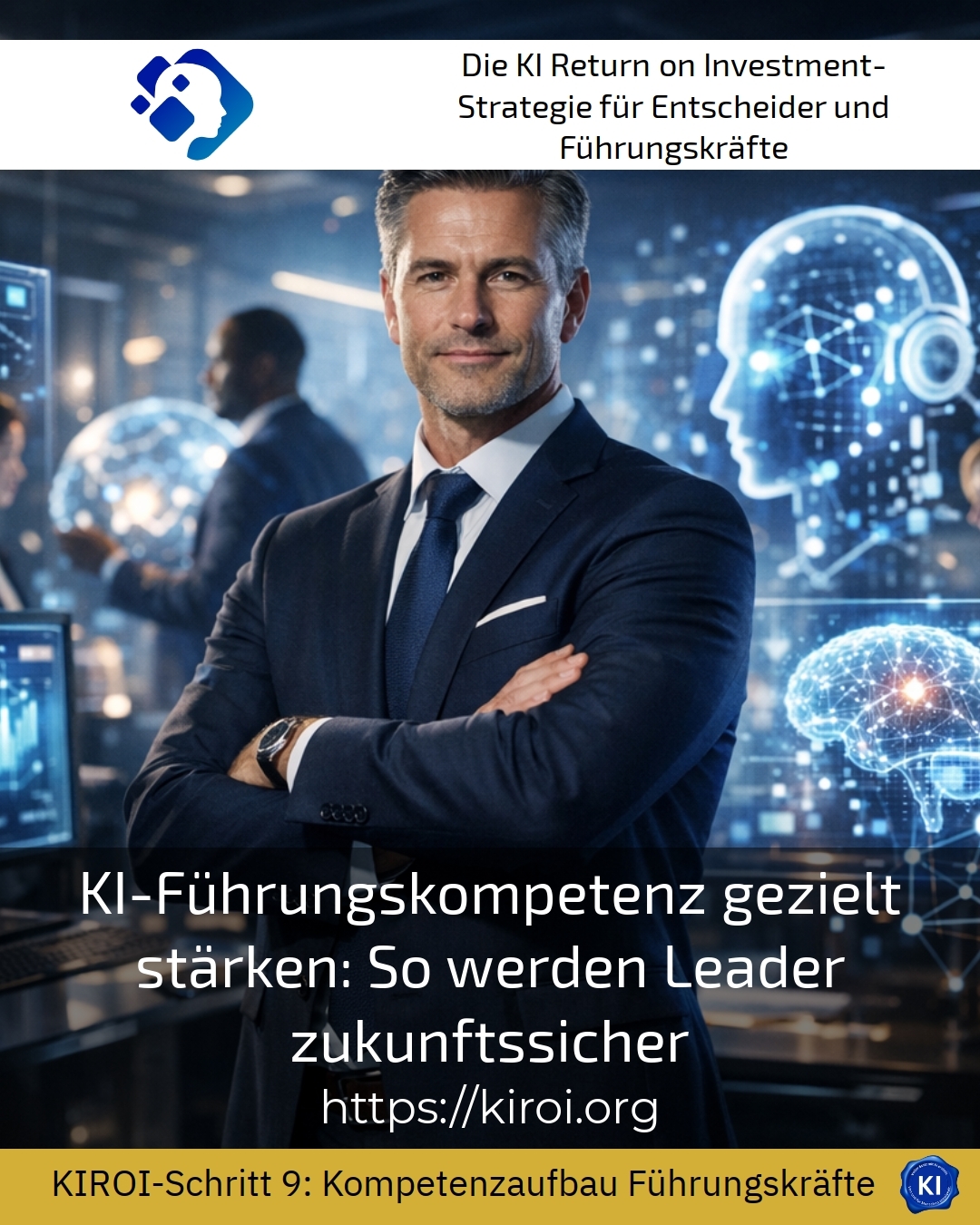
Will executives who do not develop digital skills today still be relevant to their organizations tomorrow?
This question currently concerns decision-makers in almost all industries and business sizes, because the rapid technological development is fundamentally changing what is expected of leadership figures. The ability to, Strengthening AI leadership skills deliberately Being able to make decisions increasingly determines professional success and organizational competitiveness. Anyone who wants to act confidently into the future as a leader must understand how intelligent systems support decision-making processes, empower employees, and enable entirely new business models. This involves going beyond mere technical understanding and fundamentally reorienting one’s leadership philosophy to combine human strengths with machine intelligence.
The transformation of leadership in a digitized economy
Executives face an unprecedented challenge, as the demands on their role are changing faster than ever before in the history of modern organizations. While in the past, expertise and hierarchical authority represented the essential factors of success, today entirely different skills are emerging to the forefront. Adaptability, digital literacy, and the ability to lead heterogeneous teams through change processes become core competencies. Often, leaders report feeling torn between operational day-to-day business and strategic transformation.
An example from the manufacturing industry vividly illustrates this dynamic: Production managers who for decades relied on their expertise in mechanical processes and personnel management are suddenly faced with predictive maintenance systems that predict machine failures and optimize maintenance intervals. They must understand how these systems work and at the same time guide their employees in integrating these technologies [1]. Another example can be found in retail, where store managers must learn to work with automated inventory management systems that autonomously trigger reorders and analyze customer flows. In healthcare, station managers also face the task of integrating diagnostic support systems into existing workflows without neglecting the human component of patient care.
Why traditional leadership approaches are reaching their limits
The classic command-and-control model of leadership proves increasingly ineffective in dynamic, technology-driven environments because it is based on assumptions that no longer apply in today’s working world. Leaders can no longer know everything and make all decisions themselves as complexity grows exponentially and information must be processed in real time. Instead, their role evolves into an enabler, mentor, and strategic navigator who creates the framework in which teams can work independently and creatively.
This development is particularly evident in the banking sector, where department heads find that automated credit decision systems work faster and more consistently than human agents, but at the same time raise ethical questions that require competent leadership. In the logistics industry, dispatchers must learn to work with algorithmic route optimization, which sometimes yields counterintuitive results but achieves measurably better results. Insurance companies, in turn, rely on automated claims assessment, which requires team leaders to further train their employees for more complex, consultative tasks.
Targeted strengthening of AI leadership skills through systematic development
The targeted development of leadership competencies in the context of intelligent technologies requires a structured approach that takes into account both individual learning processes and organizational frameworks. It is not enough to offer isolated training sessions or provide executives with technical manuals; true competence development arises through reflective practice, continuous feedback, and the integration of new insights into leadership everyday life. Transruptive coaching supports leaders in this transformation by providing impulses for the connection between technological understanding and human-centered leadership.
A mechanical engineering company that systematically develops its leadership team typically begins with an assessment of existing competencies and development needs. Subsequently, individual learning paths are designed that combine theoretical knowledge with practical application scenarios. In the pharmaceutical industry, research leaders are increasingly using predictive models for drug development, which requires a fundamental understanding of statistical methods and their limitations. Energy providers, in turn, train their leadership team in the use of smart grid technologies, which automatically optimize load distribution and intelligently control decentralized energy sources.
Best practice with a AIROI customer A medium-sized company in the technical services sector faced the challenge of empowering its senior management to integrate intelligent systems into existing business processes. The management recognized that technical implementation alone was not sufficient; rather, the executives must actively act as drivers of transformation. Within the framework of a structured development program, the specific requirements of each department were first analyzed, and subsequently individually tailored learning modules were designed. The production management engaged intensively with predictive analysis methods for quality assurance, while the sales management developed competencies in personalized customer interaction. The regular exchange of experiences between the executives proved particularly valuable, where both successes and obstacles were openly discussed. After a year, the participants reported a significantly increased confidence in handling technology-supported decision-making processes. Employee satisfaction in the affected departments improved measurably, because the management team was now able to communicate competently about the added value that the new systems offer and how they facilitate daily work. This example shows that sustainable transformation begins with people and that technological tools are merely means to an end.
The connection between technological understanding and emotional intelligence
One of the biggest challenges for modern leaders is to combine technological expertise with strong emotional intelligence, because both dimensions are equally relevant for successful leadership in a digitized world. Employees often react to technological changes with uncertainty, skepticism, or even fear, and it is up to the leaders to take these emotions seriously and address them constructively. At the same time, they must themselves understand the technological possibilities to make informed decisions and communicate realistic expectations [2].
In call centers, for example, the introduction of conversational systems often leads to concerns among employees about whether their jobs are at risk. Competent leaders take these concerns seriously and show how work is changing, but not disappearing. They explain that automated systems take over routine requests while human advisors are needed for complex, emotional, or creative tasks. In the trades, digital planning tools, meanwhile, support masters in allocating resources and coordinating schedules, but the craftsmanship expertise and customer relationships remain indispensable. In the restaurant industry, where ordering systems and kitchen management software are becoming more common, leaders are needed to guide their teams through the transition and maintain a focus on quality service and hospitality.
Practical strategies for AI leadership competence in everyday life
The development of future-proof leadership competencies requires continuous practice and conscious reflection, because competence is not acquired through one-time training sessions but through repeated application in real-life situations. Leaders should regularly take time to try new technologies themselves before promoting their use in their teams, because personal experience creates understanding and credibility. Transruptive coaching accompanies this process through targeted reflection prompts and individual feedback.
In construction, project managers are increasingly experimenting with building information modeling and automated conflict detection systems that identify planning errors early on. They learn to view these tools not as a competition to human expertise but as an extension of their own capabilities. In the media industry, editors use analytical tools that predict reader interests and identify thematic trends, but they also maintain a journalistic sense of relevance for important stories. In agriculture, where precision farming technologies are increasingly becoming widespread, managers need to interpret sensor data and combine it with years of experience.
Learning culture as the foundation for continuous development
Leaders who are their own Strengthening AI leadership skills deliberately To achieve this, organizations first need to establish a learning culture in their teams that promotes a spirit of experimentation and understands mistakes as learning opportunities. This requires a paradigm shift in many organizations that have traditionally focused on avoiding errors and optimizing efficiency. When employees experience that their leadership is themselves open to learning and admitting uncertainty, the barrier to articulating their own learning needs and trying new things decreases [3].
One textile company implemented this philosophy by introducing monthly „learning hours“ for department managers where new technologies were explored together. In an architecture office, project managers regularly share their experiences with generative design tools that can create hundreds of design variants in minutes. A tax consulting firm, in turn, established weekly exchange sessions where employees share their insights in using automated review tools. These examples show that learning culture is not an abstract concept but is embedded through concrete practices in everyday work.
Best practice with a AIROI customer A facility management services company recognized that digital transformation can only succeed if leadership at all levels is actively involved and understands their own development as an integral part of the transformation process. The company initiated a comprehensive program that combined technological training with leadership development and placed special emphasis on practical application. The facility managers first learned how sensor-based building monitoring works and what data the systems generate. Then they explored how to use this information for better decisions while also teaching their teams why this data is valuable. A particularly important aspect was working on their own attitude towards technological change, as many leaders carried unconscious reservations that they projected onto their teams. Through reflection exercises and collegial exchange, these reservations could be addressed and transformed into constructive curiosity. Upon completion of the program, the participants reported an increased confidence in using digital tools and an improved ability to lead their teams through change processes. Employee turnover in the participating areas decreased significantly, which the company attributed to improved leadership quality.
The role of coaching and mentoring in the transformation process
Many leaders face specific challenges in the context of technological change and seek guidance in an increasingly complex leadership landscape. Often they report feeling overwhelmed by the speed of change, conflicts between different stakeholder groups, or uncertainty about how to redefine their own role. Transruptive coaching supports these very issues by providing a protected space for reflection and creating individual development paths.
For example, a sales manager from the automotive supply industry faced the challenge of preparing his team to use a new CRM system with integrated predictive capabilities. A nursing director, meanwhile, sought support in how to introduce documentation assistants without making the nursing staff feel monitored or replaced. A hotel director asked for strategies on how to use revenue management systems while simultaneously preserving the personal service culture of his establishment. These examples illustrate that the topics are diverse, but a common thread connects them: it is always about integrating technology and humanity.
Targetly strengthen AI leadership skills through peer learning and networks
In addition to individual support, peer learning and professional networks play an important role in developing future-proof leadership skills because the exchange with like-minded people opens up new perspectives and reduces the feeling of being alone with one’s own challenges. Leaders who regularly interact with colleagues from other organizations or industries often develop more creative solutions to their specific problems. They learn from the experiences of others without having to make every mistake themselves.
In the food industry, industry circles have established forums where production managers share their experiences with automated quality control systems [4]. Human resources managers from various medium-sized companies meet regularly to exchange best practices for using recruiting assistants. Managing directors of small businesses, in turn, use association meetings to explore together how digital tools can address their specific challenges. This networking creates synergies and significantly accelerates the collective learning process.
My AIROI Analysis
The systematic development of leadership competencies in the context of intelligent technologies is no longer an optional additional qualification, but a fundamental prerequisite for successful leadership in the modern economy. My analysis shows that leaders who actively shape this development generate significant benefits for themselves and their organizations, while those who wait are increasingly falling behind. The AIROI approach emphasizes that technological competence alone is not sufficient; it must always be combined with human-centered leadership qualities.
I find the insight particularly relevant that successful transformation begins with the leadership’s own attitude, because only those who are themselves open to change can lead others through change processes. The examples presented in this article from various industries illustrate that while challenges are context-specific, they do share common patterns. Leaders must learn to realistically assess technological possibilities, mentor their teams competently, and establish a learning culture that enables continuous adaptation.
The good news is that these competencies are developable, regardless of age, industry, or previous technological affinity. What matters is the willingness to engage in a continuous learning process and to seek professional support when the challenges become complex. Transruptive coaching provides just such guidance and helps leaders strategically shape and implement their individual development in a sustainable way.
Further links from the text above:
[1] McKinsey – AI and the Future of Leadership
[2] Harvard Business Review – Emotional Intelligence
[3] World Economic Forum – Future of Work
[4] Gartner – Future of Work Research
For more information and if you have any questions, please contact Contact us or read more blog posts on the topic Artificial intelligence here.






 Deutsch
 English (UK)