
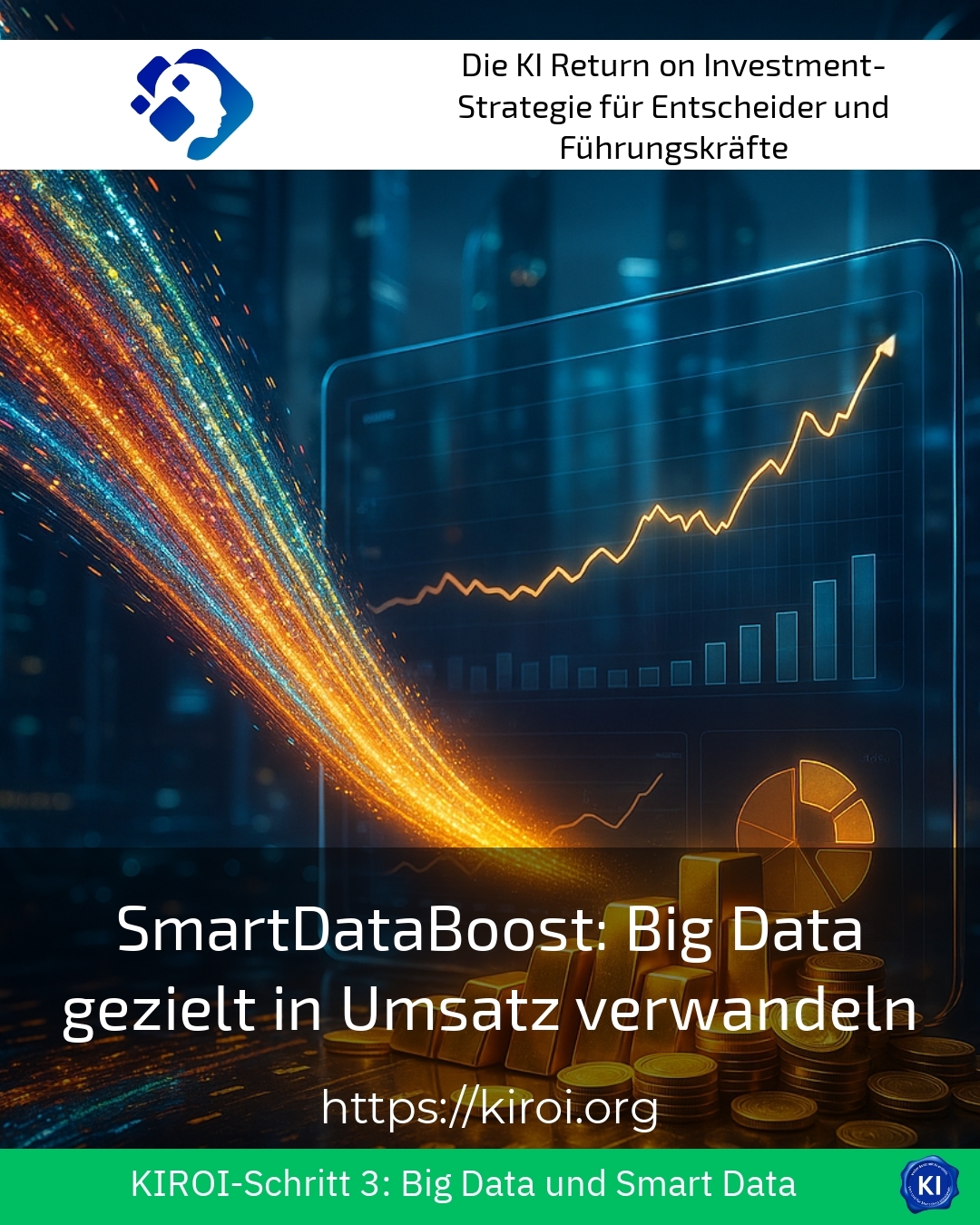
Digital transformation has unleashed a flood of information that frankly overwhelms many businesses. However, hidden within these vast data streams is enormous potential just waiting to be unlocked. SmartDataBoost describes an approach that does precisely this, transforming raw data into measurable business outcomes. Clients often report sitting on veritable data goldmines without being able to leverage them profitably. This article outlines ways how modern companies can strategically utilise their analytical capabilities.
Why SmartDataBoost Makes the Difference
In a world where billions of data points are created daily, mere collection is no longer enough. Instead, businesses need intelligent strategies to distinguish relevant information from irrelevant noise. This distinction forms the core of successful business models. For example, a medium-sized retailer can develop precise demand forecasts from till data, customer footfall and weather data. At the same time, analysing social media interactions enables a deep understanding of customer desires. The combination of different data sources opens up entirely new perspectives. Fragmented knowledge thus becomes a coherent overall picture that soundly supports strategic decisions.
Insurance companies are already successfully using this methodology for risk assessment. They analyse damage patterns and identify potential fraud cases early on. Banks, in turn, rely on predictive models for creditworthiness checks. And energy providers optimise their network utilisation through real-time analysis of consumption data. These examples impressively demonstrate the broad range of possible applications. Transruption Coaching supports companies in systematically integrating such approaches into their processes.
Understanding the strategic dimension of SmartDataBoost
A purely technical perspective falls short because it neglects the human element. Successful data strategies require a profound cultural transformation within the organisation. Employees must be empowered to apply data-based insights in their daily work. Leaders, in turn, face the task of establishing a culture of fact-based decision-making. This is not about replacing gut feeling and experience, but about meaningfully supplementing them with objective analyses.
A logistics company can revolutionise its route planning through fleet telemetry. A hospital can significantly improve the quality of care through patient data analysis. A manufacturing plant can considerably reduce unplanned downtimes through predictive maintenance. These use cases show that added value can be achieved across industries. However, implementation requires a well-thought-out approach and professional support.
Best practice with a AIROI customer
An internationally active automotive supplier faced the challenge of sustainably increasing its production efficiency. While existing machine data was being recorded, it was not being systematically analysed. As part of a transruptive coaching project, we collaboratively developed a comprehensive analysis strategy. First, we identified the most relevant data points along the entire production line. Subsequently, we implemented a dashboard that visualised deviations in real-time. Employees received intensive training on interpreting the analysis results. Within six months, the company was able to reduce its scrap rate by fourteen percent. Energy costs simultaneously decreased by eight percent through optimised machine running times. Particularly noteworthy was the high level of acceptance among production employees. They did not experience the new tools as a control instrument, but as a genuine aid to their work. The return on investment was achieved after just nine months, impressively demonstrating the economic viability of the approach.
Data quality as the foundation for sustainable success
The best analysis methodology remains ineffective if the underlying information is deficient. Data quality encompasses several dimensions such as completeness, timeliness, consistency, and accuracy. Many organisations underestimate the effort required for a solid data foundation. Fragmented systems, historically developed structures, and a lack of standards further complicate consolidation. This is where SmartDataBoost by first carrying out an honest stocktake.
Pharmaceutical companies know the challenge of inconsistent clinical trial data all too well. Telecommunications providers struggle to integrate customer data from different sales channels. Retail companies, in turn, must synchronise article and price information across numerous systems. These examples illustrate the complexity of modern data landscapes. Cleansing and harmonisation require both technical expertise and deep business understanding.
Practical steps for quality improvement
The first step is a comprehensive data inventory, which captures all relevant sources. This is followed by an assessment of individual data sets according to defined quality criteria. Priorities are set based on business benefit and the effort involved in cleaning. The implementation of automated validation rules prevents future quality issues at the source. Regular audits ensure that standards, once achieved, are continuously maintained.
For example, a financial services provider introduced plausibility checks for customer data entry. A mechanical engineering company standardized its product categorisation across all plants. A health insurer consistently harmonised the coding of diagnoses and treatments. These measures created the prerequisite for meaningful analyses. Without this foundational work, all further initiatives would have been doomed to failure.
Deepen customer understanding through intelligent analyses
Customer expectations have fundamentally changed in recent years. People expect personalised communication, relevant recommendations, and seamless experiences across all touchpoints. Companies that meet these expectations secure crucial competitive advantages. The prerequisite for this is a profound understanding of individual preferences and behaviours. This is precisely where SmartDataBoost its full potential and supports companies in developing customer-centric strategies.
Fashion retailers analyse purchase histories and browsing behaviour for personalised product recommendations. Tour operators use past bookings to predict future travel preferences. Streaming services optimise their content recommendations through continuous analysis of user behaviour. Hotels personalise the guest experience based on documented preferences. These applications impressively demonstrate the enormous potential of customer-centric data utilisation.
Best practice with a AIROI customer
A long-established furniture retailer with several branches in German-speaking countries wanted to fundamentally redesign its customer relationships. The existing customer card data had previously only been used for simple discount promotions. Together, within the framework of the transruption coaching project, we developed a holistic customer intelligence strategy. We integrated data from the online shop, stationary checkouts, and customer service onto a central platform. Based on this, we created differentiated customer segments with specific characteristics and needs. Marketing campaigns were subsequently tailored to these segments and delivered individually. The conversion rate of personalised communications was three times higher than with generic campaigns. At the same time, customer satisfaction increased measurably, which was reflected in improved reviews. The average basket value rose by twelve percent within the first year. The project team also established a continuous learning process for the constant refinement of segmentation.
From analysis to activating customer engagement
Insights alone do not yet generate revenue, which is why activation is crucial [1]. The translation of analytical insights into concrete marketing and sales actions requires well-thought-out processes. Automated triggers, for example, can initiate personalised communication for specific behavioural patterns. A customer who has viewed a product multiple times might receive a targeted prompt. Another customer whose purchasing frequency is declining might be reactivated through a loyalty offer.
Online retailers use abandoned cart reminders extremely successfully, significantly reducing purchase cancellations. Gyms identify members at risk of cancelling and intervene in a timely manner with attractive offers. Energy providers proactively inform customers about savings potential, thereby strengthening customer loyalty sustainably. Telecommunications providers recommend optimised tariffs based on individual usage behaviour. These examples illustrate how data-driven activation works across various industries.
Process optimisation as an underestimated value driver
Alongside revenue growth, cost optimisation offers significant potential that is often overlooked. Inefficient processes not only incur direct costs but also tie up valuable resources unnecessarily. The systematic analysis of process data reliably uncovers bottlenecks, redundancies, and waste. On this basis, targeted improvement measures can be developed and prioritised. The return on investment for such initiatives is often particularly attractive and can be realised quickly.
Logistics companies significantly reduce tied-up capital by optimising inventory levels through precise demand forecasting. Manufacturing companies consistently minimise set-up times through intelligent order sequencing. Service companies sustainably improve their staff scheduling by analysing utilisation patterns. Hospitals noticeably reduce waiting times through data-driven appointment scheduling. These use cases impressively demonstrate the breadth of optimisation possibilities.
Predictive Maintenance as a prime example
Predictive maintenance illustrates the potential for optimisation particularly clearly and convincingly [2]. Instead of maintaining machines at fixed intervals, maintenance is carried out as needed. Sensor data enables early detection of wear or impending failures. Unplanned downtimes, which often cause immense costs, are thus significantly reduced. At the same time, maintenance effort decreases because unnecessary interventions are eliminated.
Wind farm operators continuously monitor their turbines and optimise maintenance scheduling. Airlines analyse engine data to predict maintenance needs with high precision. Lift manufacturers offer their customers proactive services based on usage data. Printing press manufacturers monitor their equipment at the customer's site and respond reliably before failure. These examples show how predictive maintenance creates added value across various industries.
Best practice with a AIROI customer
A medium-sized manufacturer of packaging machines wanted to fundamentally transform its service business. Previously, the company only reacted to customer fault reports. In the transruption coaching project, we jointly developed a strategy for proactive service offerings. We designed an IoT-based monitoring system that continuously records critical machine parameters. Machine learning algorithms were trained to detect anomalies and impending failures early on. Service technicians received mobile dashboards that provided them with real-time recommendations for action. The average machine availability for customers increased by five percentage points. Customer satisfaction improved significantly, leading to higher service contract renewal rates. The company was also able to develop new, high-revenue service products based on the data platform. The shift from a reactive to a proactive service provider sustainably strengthened the competitive position and created new differentiation opportunities.
SmartDataBoost and the Ethical Dimension
With the increasing use of data, so too does the responsibility for its proper handling grow. Data protection, transparency, and ethical guidelines are not optional additions, but essential foundations. Customers rightly expect their information to be used securely and for its intended purpose [3]. Breaches can not only have legal consequences but also permanently damage trust. A responsible data strategy systematically considers these aspects from the outset.
Healthcare providers must handle particularly sensitive patient data with the utmost care. Financial institutions are subject to strict regulatory requirements regarding data processing. Insurers must avoid discrimination in algorithmic risk assessment. Human resources providers must not take protected characteristics into account when selecting applicants. These examples illustrate the complexity of ethical issues in various contexts.
My AIROI Analysis
The systematic use of company data for value creation has proven to be one of the most effective levers for sustainable business success. In my consulting practice, I regularly observe how organisations can achieve transformative results through intelligent data strategies. The key here lies not solely in technology, but rather in the combination of clear objective setting, a solid data foundation, and a cultural readiness for change. SmartDataBoost describes precisely this holistic approach, which integrates technical, organisational, and human aspects.
Particularly noteworthy is the democratisation of analytical skills that we are currently witnessing. Advanced tools enable even non-experts to gain valuable insights from data. This development is increasingly shifting the challenge from technical implementation to strategic alignment. Companies must learn to ask the right questions and to profitably leverage the answers. Transruption coaching supports precisely this process and provides impetus for sustainable change.
The coming years will show that data-driven organisations can realise significant competitive advantages. Those who lay the groundwork today will benefit from the fruits of this investment tomorrow. This is not about perfect systems, but about continuous learning and gradual improvement. The journey is more important than a supposed end goal, which doesn't exist anyway.
Further links from the text above:
[1] McKinsey: The Value of Getting Personalisation Right
[2] IBM: Manutenzione predittiva spiegata
[3] European Commission: Data Protection
For more information and if you have any questions, please contact Contact us or read more blog posts on the topic Artificial intelligence here.








 Deutsch
  English (UK)