kiroi.org

KIROI - Artificial Intelligence Return on Invest
The AI strategy for decision-makers and managers

Business excellence for decision-makers & managers by and with Sanjay Sauldie

KIROI - Artificial Intelligence Return on Invest: The AI strategy for decision-makers and managers

KIROI - Artificial Intelligence Return on Invest: The AI strategy for decision-makers and managers

Start » Smart data strategies: KIROI step 3 for decision-makers
6 September 2025

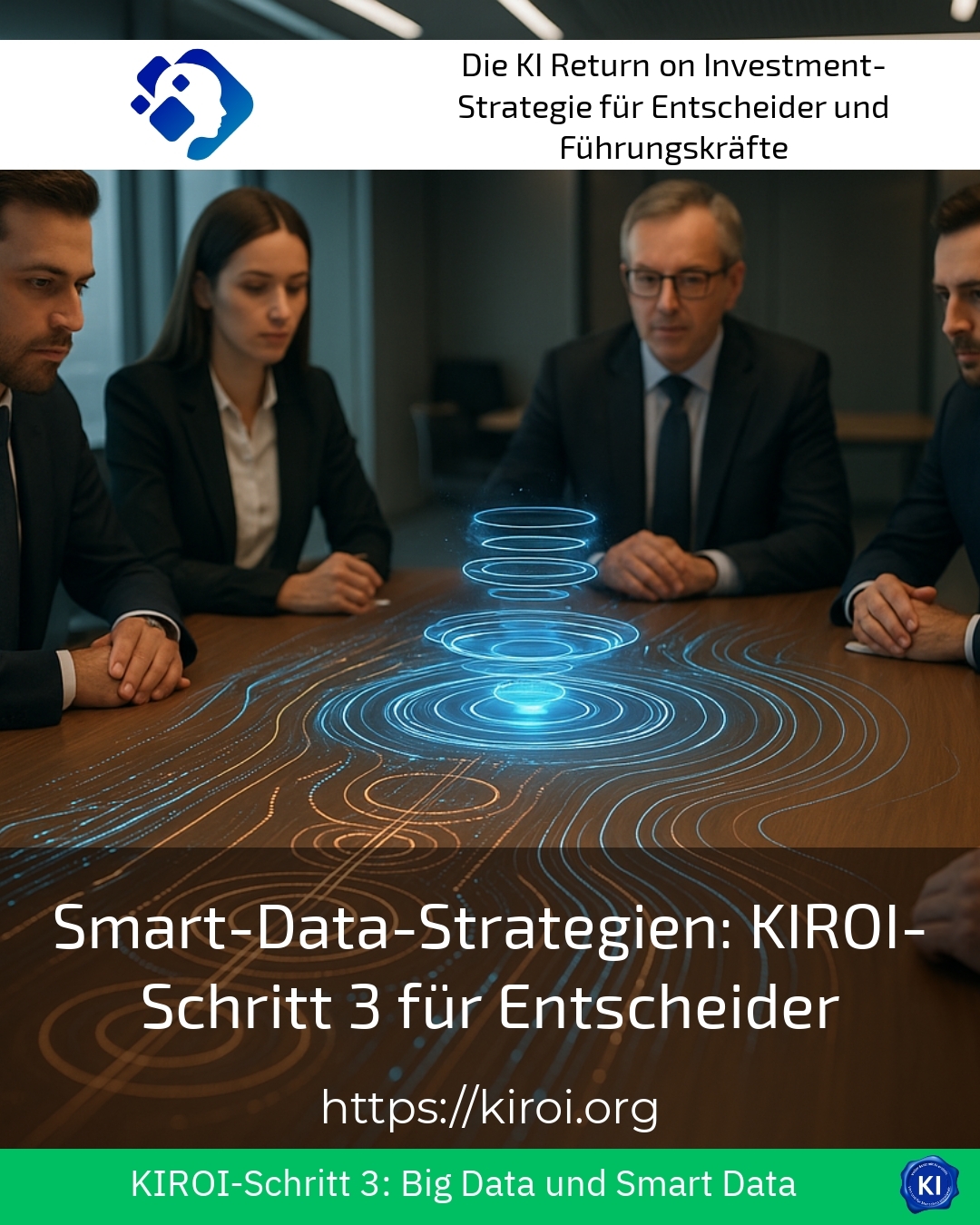
Smart data strategies: KIROI step 3 for decision-makers

4.5
(777)

The importance of data analysis in companies

Decision-makers today face the challenge of managing a vast amount of data that accumulates daily within companies. The goal is not only to capture large volumes from this data flood but, above all, to filter out information that is truly relevant. Smart data strategies are essential for this, as they help to selectively use data that creates significant added value and improves real decisions.

Companies pursuing smart data strategies benefit from more accurate analyses, reduced sources of error, and accelerated work processes. In many cases, this provides management with the necessary foundation to make operational or strategic decisions more confidently. However, implementation poses many questions: How are data organised and evaluated so that the result remains manageable? How can one get started when not all stakeholders are experts in data analysis? Such questions frequently arise in consultations.

How smart data strategies support

Smart data strategies aim to intelligently filter and utilise data, rather than just collecting it. It is particularly important for decision-makers to increase the efficiency of data projects by obtaining directly actionable insights. The challenge often lies in preparing complex data sets in such a way that they remain understandable and implementable in everyday business operations. Accompanying coaching can provide impetus and show how projects can be managed agilely.

KIROI BEST PRACTICE at company XYZ (name changed due to NDA contract) A marketing department faced the challenge of deriving targeted campaigns from extensive customer data. Smart data strategies significantly reduced wastage, and customer targeting became more precise. This led to increased customer satisfaction and more efficient marketing costs. The accompanying coaching supported the practical setup of the data process.

Smart data strategies also help in the healthcare sector to evaluate patient data in such a way that bottlenecks can be predicted and resources can be better planned. The integration of data protection plays an important role here, so that compliance and efficiency do not preclude each other.

In the logistics sector, smart data strategies enable the identification of real-time trends in supply chains to respond to disruptions promptly and adapt operations flexibly.

Smart Data as the Basis for Data-Intelligent Decisions

Smart data strategies are not about the sheer volume of data, but about the quality and relevance of the data. Decision-makers need useful insights that can be immediately translated into action steps. Smart data provides precisely this information, which makes it possible to optimise processes in a targeted manner and react more quickly to market movements.

KIROI BEST PRACTICE at ABC (name changed due to NDA contract) Sales data was analysed here to gain a better understanding of trends and customer needs. The marketing strategies derived from this led to a significant increase in revenue. This allowed resources to be used more effectively and customer satisfaction to be improved.

Supported by artificial intelligence and machine learning techniques, processes can be automated, effort reduced and higher productivity achieved. At the same time, new opportunities for growth emerge when hidden patterns in the data are recognised.

Typical questions and support during implementation

Many executives involved with smart data strategies wonder how to find the relevant data sources or how to make data usable without being an expert themselves. They often report uncertainty when selecting analytical tools and integrating them into existing processes.

Coaching supports by highlighting suitable methods, providing impetus for project management, and helping to guide the implementation step by step. In this way, the project remains tangible and pragmatic, and specialised support options can be utilised.

KIROI BEST PRACTICE at DEF (name changed due to NDA contract) A manufacturing company wanted to identify inefficiencies in its production. Guided smart data analyses made bottlenecks visible and improved processes. The coaching accompanied the team in developing a data management system that sustainably increased decision-making quality.

My analysis

Smart data strategies are crucial building blocks for future data-driven business management. They help to structure information flows and focus on relevant insights. In this context, expert coaching specifically supports implementation and project management. This makes complexity manageable and allows the potential of data-driven decisions to be better exploited.

Further links from the text above:

[1] Mastering smart data analysis: KIROI step 3 for decision-makers

[4] Mastering data intelligence: KIROI step 3 to big & smart data

[7] The ROI of a Smart Data Strategy

For more information and if you have any questions, please contact Contact us on or read further blog posts on the topic Artificial Intelligence Blog here.
How useful was this post?

Click on a star to rate it!

Average rating 4.5 / 5. Vote count: 777

No votes so far! Be the first to rate this post.

Spread the love

transruption.org

The digital toolbox for
the digital winners of today and tomorrow

Business excellence for decision-makers & managers by and with Sanjay Sauldie

transruption
transruption

transruption: The digital toolbox for
the digital winners of today and tomorrow

Start » Smart data strategies: KIROI step 3 for decision-makers
6 September 2025

Smart data strategies: KIROI step 3 for decision-makers

4.5
(777)

The importance of data analysis in companies

Decision-makers today face the challenge of managing a vast amount of data that accumulates daily within companies. The goal is not only to capture large volumes from this data flood but, above all, to filter out information that is truly relevant. Smart data strategies are essential for this, as they help to selectively use data that creates significant added value and improves real decisions.

Companies pursuing smart data strategies benefit from more accurate analyses, reduced sources of error, and accelerated work processes. In many cases, this provides management with the necessary foundation to make operational or strategic decisions more confidently. However, implementation poses many questions: How are data organised and evaluated so that the result remains manageable? How can one get started when not all stakeholders are experts in data analysis? Such questions frequently arise in consultations.

How smart data strategies support

Smart data strategies aim to intelligently filter and utilise data, rather than just collecting it. It is particularly important for decision-makers to increase the efficiency of data projects by obtaining directly actionable insights. The challenge often lies in preparing complex data sets in such a way that they remain understandable and implementable in everyday business operations. Accompanying coaching can provide impetus and show how projects can be managed agilely.

KIROI BEST PRACTICE at company XYZ (name changed due to NDA contract) A marketing department faced the challenge of deriving targeted campaigns from extensive customer data. Smart data strategies significantly reduced wastage, and customer targeting became more precise. This led to increased customer satisfaction and more efficient marketing costs. The accompanying coaching supported the practical setup of the data process.

Smart data strategies also help in the healthcare sector to evaluate patient data in such a way that bottlenecks can be predicted and resources can be better planned. The integration of data protection plays an important role here, so that compliance and efficiency do not preclude each other.

In the logistics sector, smart data strategies enable the identification of real-time trends in supply chains to respond to disruptions promptly and adapt operations flexibly.

Smart Data as the Basis for Data-Intelligent Decisions

Smart data strategies are not about the sheer volume of data, but about the quality and relevance of the data. Decision-makers need useful insights that can be immediately translated into action steps. Smart data provides precisely this information, which makes it possible to optimise processes in a targeted manner and react more quickly to market movements.

KIROI BEST PRACTICE at ABC (name changed due to NDA contract) Sales data was analysed here to gain a better understanding of trends and customer needs. The marketing strategies derived from this led to a significant increase in revenue. This allowed resources to be used more effectively and customer satisfaction to be improved.

Supported by artificial intelligence and machine learning techniques, processes can be automated, effort reduced and higher productivity achieved. At the same time, new opportunities for growth emerge when hidden patterns in the data are recognised.

Typical questions and support during implementation

Many executives involved with smart data strategies wonder how to find the relevant data sources or how to make data usable without being an expert themselves. They often report uncertainty when selecting analytical tools and integrating them into existing processes.

Coaching supports by highlighting suitable methods, providing impetus for project management, and helping to guide the implementation step by step. In this way, the project remains tangible and pragmatic, and specialised support options can be utilised.

KIROI BEST PRACTICE at DEF (name changed due to NDA contract) A manufacturing company wanted to identify inefficiencies in its production. Guided smart data analyses made bottlenecks visible and improved processes. The coaching accompanied the team in developing a data management system that sustainably increased decision-making quality.

My analysis

Smart data strategies are crucial building blocks for future data-driven business management. They help to structure information flows and focus on relevant insights. In this context, expert coaching specifically supports implementation and project management. This makes complexity manageable and allows the potential of data-driven decisions to be better exploited.

Further links from the text above:

[1] Mastering smart data analysis: KIROI step 3 for decision-makers

[4] Mastering data intelligence: KIROI step 3 to big & smart data

[7] The ROI of a Smart Data Strategy

For more information and if you have any questions, please contact Contact us on or read further blog posts on the topic Artificial Intelligence Blog here.

How useful was this post?

Click on a star to rate it!

Average rating 4.5 / 5. Vote count: 777

No votes so far! Be the first to rate this post.

Spread the love

Other content worth reading:

Smart data strategies: KIROI step 3 for decision-makers

written by:

Keywords:

#DatengetriebeneEntscheidungen #KIImUnternehmen #SmartData #Unternehmensstrategie Data analysis

Follow me on my channels:

Questions on the topic? Contact us now without obligation

Contact us

[wpforms id="331781" title="false"]

More articles worth reading

    Leave a comment