
Are we on the verge of a fundamental change that will upend the entire value chain of the manufacturing industry, and are the current business models actually still viable?
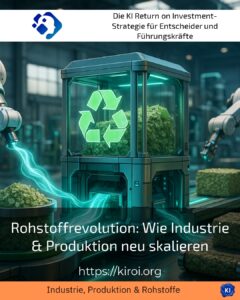
The answer to this question is currently occupying executives in boardrooms worldwide. The Resource revolution: How to scale up industry and production anew Current discussions in business circles and strategy departments are shaping the debate. Traditional supply chains are coming under enormous pressure. At the same time, completely new opportunities are opening up through innovative technologies and changing material flows. Companies that recognize this development early gain crucial competitive advantages. Others, however, risk losing the ability to keep up with a rapidly changing economic landscape.
Understanding the tectonic shifts in the materials industry
The foundations of industrial manufacturing are undergoing a profound transformation process. Traditional procurement strategies are increasingly reaching their limits. Geopolitical tensions are significantly affecting the availability of critical materials. The automotive sector, for example, is experiencing these changes in a particularly intense way. Manufacturers such as BMW and Mercedes-Benz are fundamentally rethinking their entire supplier structures [1]. They are investing heavily in alternative material sources and closed-loop systems.
The steel industry is also showing remarkable adaptive responses to these developments. ThyssenKrupp and Salzgitter are experimenting with hydrogen-based production as a future-oriented alternative [2]. These technologies promise a significant reduction in CO2 emissions while maintaining material safety. Likewise, the mechanical engineering industry is reacting very dynamically to the changed conditions. Companies such as TRUMPF and DMG Mori are developing production processes that operate less resource-intensively. They are increasingly relying on additive manufacturing and more precise machining methods.
The chemical industry is also undergoing a similar metamorphosis of its basic structures. BASF and Evonik are intensively researching bio-based alternatives to petrochemical starting materials [3]. These efforts show how broad the scope of this transformation is. Resource revolution: How to scale up industry and production anew The transformation affects not only individual companies but entire value-added networks as a whole.
Circular economy as a strategic lever for industrial realignment
The implementation of circular business models is gaining increasing importance in the finalizing economy. Siemens impressively demonstrates how components from old devices can be systematically reused [4]. The company has established its own take-back programs that return significant amounts of material to the production cycle. The electronics industry is following this example with increasing commitment and investment readiness.
Bosch has developed and successfully implemented a comprehensive remanufacturing program for automotive components. Starter and generator motors are refurbished, achieving quality standards comparable to new parts. This strategy significantly reduces primary material requirements by up to seventy percent. At the same time, it creates new business opportunities with attractive margins for the company.
Best practice with a AIROI customer
A medium-sized supplier to the automotive industry faced the challenge of significantly reducing its material costs while simultaneously meeting the sustainability requirements of its large customers. As part of a transruptive coaching program, we supported the company in completely redesigning its procurement strategy over several months. The first step involved digitizing and analyzing all material flows. In doing so, we identified significant potential for the recycling of production waste, which had previously been considered worthless. Together, we developed a closed-loop system for aluminum and copper components within the manufacturing process. The implementation initially required investments in new sorting and processing technologies, which quickly paid off. After eighteen months, the company was able to reduce its primary material purchases by thirty-four percent. Production costs fell by nineteen percent while quality standards were fully maintained. Additionally, the company won several tenders because it could demonstrate superior sustainability metrics. Today, the management reports on a significantly improved competitive position in international comparison. This project exemplifies how strategic guidance in complex transformation projects can generate tangible economic benefits.
Digitalization as a catalyst for the raw material revolution: How to scale up industry & production
Artificial intelligence and data-driven systems are significantly accelerating the transformation of the materials industry. Predictive analytics enables more precise planning of needs and continuously optimizes inventory levels. The automotive industry is already intensively using these technologies in its procurement processes. Volkswagen is using AI-supported systems to identify material shortages early [5].
Machine tool manufacturing also benefits significantly from digitized material flows. Companies like Grob and Heller continuously optimize their production through real-time data analysis. Wear is predicted accurately, allowing tools to be optimally loaded. These efficiency gains significantly reduce overall material consumption in a sustainable manner.
The packaging industry is demonstrating innovative approaches to material substitution through digital support. Krones and SIG are using simulation software to develop lighter packaging solutions. These achieve identical functionality with significantly reduced material usage per unit. At the same time, they are creating new opportunities for recyclable monomaterials in the industry.
Regional value-added networks in response to global uncertainties
The relocation of industrial production to geographically close locations is becoming increasingly strategic. Nearshoring and reshoring are increasingly shaping the investment decisions of large corporations worldwide. Intel plans massive factory relocations in Europe to reduce dependencies on Asian suppliers [6]. This development is fundamentally and sustainably influencing the entire semiconductor supply chain.
The textile and clothing industry is also experiencing a remarkable renaissance in European manufacturing locations. Hugo Boss and Trigema are investing more in automated production facilities in Germany. These enable competitive production despite higher labor costs compared to international standards. At the same time, short transport distances significantly reduce the ecological footprint of products.
The furniture industry is demonstrating similar trends with considerable success in various market segments. Hülsta and Musterring are increasingly relying on regional wood suppliers from sustainable forestry. The proximity to raw material sources enables more flexible responses to customer requests and shorter delivery times. At the same time, these strategies strengthen local economic cycles and employment levels on a lasting basis.
Best practice with a AIROI customer
A leading manufacturer of industrial electronics approached us with the question of how to implement regional sourcing strategies without jeopardizing the cost structure or risking quality losses. In the course of intensive transruptive coaching, we first comprehensively analyzed the existing supplier base and its geographical distribution. We found that seventy-eight percent of the critical components originated from Asian markets and posed significant risks. Together, we developed a multi-stage strategy to diversify the sourcing sources over a period of eighteen months. The first step involved identifying European alternative suppliers for strategically important components. In parallel, the company invested in building its own manufacturing capabilities for selected components at its main site. The support also included renegotiating existing supply contracts and establishing dual-sourcing strategies. After completing the project, the company was able to significantly improve its supply security and reduce delivery times. The higher entry prices were largely compensated for by lower logistics costs and reduced warehousing. Additionally, the management reported improved planning certainty and faster responsiveness to market changes. The strategic realignment has made the company more crisis-resistant and strengthened its market position.
Innovative materials as drivers of industrial transformation
The development of new materials opens up completely new design possibilities for the manufacturing industry. Carbon fiber reinforced plastics are revolutionizing lightweight construction in the automotive and aerospace industries fundamentally. SGL Carbon and Toray supply leading manufacturers with high-strength materials for demanding applications [7]. These materials enable significant weight savings while maintaining superior mechanical properties.
The construction industry is intensively experimenting with alternative binders and additives for concrete. HeidelbergCement and Holcim are developing CO2-reduced cement variants for various applications. These innovations directly address one of the largest industrial emitters worldwide. At the same time, companies are exploring the use of recycled materials as a concrete additive.
The packaging industry is currently making remarkable progress with bio-based and compostable materials. Companies such as Storopack and Papier Mettler are intensively developing alternatives to petroleum-based foams. These materials offer comparable protective functions with significantly improved overall environmental performance. Demand for such solutions is growing continuously due to stricter regulatory requirements.
Resource revolution: How industry and production are being re-scaled through process integration
The vertical integration of production processes enables more efficient resource utilization in many industries. Industrial companies are fundamentally rethinking their make-or-buy decisions against the backdrop of changing conditions. Tesla impressively demonstrates how extensive in-house production can generate competitive advantages [8]. The company produces battery cells, drives, and software itself and controls critical components.
The food industry is increasingly showing similar integration trends in processing and packaging. Nestlé and Unilever are investing significantly in their own plastic recycling facilities for their packaging. This strategy ensures access to recycled materials and reduces dependence on external suppliers. At the same time, closed material cycles are created within the company structures.
The pharmaceutical industry is demonstrating innovative approaches in integrating active ingredient production and packaging. Boehringer Ingelheim and Merck are developing integrated production lines with minimized material transfer between process steps. These concepts significantly reduce contamination risks and material losses during manufacturing. At the same time, throughput times and inventory levels across the entire value chain are noticeably reduced.
Best practice with a AIROI customer
A medium-sized manufacturer of precision components for medical technology sought support in optimizing its material efficiency and turned to our transruptive coaching team. The initial situation was characterized by high rejection rates and suboptimal utilization of expensive special alloys. As part of our guidance, we first conducted a comprehensive material flow analysis that uncovered hidden inefficiencies. We identified significant potential for optimizing cutting patterns and utilizing residual material from various process steps. Together with the engineering team, we developed new manufacturing strategies using digital simulation tools. The implementation also included training employees in material-efficient thinking and action. In parallel, we established a systematic recording system for material consumption and causes of waste in the company. After twelve months, the company was able to reduce its material usage by twenty-two percent and reduce costs. The rejection rate decreased from eight to under three percent through optimized processes. Additionally, the company generated new revenue through the sale of sorted material residues to recycling companies. The management emphasizes that strategic guidance was crucial for the sustainable success.
My AIROI Analysis
Industrial transformation is at a crucial turning point, bringing far-reaching strategic implications for companies of all sizes and requiring fundamental changes in business models. The examples from various industries clearly show that successful adaptation to changing conditions is possible when companies are willing to question established patterns of thinking and to pursue new paths. Circular economy, digitalization, and regional value creation form the central pillars of a future-proof strategy that companies should systematically develop.
From my observation of the industry and the guidance I provide to numerous transformation projects, it can be concluded that companies that act early can build significant advantages over hesitant competitors. The technological capabilities for resource-efficient production are now more advanced than ever in the history of industry. At the same time, the pressure from regulation, customer demands, and societal expectations is continuously increasing.
Medium-sized companies often possess the agility to react more quickly to changes than large corporate structures, but they often require external impetus and methodological guidance for complex transformation projects. Transruptive coaching can provide valuable support by providing strategic guidance and structured support for implementation processes. The successful case studies demonstrate that economic success and sustainable resource utilization do not have to be opposites but can reinforce each other.
The coming years will show which companies will take advantage of the opportunities of industrial transformation and which will fall behind. It will be crucial whether executives recognize the urgency and act consistently before external constraints no longer leave them with any options.
Further links from the text above:
[1] BMW Group sustainability strategy
[2] ThyssenKrupp's climate strategy hydrogen
[3] BASF sustainability initiative
[4] Siemens circular economy program
[5] Volkswagen Digital Supply Chain
[6] Intel investments in Europe
[7] SGL Carbon Material Innovations
[8] Tesla’s production integration
For more information and if you have any questions, please contact Contact us or read more blog posts on the topic Artificial intelligence here.









 Deutsch
  English (UK)