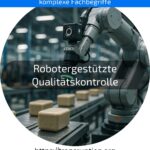
The term robot-assisted quality control originates from the fields of industry and Industry 4.0, automation, and robotics. It describes the use of robots to automatically check the quality of products during manufacturing. The aim is to detect errors or deviations early on, thereby ensuring consistently high quality.
Instead of relying on manual checks by humans, companies are using robots equipped with cameras, sensors, or lasers. These robots check, for example, whether components have been assembled correctly or if there are cracks and scratches in products. The robots often work faster and more accurately than humans, which not only saves time but also reduces costs.
A vivid example: In a car factory, a robot arm moves over the freshly painted bodywork, automatically scanning for minor paint defects or dents. If it finds a fault, the part can be immediately rejected. Robotic quality control therefore leads to less waste, improved production processes and satisfied customers, because faulty products hardly ever leave the factory.






 Deutsch
  English (UK)