
What actually happens when the smartest minds in the company suddenly no longer need them to answer questions?
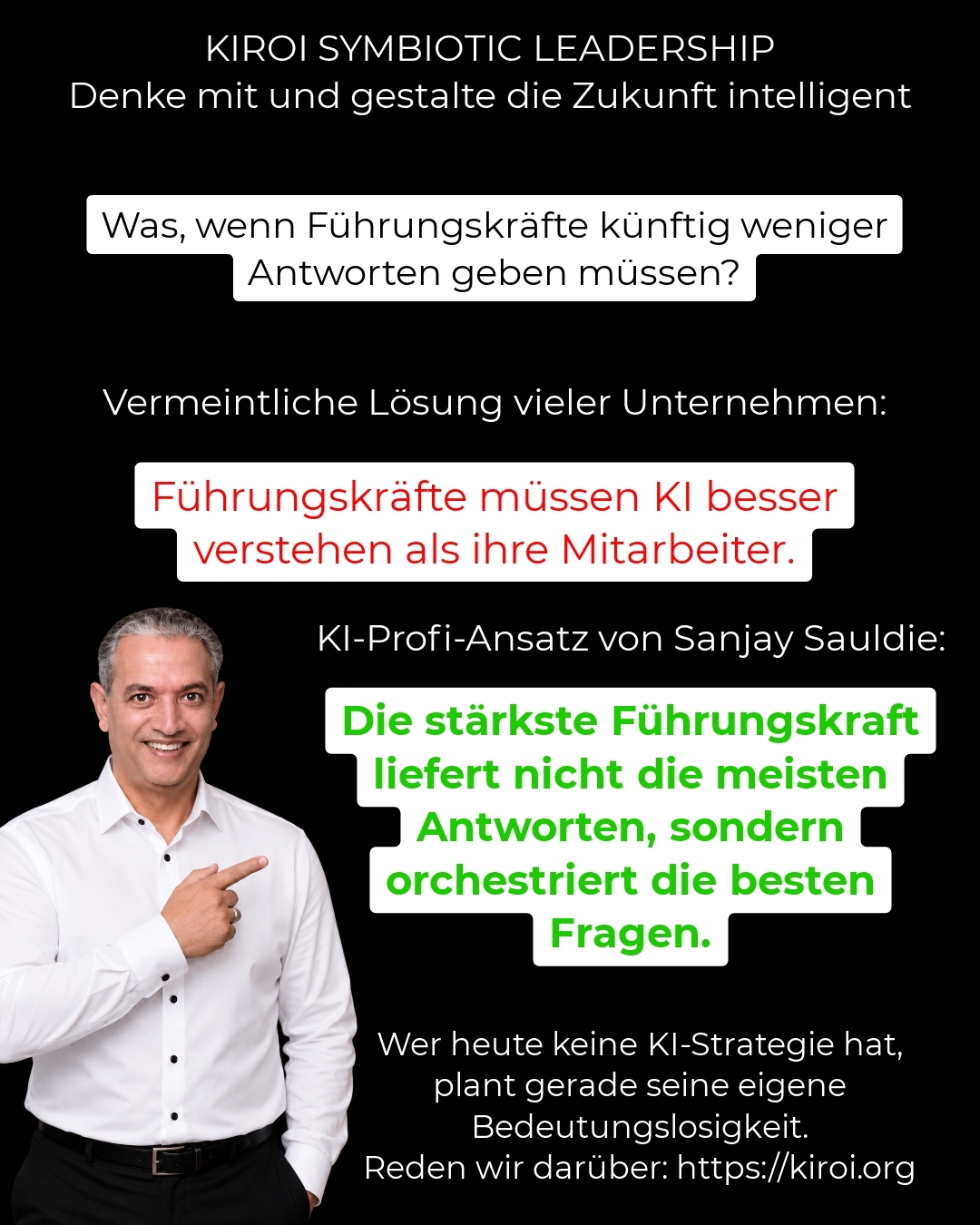
This question currently concerns numerous decision-makers in medium-sized and large organizations. Because the times when Executives understand AI better than their employees As intelligent systems increasingly take on analytical tasks, they are rapidly changing. They provide forecasts and recommendations for action. At the same time, the expectation of people in leadership positions is fundamentally changing. Anyone who still believes that authority arises solely from specialized knowledge will soon find themselves in empty conference rooms. The new currency is no longer called answer, but question. And this is where a fundamental change takes place that poses enormous challenges for many organizations.
The old paradigm is crumbling at every turn
For decades, an unwritten rule applied in companies of all sizes. Those who wanted to advance had to know the information. Leadership figures defined themselves through their knowledge of the numbers and their understanding of strategic connections. In meetings, they demonstrated their competence through quick solutions. This dynamic shaped entire generations of managers. They invested countless hours in further training and professional conferences. Advancement was closely linked to the ability to independently penetrate complex problems. But this model is faltering. Algorithms today analyze mountains of data in seconds. They detect patterns that remain hidden from the human eye. And they become more powerful by the day.
A medium-sized machine manufacturer noticed this shift particularly clearly. For years, the management had placed experienced engineers in leadership positions. These people knew every screw and every production process. Then the company implemented an intelligent analysis system for production. Suddenly, the software provided more accurate predictions than the most experienced employees. The reactions ranged from uncertainty to outright rejection. Similarly, a logistics company that introduced route optimization faced similar challenges. Supervisors who had been indispensable for decades saw their role questioned. A financial services provider, meanwhile, found that junior staff mastered certain tools faster than their superiors.
How average organizations are responding to this challenge
The majority of companies take an obvious but often insufficient approach. They invest heavily in training programs for their senior management. The logic behind this seems straightforward at first. If Executives understand AI better than their employees, They retain their knowledge advantage. Workshops provide the technical fundamentals and application scenarios. External consultants explain algorithms and data structures. The top management should be one step ahead again. But this approach is too short-sighted for several reasons.
First, technologies evolve faster than any training program. What is state of the art today is outdated tomorrow. Second, this approach ignores the real transformation. It’s not about who has accumulated the most knowledge. It’s about who can provide the right impulses. A retail company trained its entire leadership team in data analysis. After six months, it turned out that the systems themselves provided better evaluations. A pharmaceutical company invested in extensive technology seminars for management. The employees in the specialist departments were nevertheless faster at using new tools. An insurance company, on the other hand, noticed that newly graduated university graduates used the technology more intuitively.
The fundamental problem with this approach lies in a misunderstanding. Companies are trying to win an old game with new rules. They want to preserve their knowledge advantage rather than redefining the rules of the game. This strategy often leads to frustration on all sides. Leaders feel overwhelmed and driven. Employees perceive their supervisors as technically insecure. The true potential of the new tools remains untapped.
The hidden costs of the race for knowledge leadership
The attempt to stay ahead through continuous training generates significant resource consumption. Leadership figures spend time in seminars instead of strategic discussions. They focus on technical details rather than human dynamics. A automotive supplier quantified the costs of leadership training at a six-figure sum annually. The measurable benefits remained modest. A telecommunications provider made similar observations. The leadership level was technically better informed, but hardly capable of action. An energy provider even noticed a decline in employee satisfaction. The teams felt less valued by their supervisors due to the technical focus of their superiors.
Best practice with a AIROI customer
A medium-sized manufacturing company with about 800 employees faced a classic challenge in the field of digital transformation. The management had established extensive training programs for all levels of management. The goal was clearly formulated: The management level should be more technically competent than the operational teams. After a year of intensive training, a sobering picture emerged. The executives spent an average of twelve hours per month in training. At the same time, the time for strategic leadership tasks significantly decreased. Employee surveys revealed growing dissatisfaction. The teams lacked genuine conversations and guidance. As part of the transruptive coaching approach, the approach was fundamentally changed. Instead of imparting technical know-how, the workshops focused on questioning techniques. The executives learned to lead productive dialogues with their teams. They practiced asking the right questions instead of providing quick answers. After six months, measurable improvements were observed. The rate of innovation increased by about thirty percent. Employee satisfaction reached the level before the transformation phase. What was crucial was the realization that leadership does not mean knowledge, but enablement.
The AIROI-approach: Orchestration instead of dominance
The AIROI-methodology is based on a fundamental realignment of leadership understanding. The core concept can be succinctly formulated: The strongest leader does not provide the most answers, but orchestrates the best questions. This shift in perspective has far-reaching consequences for practice. It frees leaders from the pressure to know everything. At the same time, it opens up new spaces for real value creation. Because the quality of a question decisively determines the quality of the answers.
In transruptions coaching, we accompany leadership figures on this journey. Often, clients report an initial sense of uncertainty. They have learned to demonstrate competence through quick solutions. The idea of asking questions instead seems counterintuitive at first. However, the experiences from numerous projects show a different picture. Teams respond more positively to leadership that asks questions. Ownership of responsibility increases measurably. Innovative ideas often arise more frequently from the collective.
Why leaders need to better understand AI – but in a different way than expected
The sentence that Executives understand AI better than their employees Should, contains a true core. However, understanding lies on a different level than commonly assumed. It is not about technical depth, but about strategic alignment. Leaders must understand what questions they can ask intelligent systems. They must understand where human intuition remains indispensable. And they must recognize how to optimally orchestrate human and machine.
One business made this experience vividly clear. The purchasing department understood technically how the forecasting system worked. But only the right questions to the system and the employees led to better decisions. One construction company reported similar experiences from project planning. The software provided precise schedules, but only the collaboratively developed collaboration led to realistic implementations. One healthcare provider recognized that medical systems can provide diagnostic suggestions. The medical art, however, lies in asking the right questions and incorporating context.
Practical impulses for changing the leadership role
The transformation from a responder to a questioner requires conscious practice. As part of our support for projects, executives develop new routines. They learn to start meetings with open questions instead of status reports. They practice taking breaks instead of presenting solutions. These changes initially seem small, but they have significant impact. A media company completely restructured its weekly leadership rounds. Instead of presentations, structured question-and-answer dialogues took center stage. The quality of the strategic discussions improved noticeably.
A chemical company implemented the concept of asking questions in the research department. The laboratory management no longer presented hypotheses but moderated question processes. The number of research approaches pursued increased significantly. An real estate developer, in turn, reported changes in project discussions. The construction management systematically inquired about obstacles and ideas instead of issuing instructions. Cooperation with subcontractors improved noticeably.
Best practice with a AIROI customer
A regionally oriented financial services provider with approximately 450 employees approached us with a specific request. The senior management felt increasingly superfluous with new analytical tools. The systems provided better risk assessments than experienced credit specialists. The mood in the management level was characterized by uncertainty. As part of the transruptive coaching process, we developed an alternative approach. The management learned to redefine their role. They became moderators between technical systems and human expertise. Specifically, this meant asking questions that neither humans nor machines alone could answer. They inquired about exceptions, contexts, and ethical implications. These questions led to significantly more nuanced decisions. The error rate in credit decisions decreased by approximately fifteen percent. At the same time, customer satisfaction increased measurably. The management reported a new sense of self-worth and increased motivation. The most important insight: Technical systems provide answers, but people need to ask the right questions.
The art of orchestration in practice
Orchestration means combining different voices into a harmonious whole. Translated into leadership, it means bringing people and systems together so that added value is created. This requires a deep understanding of the strengths and limitations of all involved parties. Intelligent systems excel at processing large amounts of data. People excel at intuition and context understanding. The leadership task lies in optimally combining both qualities.
A logistics company consistently implemented this idea. The dispatch department used algorithmic route suggestions as a starting point. The dispatchers supplemented this with local knowledge and experience. The management level orchestrated this dialogue through targeted questions. A food manufacturer followed a similar approach in product development. Trend analyses from intelligent systems met the creativity of the development teams. The product management posed connecting questions that opened up new perspectives. A service company, in turn, orchestrated the collaboration between automated customer analysis and personal advice.
My AIROI Analysis
Developments in recent years have initiated a fundamental shift in leadership understanding that many organizations are only gradually beginning to grasp. The classic advantage of knowledge is losing its significance as a basis for legitimizing leadership positions, while the ability to ask intelligent questions is becoming increasingly valuable. This transformation opens enormous opportunities for companies that are willing to fundamentally rethink their leadership culture. At the same time, it poses risks for those who cling to the old paradigm and try to maintain a lead that is structurally no longer sustainable through ever more training.
The AIROI-methodology offers a pragmatic way through this transformation by freeing leadership from the burden of omniscience and instead relying on the power of the right questions. Our experiences from numerous mentoring projects consistently show that questioning leadership leads to better results than directive leadership. Teams develop more self-responsibility and often bring innovative ideas more frequently. Collaboration between human expertise and technical systems succeeds more smoothly when leaders act as orchestrators rather than experts. The crucial step is to translate this insight into concrete leadership actions and develop the necessary routines. This requires guidance, practice, and the willingness to let go of cherished patterns. The future belongs to those leadership figures who have the courage to give fewer answers and ask more questions.
Further links from the text above:
[1] AIROI-Blog: Artificial Intelligence and Leadership
[2] Contact for transruptive support
Are you a leader and would you like to learn how you can genuinely introduce AI into your company in a valuable and sustainable way, away from the hype? Take part Contact us or read more blog posts on the topic Artificial intelligence here.










 Deutsch
 English (UK)