
Have you ever wondered why your best customers suddenly switch to the competition even though they have never complained to you? The uncomfortable truth is that most dissatisfied customers never even report it because they have long since decided that the effort is not worth it. What if good customer service means that the customer doesn’t even have to contact you? This question is changing the way successful companies think about service quality. In a world where time has become the most precious commodity, organizations that solve problems before their customers even notice them win.
The silent exodus: Why silence is more expensive than any complaint
Studies show that about 96 percent of dissatisfied customers never complain directly [1]. They simply disappear. For example, an energy provider loses hundreds of customers every month who terminate their contracts without ever opening a support ticket. The reasons are manifold and range from unclear billing to unannounced price changes to technical problems with meter reading that no one proactively addressed. At the same time, the service departments wonder why their satisfaction levels appear stable while the customer base is continuously shrinking.
A telecommunications company only noticed through an exhaustive analysis that customers with recurring connection problems stopped contacting support an average of three months before their termination. They had already made up their minds internally. Similarly, a insurance company had the same problem; its customers preferred to switch contracts in the event of complex claims rather than struggle through multiple phone menus. These examples illustrate a fundamental problem: traditional service concepts measure success based on the quality of the interactions that take place. They completely ignore situations in which customers have already capitulated.
A financial services provider recognized through data analysis that customers who uninstalled their app after a failed transfer attempt were more than 70 percent likely to cancel within six weeks. None of these customers had ever filed a complaint. They simply did not expect to be helped, and that expectation was based on years of experience with reactive service models from other providers.
The conventional approach: How average companies are responding to the challenge
Most organizations have recognized that faster response times have become an essential competitive factor. Chatbots answer inquiries faster, and that’s why over 80 percent of larger companies are now relying on automated dialogue systems [2]. These systems can indeed deliver impressive results. A trading company reduced its average initial response time from four hours to a few seconds. A travel provider fully automated the processing of booking changes. A logistics service provider enabled its customers to retrieve shipment tracking without human interaction.
But as impressive as these advances may be, they only address the symptoms of a deeper problem. Chatbots answer inquiries faster, but they do not prevent these inquiries from ever arising. A mobile phone provider implemented a sophisticated virtual assistant that could answer contract questions within seconds. Yet the churn rate remained almost unchanged because the real sources of frustration – cluttered tariff information, hidden costs, and lack of transparency – persisted. The chatbot was merely a faster way to explain problems that simply should not have existed.
A similar situation occurred with a power provider whose automated system efficiently processed billing requests, but failed to recognize that certain customer segments were systematically paying inflated premiums and thus developing hidden dissatisfaction. An insurance company found that its chatbot answered thousands of requests about contract terms, but never questioned why so many customers had to ask for such basic information in the first place. The root of the problem lay in opaque policy documents, not in slow response times.
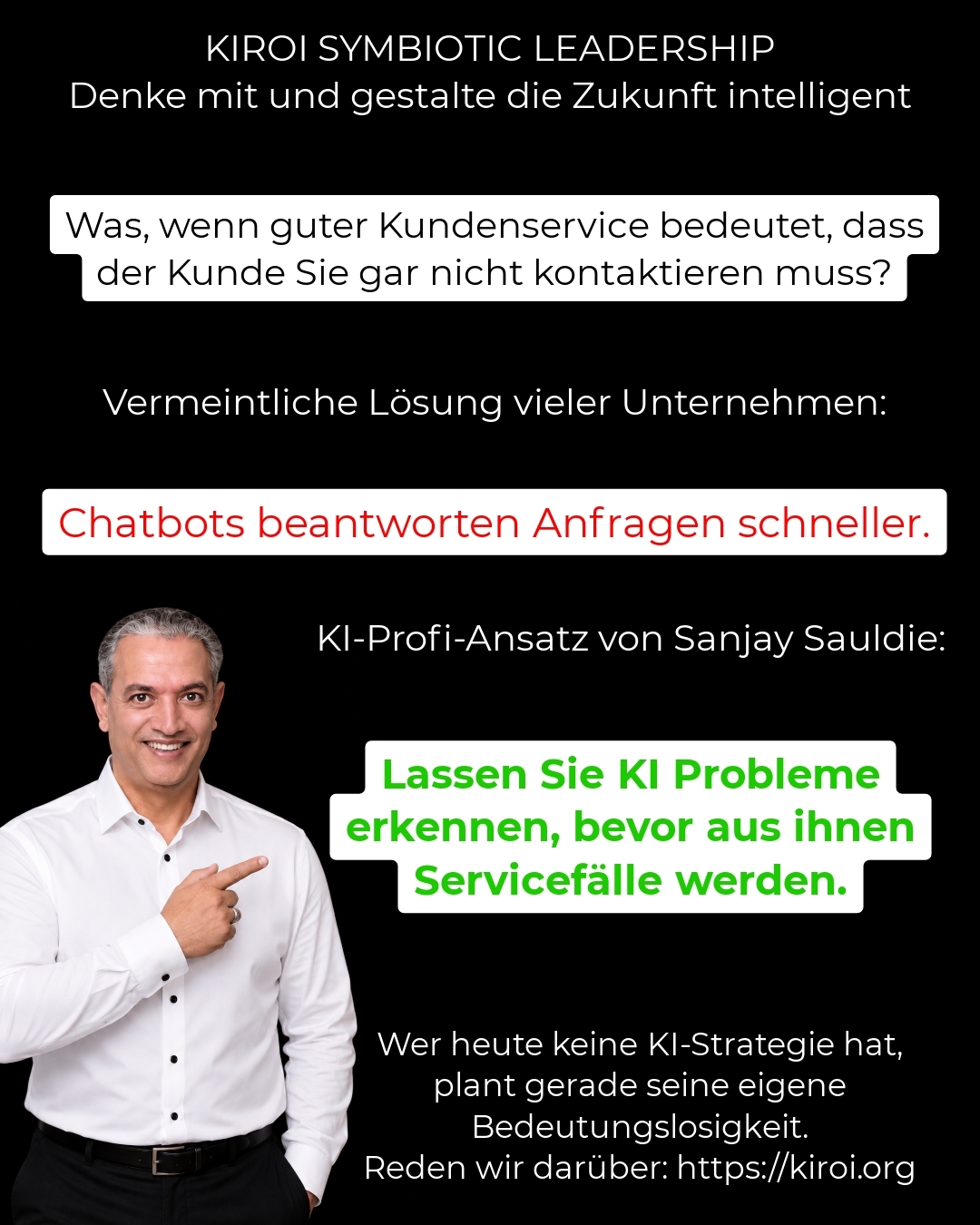
AIROI The perspective: What if good customer service means that the customer doesn't have to contact you at all?
The AIROI-approach (Artificial Intelligence Return on Investment) follows a fundamentally different philosophy. Instead of processing service requests faster, this approach aims to systematically eliminate the need for requests. The central idea: Let AI detect problems before they become service cases. This proactive model uses advanced analytical methods to identify patterns that indicate emerging customer issues, allowing companies to intervene before the customer even notices that something is wrong [3].
For example, an energy provider implemented a system that analyzes consumption anomalies in real time. When a household’s electricity consumption suddenly increases significantly without an obvious explanation such as a move or renovation, the company proactively contacts the customer with helpful information about potential causes and energy-saving tips. This intervention not only prevents unpleasant surprises on the next bill but also positions the company as a attentive partner rather than an anonymous service provider.
A telecommunications provider uses predictive analytics to identify network issues that may affect specific customers. Instead of waiting for frustrated users to report problems, the system automatically sends notifications with estimated resolution times and alternative usage options. A financial institution analyzes account movements to predict potential liquidity shortages, and proactively offers advisory sessions to affected customers before overdrafts occur.
Best practice with a AIROI customer
A nationwide service provider faced the challenge that its customer churn rate was continuously rising despite good ratings in traditional customer support. Analysis revealed that many customers left the company without ever filing a complaint because they were frustrated by recurring minor annoyances that individually never seemed serious enough to seek contact. As part of the AIROI onboarding process, the company implemented a system that continuously analyzed multiple data points – from payment behavior to app usage to contract changes – and identified so-called frustration indicators. For example, if a customer pays their invoice for the third time in a row after the second reminder, even though they had always been punctual before, the system triggers a proactive contact from a specialized advisor. This advisor does not call to remind the customer, but to understand whether there are any ambiguities or whether the payment deadline is unfavorable. Within eight months of its introduction, the silent churn rate decreased by 34 percent, while customer satisfaction levels increased by 18 percentage points. Particularly noteworthy: The number of incoming support requests decreased by 23 percent because potential problem situations were addressed in advance.
From reactive to predictive: The technological foundations of change
The technological foundation for this paradigm shift is advanced machine learning algorithms that are capable of extracting complex patterns from historical data and applying them to current situations [4]. A mobility provider uses this technology to predict which vehicles in its fleet are likely to require maintenance within the next two weeks and proactively plan corresponding service intervals before customers are affected by outages. A retail company analyzes purchasing patterns to detect when long-time customers significantly change their shopping behavior, and offers personalized incentives before the loyalty is completely eroded.
Implementing such systems, however, requires more than just technological expertise. It requires a fundamental change in corporate culture. What if good customer service means that the customer doesn’t even have to contact you? This is not just a rhetorical question, but a guiding light for organizational transformation. An insurance company had to overhaul its entire performance measurement because traditional KPIs like „number of resolved tickets“ become counterproductive in a proactive model. Instead, the company now measures „prevented problem situations“ and „proactive interventions with positive outcomes.“.
A credit institution developed a dashboard that shows in real time how many potential service cases were averted through preventive measures. A logistics company automatically informs recipients of delays before they even start tracking requests. A healthcare provider sends personalized reminders for preventive examinations based on individual risk profiles, rather than relying on generic age recommendations.
The human factor: Why AI does not replace employees but empowers them
A common misconception is that AI-powered service improvements must necessarily lead to job cuts. However, the experiences of successful AIROI implementations show a more nuanced picture [5]. When routine inquiries are prevented by proactive communication, service agents gain time for complex consultations that create real added value. A telecommunications company shifted its customer advisors from reactive problem solving to proactive customer support and saw both higher employee satisfaction and improved sales figures.
An energy provider trained its service staff to become „Customer Success Managers,“ who now focus on individual customer support in transition situations – such as home sales, moving, or the installation of solar panels. These high-quality interactions were simply not possible in the day-to-day business in the past because too much time had to be spent on repetitive requests. A financial services provider reports that its advisors now have an average of 40 percent more time for strategic customer conversations thanks to the relief from standard requests, which directly translates into higher cross-selling rates.
The AIROI accompanying support for such transformation projects therefore always includes change management components that ensure that employees do not perceive the new systems as a threat but as an opportunity. One insurance company introduced regular „success stories“ sessions in which employees report how the proactive systems helped them better advise customers. This cultural integration is often the crucial factor for long-term success.
Best practice with a AIROI customer
A medium-sized retail company with a strong online business struggled with high return rates and growing dissatisfaction among regular customers, despite the support team being considered extremely competent and friendly. AIROI The analysis revealed that many returns were due to avoidable causes – incorrect sizing, insufficient product descriptions, or delivery problems that customers only discovered after purchase. The implemented system now analyzes order patterns and identifies risk factors even during the ordering process. For example, if a customer has returned an above-average number of times in the past for a particular product type, they automatically receive expanded product information and size recommendations. For delivery addresses that experience delivery issues, the system proactively offers alternative delivery options. The company contacts customers after shipping with personalized messages that answer frequently asked questions about the product being ordered before they arise. The return rate fell by 28 percent within six months, while the repeat purchase rate rose by 19 percent. The service agents report that their conversations are now more positive in nature because frustrated return calls have become significantly less frequent.
My AIROI Analysis
The transformation from reactive to proactive customer service represents one of the most significant paradigm shifts of the past decades, and the question of what good customer service means when the customer does not have to contact you at all is increasingly becoming a strategic necessity rather than a theoretical consideration. My experience from numerous AIROI projects shows that the success of such initiatives depends on three essential factors: first, the quality and accessibility of the existing customer data; second, the organization’s willingness to question traditional success metrics; and third, the involvement of employees as active agents of change.
Companies that successfully take this path often report surprising side effects: Systematic analysis of root causes not only leads to better service, but also to product improvements, more efficient processes, and deeper customer relationships. The investment in preventive systems usually pays off faster than expected because it not only reduces service costs but also positively influences customer loyalty and word-of-mouth behavior. I accompany such transformation projects as a neutral entity that keeps both the technological possibilities and the organizational realities in mind. The AIROI accompaniment provides impetus, structures decision-making, and supports the sustainable embedding of new working practices – without imposing ready-made solutions, because every organization has its own strengths, challenges, and development paths.
Further links from the text above:
[1] SuperOffice: Study on customer complaints and silent attrition
[2] Gartner: Analyses on the spread of chatbots in companies
[3] McKinsey: The next frontier of customer engagement – AI-enabled customer service
[4] Harvard Business Review: Artificial Intelligence in Business
[5] Forrester: Research on Customer Experience and AI
Are you a leader and would you like to learn how you can genuinely introduce AI into your company in a valuable and sustainable way, away from the hype? Take part Contact us or read more blog posts on the topic Artificial intelligence here.









 Deutsch
  English (UK)