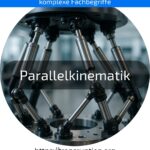
Parallel kinematics is a term from the fields of 3D printing, industry and Industry 4.0, and robotics. The term describes a special design for machines and robots in which multiple „arms“ or struts work simultaneously on a platform to move it precisely.
Unlike conventional machines where movements occur sequentially and usually via individual motors, parallel kinematics ensure that all movements occur simultaneously and in a highly coordinated manner. As a result, devices with parallel kinematics are generally faster and more precise. This is precisely what is utilised in 3D printing, for example: there, this technology allows for particularly precise and efficient printing of objects, as the print head is moved synchronously from several directions.
An understandable example: Imagine a table with three legs, each with a helper standing at the end. If each helper simultaneously pulls or pushes on the leg, the tabletop can be moved quickly and precisely in any desired direction. This type of control makes parallel kinematics a sought-after technology in modern production plants and 3D printers, especially when precision and speed are paramount.






 Deutsch
  English (UK)