
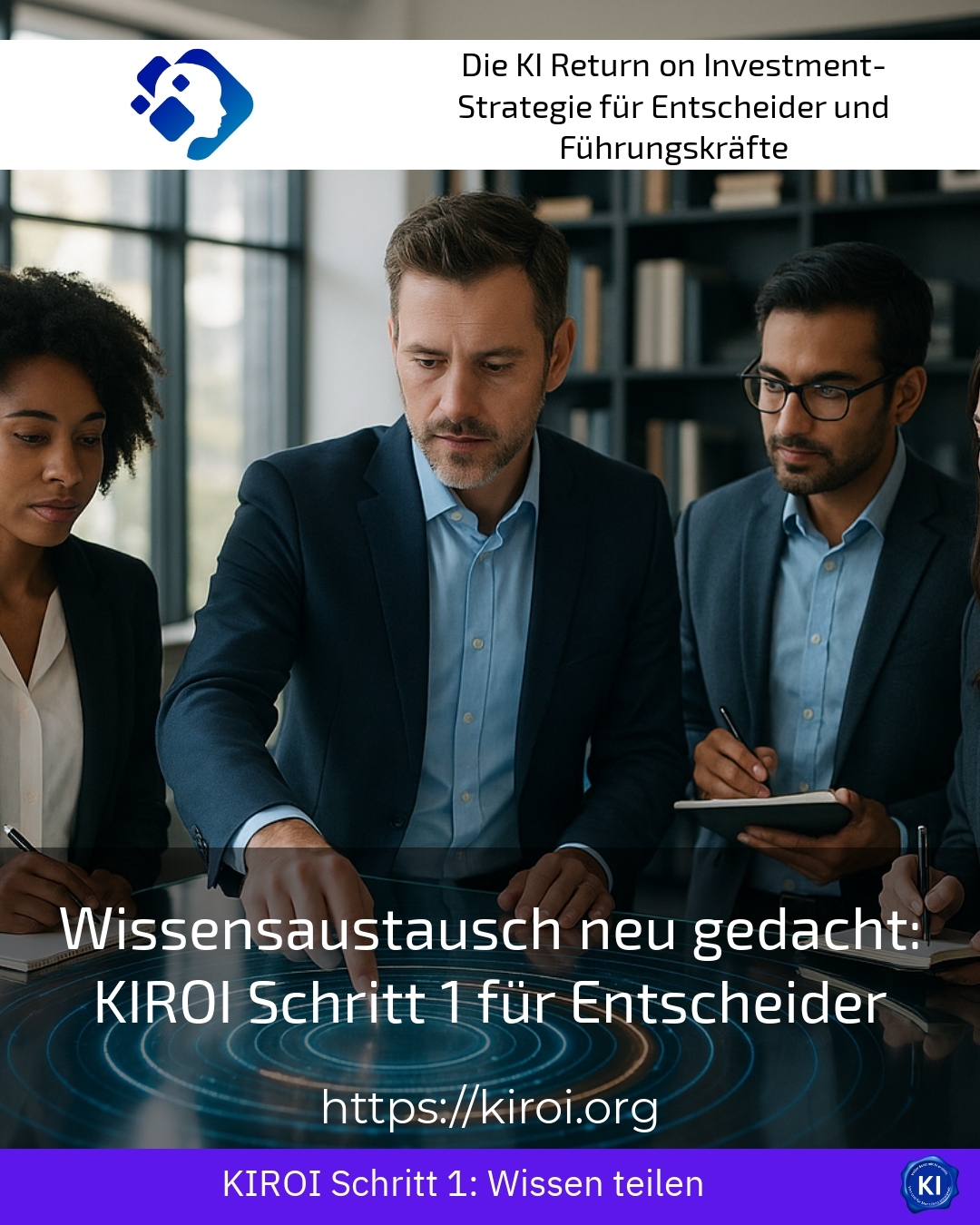
The term Knowledge sharing is increasingly gaining importance in modern organisations. Decision-makers in particular face the question of how knowledge flows can be designed efficiently and used sustainably. A newly conceived approach like KIROI Step 1 shows promising possibilities for actively supporting knowledge exchange and thereby making organisations more innovative, agile, and resilient.
Knowledge exchange as a strategic tool for decision-makers
Knowledge exchange is not simply about sharing data or information. Rather, it refers to a targeted, systematic process of exchanging expert knowledge, skills, and experiences within and across departmental boundaries. For decision-makers, this means creating the conditions that anchor knowledge exchange as an integral part of everyday work.
For example, in an innovative technology company, a weekly meeting can be established where employees share their latest findings and challenges. This breaks down silos, and the employees' implicit knowledge flows into decisions and projects[7]. In the automotive industry, it is common for interdisciplinary teams to directly exchange results from research, development, and production in order to continuously improve product quality.
In consulting, the open exchange of best practices and lessons learned in project reviews supports rapid adaptation to customer needs. This shows that the Knowledge sharing Fostering innovation, minimising risks, and ensuring well-founded decision-making processes.
KIROI Step 1: The Starting Point for Sustainable Knowledge Exchange
KIROI Step 1 focuses on actively designing a framework that doesn't leave knowledge exchange to chance, but rather consciously manages it. For decision-makers, this means, among other things, clearly defining responsibilities and creating suitable structures.
Three key examples illustrate this approach:
- A mentoring system is being introduced in a medium-sized mechanical engineering company, pairing experienced employees with new colleagues. This programme ensures a more secure and rapid flow of information and provides targeted support for new team members.
- An IT service provider uses digital knowledge platforms to make relevant documentation, tutorials, and case studies accessible to all employees at any time. This ensures that know-how is not only collected but also actively shared[5].
- A public administration body regularly organises cross-departmental workshops. In these, employees can exchange knowledge in a protected environment and develop joint solutions for current challenges.
It is particularly important that decision-makers have the motivation and openness for Knowledge sharing This is only possible if a culture of transparency, trust and appreciation is lived. Otherwise, knowledge often remains hidden in departments or minds and dissipates ineffectively[3][9].
BEST PRACTICE with one customer (name hidden due to NDA contract) It became apparent that the introduction of a digital knowledge network and accompanying training measures measurably shortened project durations. Employees were able to access previously untapped sources of experience, thus finding solutions to complex tasks more quickly. Furthermore, the network fostered collaboration within new teams in the company.
Practical tips for decision-makers on optimising knowledge sharing
In addition to shaping the framework, decision-makers should provide the following impetus:
- Establish regular knowledge exchange formats. Whether weekly meetings, retrospectives or expert discussions – continuous dialogue promotes the active transfer of implicit and explicit knowledge[4][8].
- Integrating technological solutions sensibly: Modern tools such as collaborative platforms, knowledge bases, and video formats support access to and discoverability of knowledge, increasing user acceptance[2][5].
- Communicating incentives and appreciation: Employees who share their knowledge should be recognised and rewarded. This creates a positive attitude and increases participation.
For instance, in the HR sector, it's common practice to ensure knowledge is continually accessible and to foster exchange through internal e-learning programmes and virtual workshops. In the pharmaceutical industry, structured project presentations help to make acquired specialist knowledge about new therapies or procedures broadly accessible in a short amount of time. Software development teams also frequently rely on daily stand-ups and code reviews to share and deepen knowledge in real-time.
Knowledge exchange as a driver for sustainable business success
Companies frequently report that targeted knowledge-sharing initiatives strengthen innovation, accelerate learning processes, and increase employee motivation. Decision-makers who adopt concepts like KIROI Step 1 early on can utilise resources more effectively and align networked teams towards common goals.
The transruptions coaching approach accompanies such projects and supports leaders in Knowledge sharing as part of their organisational culture. It stimulates reflection and helps to overcome obstacles. Many decision-makers report that this gives them confidence in their actions and enables them to make their teams more resilient in the long term.
My analysis
The re-imagined approach to Knowledge sharing, as conveyed by KIROI Step 1, represents an innovative building block for optimising knowledge flows. Decision-makers receive both theoretical foundations and practical recommendations for action in order to sustainably promote the exchange of knowledge within their organisation. Examples from a wide range of industries show that this strategy improves collaboration, strengthens trust and increases flexibility. A high-performing knowledge culture is therefore an important prerequisite for remaining competitive in a dynamic world.
Further links from the text above:
Knowledge Exchange – The Office Expert
Knowledge transfer - definition, methods, examples
6 methods for managers to foster knowledge sharing in the workplace
Knowledge Sharing: The Ultimate Guide
Knowledge Management in Business: Methods + Tips
For more information and if you have any questions, please contact Contact us or read more blog posts on the topic Artificial intelligence here.











 Deutsch
  English (UK)