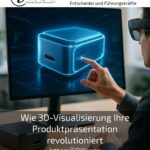
The way companies present their products has fundamentally changed. Modern 3D visualisation offers you the opportunity to excite and convince potential customers in entirely new ways. Unlike traditional photography, this digital technology allows for a realistic and detailed representation of products from every conceivable perspective. Companies from a wide variety of industries are already using the power of 3D visualisation to improve their sales opportunities and strengthen their brand position. In this article, we will show you how this innovative technology can revolutionise your product presentation and what practical benefits it brings.
The flexibility of 3D visualisation in modern product presentation
A major advantage of 3D visualisation is its incredible flexibility. You can create product variations quickly and easily, without needing to produce them physically. This saves an enormous amount of time and money. Furniture manufacturers, for example, can digitally display different designs, colours or types of fabric. This allows them to present their entire collection in an efficient way.[1]
Manufacturers of technical equipment also benefit hugely from this. They can display various material options or equipment variants with just a few clicks. In the automotive sector, 3D visualisations even allow for the dynamic display of numerous vehicle configurations. This allows customers to experience their individual desired product virtually before placing an order.
BEST PRACTICE with one customer (name hidden due to NDA contract) The company used 3D visualisation to digitally develop a variety of product variations and easily align them with end customers. This significantly reduced development costs while increasing customer satisfaction through greater involvement. The customer could have all necessary variations visualised within two weeks, instead of waiting four to six weeks for physical samples as before. This led to a faster market launch and higher sales.
Completely redesign scenarios and backgrounds
With 3D visualisation, there's no need to be tied to studio or outdoor shoots. Materials, colours, or backgrounds can be changed in seconds. You no longer need to book an expensive studio. The weather suddenly also no longer plays a role. The entire design is carried out entirely digitally.
Entire product ranges, colour variations, or complete scenarios can be visualised this way. The best part: you don't have to organise a new team each time. The flexibility is limitless. For example, a furniture company can display a sofa in a hundred different colours and materials. An electronics manufacturer can show its device in modern office environments or cosy living rooms.[5]
Cost-efficiency and time-saving through digital product development
The use of 3D visualisation saves immense resources, especially in product development. Instead of creating expensive physical prototypes, a product can be virtually tested and optimised in various designs. This significantly shortens the time to market. The costs for elaborate photoshoots are completely eliminated.[1][3]
The visualisation can even begin before the product even physically exists. This is an enormous advantage, particularly in product development. Companies can test various design concepts before a single prototype is built. Changes and adjustments can be made quickly in the virtual environment. Expensive re-productions are avoided. This not only leads to an accelerated time to market. It also significantly reduces the overall costs of product development.[3][9]
No more production errors
3D modelling involves precise measurements of each individual piece. This helps to avoid manufacturing errors. For example, medical technology companies demonstrate how complex devices function. A 3D video of a complex product doubled one such company's conversion rate.[6]
Mechanical engineers can accurately represent their conveyor systems. A 3D trade fair film of an automated conveyor system already attracted 30 percent more visitors to the stand. [6] Technical equipment from GE Additive impresses with X-ray animations. These vividly show the inner processes of the machine. Laser melting technology is explained through highly precise animations. [2]
Improved communication and emotional customer engagement through 3D visualisation
3D visualisation brings products to life and makes them understandable for potential customers. This is particularly advantageous for products that require extensive explanation. Customers can view digital 3D models from various perspectives, configure them, or even experience them interactively. This significantly enhances the understanding and attractiveness of the products.
The realistic depiction and interactive capabilities of 3D visualisations create an immersive experience. The customer experience is elevated to a new level. Trust and credibility are established because customers know exactly what to expect. This attention to detail will convince potential buyers in the long term.
Explore products from all perspectives
By allowing products to be viewed from different angles, an accurate and complete picture is created. 3D visualisation makes it possible to represent complex structures and designs with precision. Classic photography often cannot achieve this. An LED utility flood product is showcased through dynamic camera movements and precise animations. The grid pattern made up of numerous lights delivers an impressive visual statement.[2]
Window frames from architectural brands are brought closer to the viewer through sophisticated animations. Particularly the energy efficiency and the minimalist design make such videos elegant examples of professional marketing. Sony BRAVIA demonstrates its backlight system with incredibly deep blacks and dazzling lights. The 4K HDR processor is made visually tangible here.
Different types of 3D product visualisations for different purposes
There are various types of 3D product visualisations used for different purposes. Static renderings showcase products in the highest quality as single images. They are perfect for catalogues and websites. 360-degree views and interactive models allow customers to rotate products themselves and examine them from all angles.[8]
Animated functional demonstrations and exploded views show how products work. They explain internal processes and compositions. Real-time visualisation for augmented reality and virtual reality opens up entirely new possibilities. Customers can virtually try out products in their own environment. An ASUS projector is presented as a mobile entertainment solution. The product video shows how the device works indoors and outdoors.[4][8]
Detail focus through technical visualisations
Technical visualisations of CAD products enable transparent representations of details. Würth transformers are visualised on minimalist backgrounds. The animation offers detailed close-ups of circuit diagrams. This makes safety and compliance immediately understandable.
DELL showcases its PowerStore system with modern, realistic designs. The hexagonal shape is presented alongside dynamic data visualisations. This elegantly conveys core messages. Applied Medical displays its intelligent energy system with precise 3D animations. A clear narrative structure ensures an intuitive presentation.
Practical applications in various industries
The potential applications for 3D visualisation are practically limitless. In the furniture industry, entire rooms are visualised. Customers can see how a sofa looks in their living room. In the automotive industry, buyers configure their vehicles virtually. Every colour and material can be interactively selected.[1]
In e-commerce, 3D visualisation offers improved product representation. This far surpasses traditional photos and descriptions. Logitech showcases its wireless Bluetooth mouse from all angles. Customers immediately understand the ergonomics and handling. Panasonic Toughbook redefines robust flexibility. The 2-in-1 device with its unique display is impressively presented.[4]
Bugatti shoes are showcased through high-quality 3D animations. Euronda dental equipment presents its technology comprehensibly. GeoSLAM uses dynamic colours and animations. The mapping technologies are impressively demonstrated. Every industry benefits from the possibilities of modern product visualization.
E-commerce and online sales are revolutionising
In e-commerce, 3D visualisation has long since become the standard. It enables consistent representations across all channels. From the online shop to the exhibition stand, lighting moods, perspectives and quality standards remain exactly the same. This creates trust and professionalism. Wide product ranges are offered without every model being produced. Only the purchased items are then manufactured.
Customers design products entirely individually. Such a broad range leads to a higher willingness to buy. Companies save on warehousing costs and overproduction. Time to market is accelerated. This creates competitive advantages in fast-paced e-commerce.[11]
Why iROI Coaching supports you with your 3D visualisation projects
The implementation of 3D visualisation is a multifaceted project. Clients often report uncertainties about implementation, choosing the right partners and profitability. iROI-Coaching supports you with 3D visualisation projects from start to finish. We help you develop the right strategy. [1]
Together, we will determine which type of 3D visualisation is suitable for your products. We will support you in selecting partners and in budget planning. You will receive practical input for integration into your marketing channels. Our guidance will give you confidence in a forward-looking investment project. With 3D visualisation, you will position yourself as an innovative company in the market.[9]
My analysis
3D visualisation is fundamentally revolutionising the way products are presented. It combines flexibility, efficiency, and an emotional appeal that significantly enhances the customer experience. Companies from a wide range of industries report increased customer engagement and shorter development times. The ability to show products in detail and realistically before production offers significant competitive advantages.
The cost savings from forgoing physical prototypes and elaborate photo shoots are considerable. At the same time, entirely new possibilities for customer interaction are opening up. 3D visualisation is no longer a thing of the future, but a lived reality in modern businesses. Those who do not rely on 3D visualisation today will fall behind in competitiveness tomorrow. The technology is mature, the benefits are measurable, and the industry demonstrates it daily: 3D visualisation is the tool for successful product presentation.[1][3][9]
Further links from the text above:
[1] How 3D visualisation revolutionises your product presentation






 Deutsch
  English (UK)