
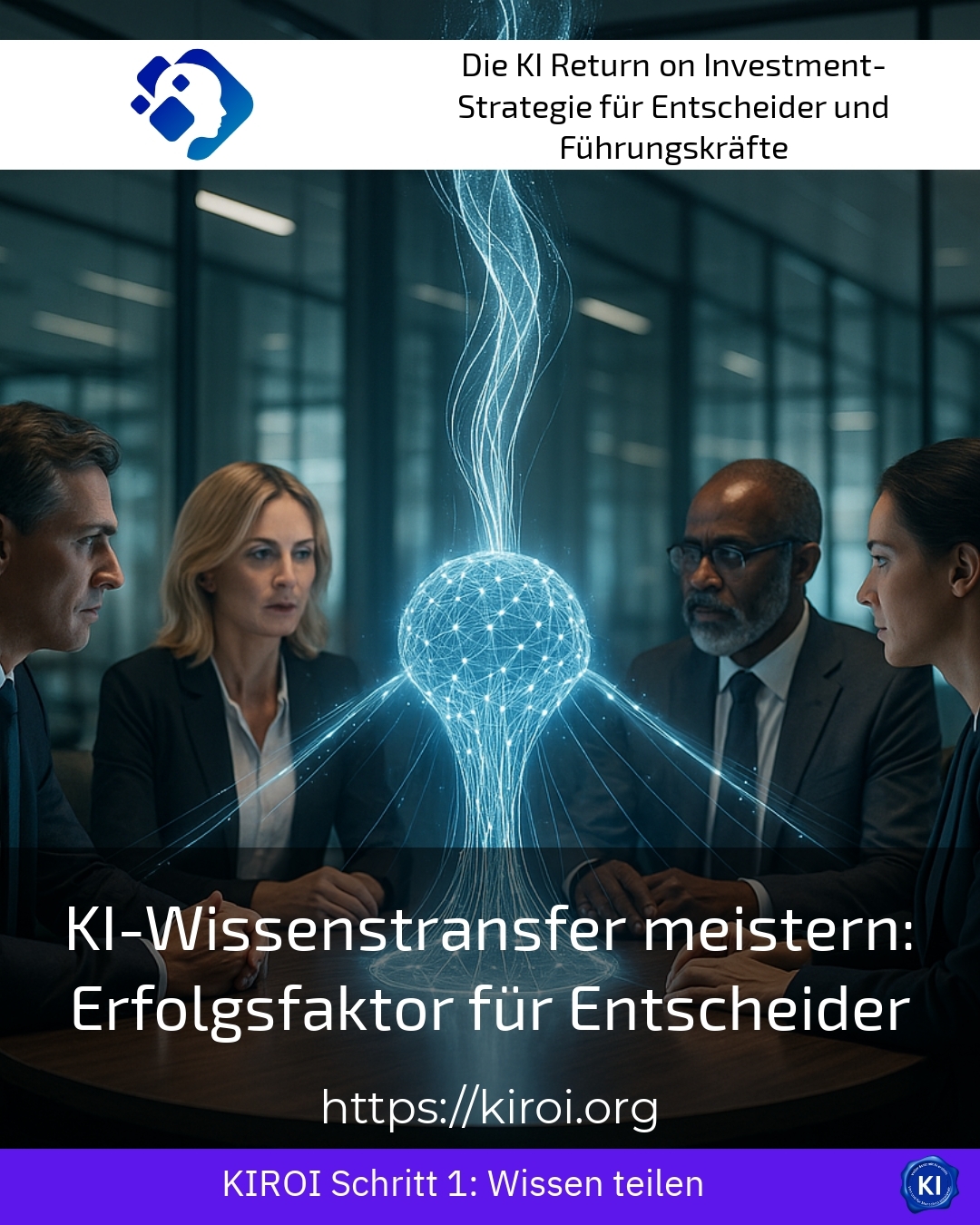
The rapid development of intelligent systems presents a key challenge for managers. How can knowledge of these transformative technologies be effectively disseminated across all areas of the organisation? Mastering AI Knowledge Transfer This will become a crucial success factor for decision-makers who want to position their organisation for the future. Because without the systematic transfer of insights and expertise, even the most promising technology initiatives will fall far short of their potential. In an era where competitive advantages increasingly depend on the speed with which companies can absorb and apply new knowledge, the quality of internal knowledge sharing will determine the success or failure of digital transformation projects.
Why the transfer of knowledge is becoming a core strategic competence
Managers often report a paradoxical situation within their organisations. On the one hand, they invest considerable resources in new technologies and pilot projects. On the other hand, the insights gained often get lost within isolated departments or project teams. This fragmentation of knowledge leads to costly duplication of effort and missed opportunities for synergy. This has a particularly serious impact when strategically important initiatives are launched without benefiting from the experience gained in previous projects [1].
This problem is particularly evident in the manufacturing sector. For example, an automotive supplier implemented smart quality control systems at one of its plants with impressive results. However, attempts to transfer these insights to other sites failed due to a lack of structures for knowledge sharing. A mechanical engineering company, on the other hand, developed highly specialised in-house expertise in predictive maintenance. However, this remained confined to a handful of experts because no systematic mechanisms for sharing it existed. A chemical group faced a similar situation: its research department developed groundbreaking optimisation algorithms, but the production departments only found out about them months later, purely by chance.
These examples illustrate that technological innovation capability alone is not enough. Rather, organisations need well-considered approaches to systematically disseminate and leverage knowledge. Transruption coaching supports decision-makers in building and sustainably anchoring precisely such structures [2].
Overcoming key barriers to AI knowledge transfer
Before effective solutions can be developed, it is essential to understand the typical obstacles. These barriers are often less technical and more cultural and organisational in nature. Clients regularly report facing similar challenges, regardless of their industry or the size of their organisation.
The first major hurdle is the so-called knowledge monopoly of individual departments. Specialist areas tend to view their expert knowledge as a resource of power. In the banking sector, for example, risk management teams often guard their modelling expertise like a treasure. Insurance companies experience similar dynamics between actuaries and sales. Even in tech-savvy start-ups, such silos emerge as soon as specialisation increases.
A second major barrier lies in the complexity of the knowledge to be transferred. Insights into the use of intelligent systems are often context-dependent and difficult to formalise. What works for demand forecasting in a retail company cannot simply be transferred to a logistics company. A pharmaceutical company cannot simply apply its experience from drug development to other areas of research. This complexity requires well-thought-out translation services that take time and resources.
The third key challenge concerns the speed of technological change. By the time knowledge has been systematically documented and disseminated, the environment has often already changed. Telecommunications providers experience this particularly acutely with network optimisations. Energy suppliers face similar challenges when integrating renewable sources. This dynamic requires agile approaches that go beyond traditional documentation processes [3].
Best practice with a AIROI customer
A medium-sized company in the manufacturing industry approached us with a specific challenge. The company had successfully implemented intelligent systems for production control at a pilot plant. The results exceeded all expectations, leading to significant efficiency improvements. However, attempts to transfer these findings to the other three production sites repeatedly failed. Local teams felt bypassed and offered passive resistance. Furthermore, there was a lack of a common language to communicate the technical concepts comprehensibly. As part of the transruption coaching, we first developed a stakeholder map that identified all relevant knowledge holders and recipients. We then established a format for regular exchange forums where experiences were shared in a way that was understandable to everyone. The introduction of so-called knowledge bridge individuals, who acted as translators between the sites, proved particularly effective. After six months, all plants reported successful adaptations of the original solution, with local adjustments being explicitly requested and encouraged. The key was not in standardisation, but in the empowering support of the transfer process.
Cultural prerequisites for successful knowledge exchange
The technical infrastructure for knowledge transfer may be in place. However, without a supportive company culture, even the most sophisticated systems remain ineffective. Decision-makers who Mastering AI Knowledge Transfer must therefore first create the cultural foundations.
In retail, progressive companies have realised that knowledge sharing must be actively rewarded. They are integrating corresponding criteria into their performance appraisal systems. Large banks are experimenting with internal marketplaces for expertise, where teams can offer their insights. Industrial companies are establishing rotation programmes that deliberately circulate skilled workers between departments. These approaches demonstrate that cultural change requires concrete structures and incentives.
Particularly noteworthy are the experiences from the healthcare sector. Hospitals and medical facilities have traditionally had highly hierarchical structures. Nevertheless, some are succeeding in establishing a culture of open exchange. They use interdisciplinary case discussions as a model for technology knowledge transfer. A pharmaceutical company adapted this approach for its research departments with considerable success. A medical device manufacturer transferred the principle to its development teams and reported accelerated innovation cycles.
Practical Methods for Systematic Knowledge Transfer
In addition to the necessary cultural foundations, organisations need specific methods and tools. These must be suited to the organisation’s specific circumstances and be practical to implement. Clients often say they are looking for pragmatic solutions that deliver results quickly.
A proven method is so-called reverse mentoring. Here, younger, tech-savvy employees pass on their knowledge to experienced managers. An insurance group is successfully using this format for the transfer of knowledge about automated claims assessment. A major bank is using it to promote understanding of algorithmic decision support in lending. A logistics company has adapted the approach for route optimisation technologies and reported increased acceptance at management level [4].
Another effective method involves structured lessons-learned processes following the completion of projects. These go beyond superficial retrospectives and systematically document insights. In the construction industry, leading companies use these approaches for projects involving digital design support. Engineering firms apply them to their experience with generative design. Architectural firms use this method to document their findings from the use of intelligent visualisation tools.
Communities of Practice form a third important building block. These informal networks of professionals with shared interests enable continuous exchange. An energy supplier established such a community for experts in the field of network load forecasting. A telecommunications provider founded a similar group for professionals in customer interaction automation. A retail group connects its specialists in inventory optimisation across locations in this way.
Mastering Technological Support for AI Knowledge Transfer
Modern technologies can significantly support knowledge transfer when used thoughtfully. This is not about introducing further complex systems, but about targeted additions to existing infrastructures.
The latest generation of knowledge management systems integrate intelligent search functions and recommendation algorithms. They help employees find relevant experiences and experts more quickly. One car manufacturer reports a halving of the time engineers spend searching for information. A chemical company is seeing similar improvements in its research department. A financial services provider uses such systems to efficiently disseminate regulatory knowledge.
Collaboration platforms enable asynchronous exchange across time zones and locations. Multinational corporations particularly benefit from these possibilities. A global consumer goods manufacturer connects its marketing analytics teams in this way. An international logistics company coordinates its optimisation experts via similar platforms. A globally operating consulting firm systematically shares project experiences through such channels.
Best practice with a AIROI customer
An internationally operating trading company sought support in scaling its personalisation initiatives. The central analytics team had developed impressive solutions for individualised customer engagement. However, the country organisations struggled to utilise this knowledge effectively. The complexity of the concepts and language barriers further hindered the transfer. As part of the transruptions-coaching support, we initially developed a multi-layered communication concept. This addressed different target groups with adapted levels of detail and formats. Compact briefings with strategic implications were created for management. Practical guides with concrete use cases were developed for operational teams. Detailed documentation of the underlying methods was provided for technical specialists. Additionally, we established a network of local champions who served as primary points of contact in the country organisations. These individuals received intensive training and regular updates directly from the central team. The result was significantly accelerated adoption of the solutions in all markets, with local teams also contributing their own suggestions for improvement. This feedback, in turn, enriched central development and created a self-reinforcing cycle of knowledge exchange.
The role of managers in the transfer process
Decision-makers significantly shape how knowledge flows within an organisation through their behaviour. Their role as exemplars can accelerate or block transfer processes. Therefore, the leadership dimension deserves particular attention in all initiatives aimed at improving knowledge sharing.
In the financial sector, we observe that successful transformations are always accompanied by visible commitment from senior management. Boards of directors who participate in learning formats themselves signal the importance of the subject. A bank board member who regularly attends the internal community for data analysis sends a strong signal. An insurance CEO who publicly reports on her own learning curves promotes a culture of openness.
Leaders must also actively create and protect spaces for exchange. In the fast-paced consumer goods industry, knowledge transfer often competes with daily operations. Successful organisations explicitly reserve time and resources for exchange formats. One food manufacturer blocks two hours weekly for interdepartmental learning sessions. A fashion company established monthly innovation days without operational meetings. An electronics conglomerate introduced sabbaticals for knowledge transfer between departments.
Ultimately, it is up to managers to put the right incentive structures in place. Traditional appraisal systems often reward individual performance rather than collective knowledge development. Progressive companies adapt their systems accordingly. One technology group explicitly assesses employees based on their contribution to knowledge transfer. A consultancy firm makes the documentation of project experience a prerequisite for promotion. An industrial company awards bonus payments for demonstrably shared knowledge [5].
Establishing success measurement in knowledge transfer
What isn't measured is difficult to improve. This management adage also applies to knowledge transfer. However, quantifying knowledge flows presents organisations with methodological challenges that require creative solutions.
Process-oriented key figures form an initial starting point. They measure activities such as the number of knowledge transfer events held or the intensity of use of knowledge platforms. A media company tracks the frequency of cross-departmental collaborations. A telecommunications provider measures the access rates to its internal knowledge base. A logistics company records participation rates in learning formats.
Results-oriented key performance indicators go a step further. They attempt to capture the impact of knowledge transfer on business outcomes. A retailer correlates the use of best practice documentation with store performance. A manufacturing company compares ramp-up curves of new production lines before and after the introduction of systematic knowledge transfer processes. A financial services provider analyses the quality of decisions depending on access to relevant experience.
My AIROI Analysis
The ability to systematically disseminate knowledge about smart technologies and put it to practical use is becoming a key competitive factor of our time. Organisations that recognise this and establish appropriate structures gain a lasting advantage over competitors who continue to rely on fragmented and haphazard knowledge sharing.
The analysis of numerous transformation projects clearly shows that technological investments alone are not enough. The real lever lies in enabling the entire organisation to benefit collectively from individual insights. This requires a holistic approach that addresses cultural, structural, and technological dimensions equally. Mastering AI Knowledge Transfer This does not mean implementing perfect systems, but rather establishing dynamic processes of exchange.
Decision-makers face the task of actively shaping this transformation. They must be role models, create space, and set incentives. The good news is that numerous tried and tested methods and approaches exist that can be built upon. Transruption coaching provides impetus and supports organisations on their individual journeys. This is because every organisation brings its own prerequisites that must be considered to achieve sustainable change.
The coming years will show which companies successfully master this challenge. Those who set the course now will be among the winners of the technological transformation. Those who, on the other hand, leave knowledge transfer to chance, risk not achieving the hoped-for results despite significant investments. The decision lies with those in charge, and the time to act is now.
Further links from the text above:
[1] Harvard Business Review – Knowledge Management
[2] transruptions-Coaching – Support for Digital Transformation
[4] MIT Sloan – Artificial Intelligence Research
For more information and if you have any questions, please contact Contact us or read more blog posts on the topic Artificial intelligence here.







 Deutsch
  English (UK)