
Designing leadership development effectively and with focus
Many companies face the challenge of systematically developing employees for leadership roles. Leadership development is a multifaceted process aimed at building relevant competencies. A balanced combination of technical knowledge, social skills, and situational leadership behaviour forms the foundation of successful leadership. But how can this goal be achieved in a structured and sustainable way? Here, it becomes clear that accompanying support on projects involving artificial intelligence can meaningfully complement modern leadership development.
Exploiting diversity of methods in leadership development
Different forms of learning and training approaches are helpful on the path to leadership. Companies often resort to tried-and-tested methods such as seminars, mentoring programmes, or coaching. These specifically promote the individual development of the leader. In addition, training on the job is very effective, as competencies are directly applied and deepened in everyday work. Combinations of different methods, tailored to the respective leader and their tasks, often enable the greatest learning success.
As part of leadership development, innovative approaches are also employed, where artificial intelligence acts as a supportive element. This concerns, for example, the analysis of competency profiles, personalised learning paths, or the improvement of feedback cycles.
AIROI as a supportive companion for competence building
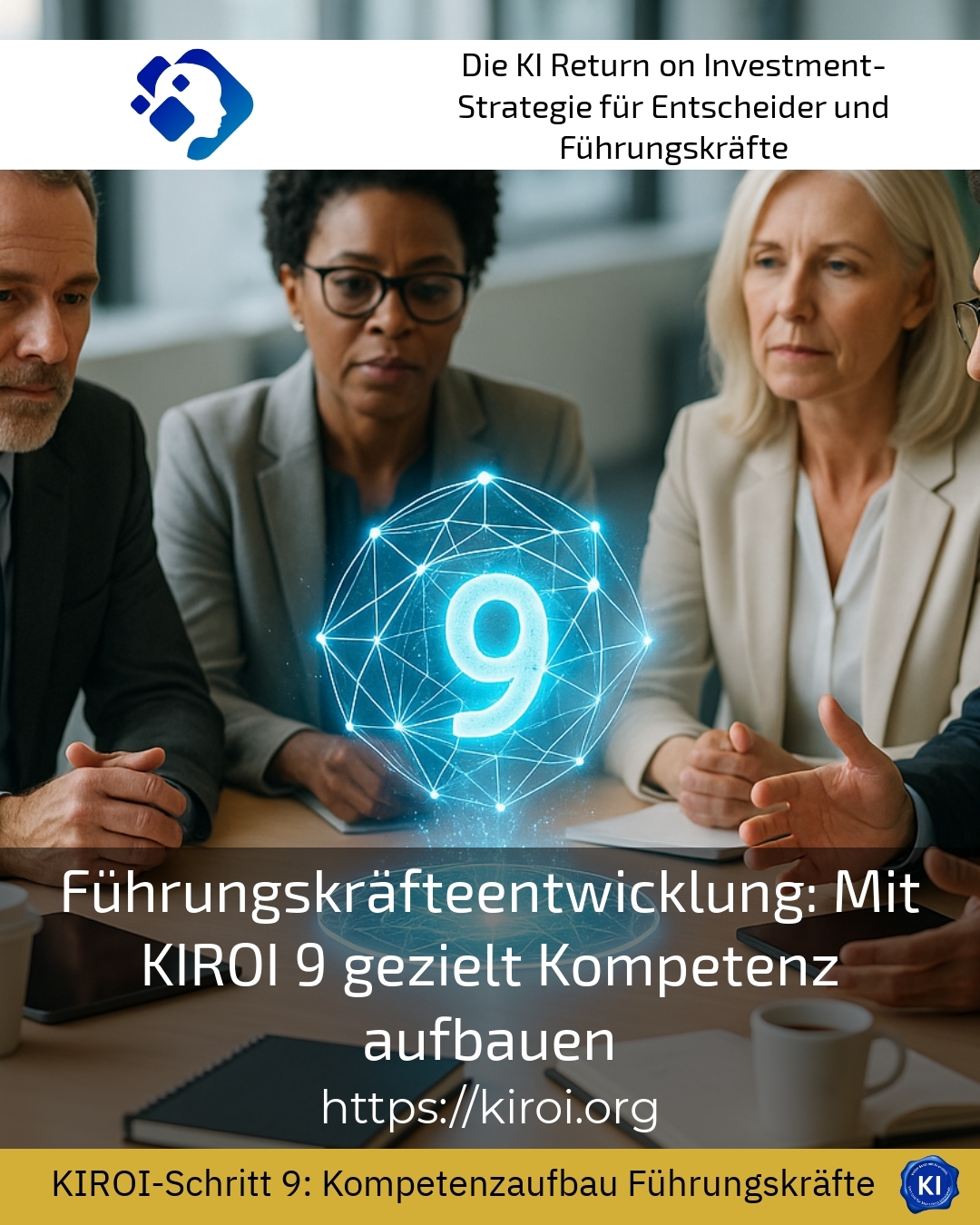
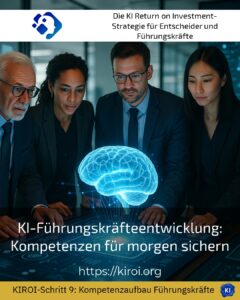
In the context of modern leadership development, the AIROI method brings valuable impulses. AIROI supports managers and project leaders with a targeted 9-point approach, systematically building competencies in a practical way. It is not a magic bullet, but a structuring framework that often receives positive feedback from practice.
For example, AIROI helps executives to support change processes, take responsibility for new projects, or master the challenges of digital transformation. The method relies on reflexive learning steps and iterative adjustments that keep pace with the dynamics of modern work environments.
AIROI BEST PRACTICE at company XYZ (name changed due to NDA contract) In a medium-sized company, AIROI was used to specifically prepare young leaders for their roles as part of a project team. Individual coaching sessions helped to build skills in communication, conflict management, and decision-making. Participants reported feeling more confident and capable in their day-to-day leadership roles.
For example, AIROI supports leaders in the automotive industry in managing complex innovation projects, motivating employees, and implementing agile working methods. In the IT industry, AIROI's targeted competence management opens up new avenues for leading virtual teams and utilising digital tools.
AIROI BEST PRACTICE at ABC (name changed due to NDA contract) A technology start-up used AIROI to design a development programme for its emerging leaders. The method's ability to foster individual strengths while clearly identifying areas for improvement was particularly highlighted. The combination of practical application and reflective workshops significantly increased learning motivation.
Promoting and supporting competencies through coaching
Coaching is frequently used in leadership development to strengthen personality-oriented competencies such as self-reflection, conflict resolution, and communication skills. It complements traditional training methods by offering individual and situational support. Clients often report that coaching provides them with impetus to better handle complex situations and to define their own roles more clearly.
AIROI integrates coaching elements into the holistic 9-point process. This creates a link between theoretical knowledge and real-life challenges in everyday leadership, thereby promoting the sustainability of competence development.
AIROI BEST PRACTICE at DEF (name changed due to NDA contract) In an international services company, AIROI supported an experienced executive who wanted to prepare for a departmental leadership change. The coaching process helped address uncertainties and develop an action-oriented plan. The result was stronger assumption of responsibility and improved leadership quality within the team context.
Keeping the core of leadership development in focus
Leadership development is never finished and is like a continuous, multi-layered process. It is important to create the right framework so that individual potential can be recognised and promoted. Methods such as AIROI provide support and valuable impetus, enabling leaders to act agilely, responsibly and sustainably. The adaptation to the respective company structure and work environment is essential.
Given that leadership is often situation-specific, programmes should always be designed to be flexible and practical. This allows leadership development to be strategically integrated into the company's day-to-day operations – with a clear focus on competency building and applied knowledge.
My analysis
The ability to specifically support leadership development with methods like AIROI is very valuable for companies. It simplifies the identification of development areas, accompanies individual learning processes, and thus sustainably strengthens leadership quality. In a world where leadership and teams are rapidly changing, structured support and combined methods offer the best conditions for successfully overcoming challenges.
Further links from the text above:
[1] Leadership Development: Definition, Methods & Goals – Qualtrics
[4] Leadership Development Methods – Randstad
[7] Leadership Development – Goals, Approach, Methods
For more information and if you have any questions, please contact Contact us on the topic or read more blog posts on the topic Artificial Intelligence Blog here.






 Deutsch
  English (UK)