
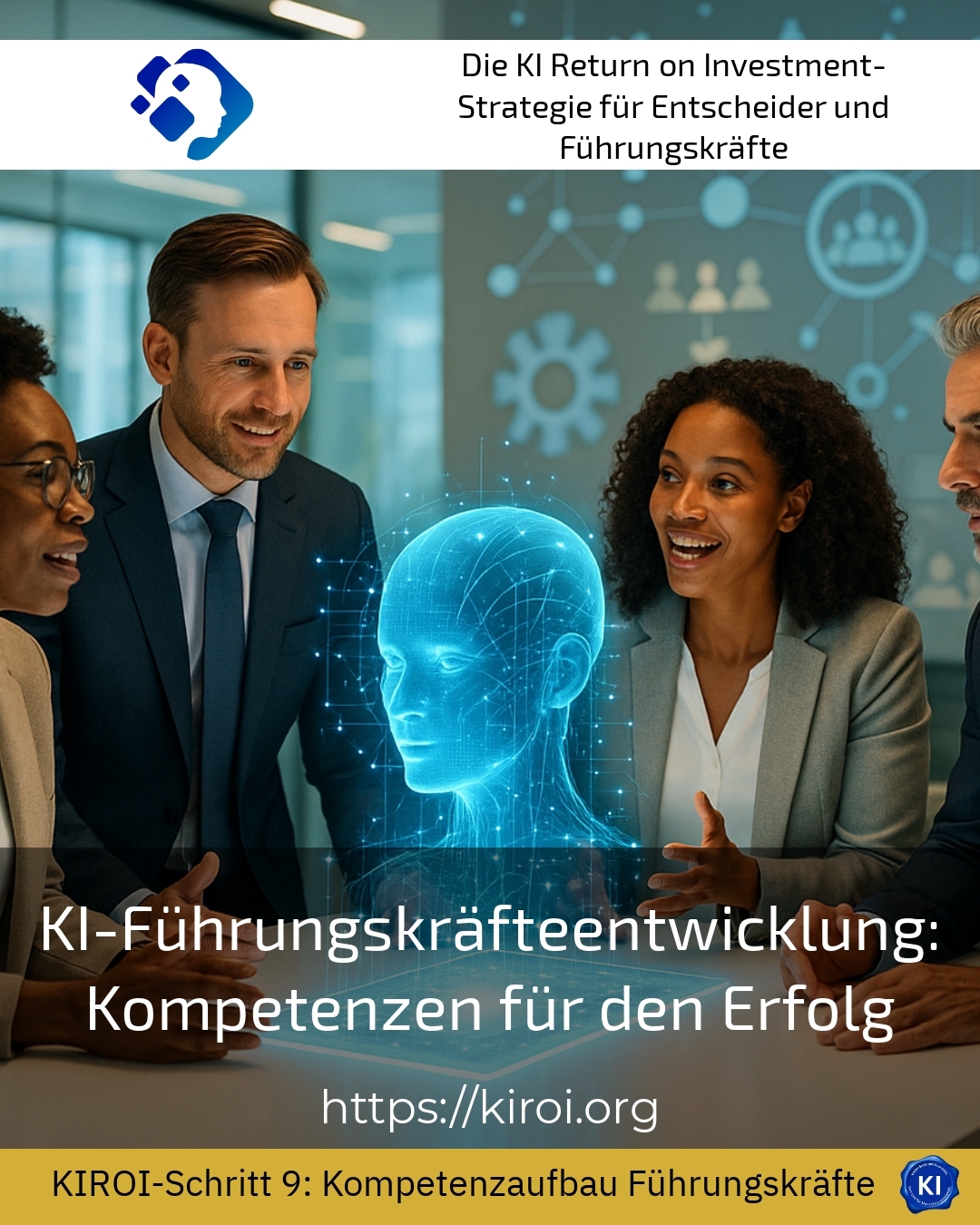
The world of work is changing rapidly. Decision-makers face entirely new challenges. Algorithms analyse data faster than humans. At the same time, the pressure on leaders is increasing significantly. Those leading teams today need different skills than they did a few years ago. AI Leadership Development: Competencies for Success This therefore moves to the forefront of strategic personnel planning. Companies are increasingly recognising the urgency of this transformation. But what specific skills do modern leaders really need? And how can organisations specifically prepare their decision-makers for this new era? This article illuminates the essential aspects and provides practical impetus for successful development.
The changed role of leaders in the digital age
Traditional leadership models are increasingly reaching their limits. The hierarchical chain of command is giving way to agile structures. Today, managers function more as coaches and facilitators. They guide their teams through complex change processes. In doing so, they must be able to understand and interpret technological developments. A production manager in the automotive sector recently reported on his experiences. He had to learn not to see automated systems as a threat. Instead, he now uses them as valuable decision support.
The ability to critically reflect on technological possibilities is becoming increasingly important. Leaders need to know when human intuition is superior to algorithmic recommendations. An example from the banking sector illustrates this impressively. A branch manager ignored the automated credit decision for a long-standing business customer. Her understanding of people and local market knowledge proved crucial. The loan was approved, and the customer flourished. Such situations require courage and sound judgment in equal measure.
This development is particularly evident in healthcare. Senior physicians today must integrate diagnostic support systems into their decision-making. At the same time, they bear full responsibility for treatment decisions. This tension between technological support and human responsibility shapes leadership in daily practice. Transruption coaching supports leaders precisely with these complex issues. It helps to meaningfully combine technology and humanity.
AI Leadership Development: Competencies for Success in the Corporate Everyday
Modern leaders require a broad range of skills. A fundamental understanding of technology forms the basis for successful collaboration with subject matter experts. Decision-makers don't need to become programmers, but they should understand how data-driven systems generally work. A sales manager in mechanical engineering illustrates this clearly. He took the time to truly understand how his new CRM system functioned. This enabled him to convincingly communicate the benefits to his team. Acceptance increased significantly, and the usage rate doubled.
Emotional intelligence is gaining importance in parallel with technological development. In uncertain times, people are looking for guidance and support. Leaders who communicate empathetically build trust and stability. This was evident in a logistics company during a comprehensive automation phase. The managing director held regular open discussion rounds with all employees. She listened actively and took their fears seriously. Although jobs changed, staff turnover remained remarkably low.
Strategic thinking in complex environments is another core competency. Leaders must consider various scenarios and remain flexible. A retail group experienced this during the introduction of automated ordering systems. The original strategy had to be adjusted multiple times. The responsible department head demonstrated adaptability and perseverance. Ultimately, his iterative approach led to the success of the entire project.
Best practice with a AIROI customer
A medium-sized manufacturing company faced enormous challenges with digital transformation. The management level felt completely overwhelmed by the speed of technological change. Many decision-makers were hesitant to engage with data-driven systems. Transruption coaching supported the entire management team intensively over a period of several months. Initially, individual assessments were carried out to identify personal strengths and areas for development. Subsequently, the managers collectively developed a vision for the technology-supported future of their company. Regular reflection sessions helped to recognise progress and address obstacles early on. Participants frequently reported increased self-confidence in dealing with new technologies. The networking between managers during the process was particularly valuable. They exchanged experiences and supported each other with difficult decisions. After the coaching concluded, the company's innovation culture had noticeably improved. New projects were initiated more quickly and implemented more successfully. Employee satisfaction measurably increased because the managers now communicated more clearly and confidently.
Communicative excellence as a key competence
The ability to convey complex issues understandably is becoming increasingly important. Leaders must be able to translate between technical experts and other stakeholders. In an insurance company, this became evident during the introduction of automated claims processing. The department head responsible developed a clear communication strategy. He explained the changes understandably to both the board of directors and the claims processors. This helped to reduce resistance early on and increase acceptance.
Transparency in communication builds trust and credibility. An example from the retail sector illustrates this impressively. A managing director communicated openly about the planned changes due to automated inventory management systems. She highlighted both opportunities and potential challenges for the team. this honesty was greatly appreciated and rewarded by the employees. Consequently, the collaboration during the implementation was significantly smoother than in comparable projects.
In the pharmaceutical industry, ethical communication aspects play a particularly important role. Leaders there must communicate decisions about algorithmic patient selection for studies. A research director developed a transparent communication approach for this. He explained the criteria and limitations of automated pre-selection to all stakeholders. This fostered understanding and acceptance among doctors and patients alike [1].
Ethical competence and responsible action
The integration of technological systems raises complex ethical questions. Leaders bear the responsibility for fair and non-discriminatory decision-making processes. This became particularly clear in a human resources services company. The automated applicant management system delivered biased results for certain applicant groups. The HR management recognised the problem and acted decisively. They had the system reviewed and adjusted before further decisions were made.
Responsibility is also demonstrated in the handling of employee data. In the financial sector, modern systems collect extensive information on work behaviour and performance. A department head at a bank set clear limits for its use. He established transparent guidelines and communicated them openly to his team. This noticeably increased employees' trust in management. Therefore, AI leadership development: Competencies for Success always includes ethical reflection skills.
In the energy sector, issues of sustainability and social responsibility play a central role. Leaders in this field must balance technological efficiency gains against potential job losses. A power plant manager, together with his team, developed a socially responsible transformation plan. No one was made redundant; instead, all employees were qualified for new tasks. This approach required courage and a clear set of values at a leadership level [2].
Willingness to learn and continuous development
The half-life of knowledge is shortening dramatically. Leaders must therefore champion and foster lifelong learning. This is particularly evident in the telecommunications industry. A technical director with over twenty years of professional experience actively embraced new learning challenges. He completed further training courses and was coached by younger team members. This openness inspired the entire team and sustainably improved the innovation culture.
A culture of constructive failure and experimental thinking are also part of this competency. An example from the media industry illustrates this clearly. An editor-in-chief introduced regular experimental rounds for new formats. Not every attempt was successful, but the learnings were systematically documented. This culture of constructive failure fostered creativity and a willingness to take risks within the team. Transruption coaching often provides impetus for establishing such learning cultures in organisations.
In the food industry, a willingness to learn is evident in a special way. Quality managers there must constantly understand new analytical methods and testing procedures. A Head of Quality established weekly knowledge sharing meetings in her department. Experts presented new developments and discussed practical applications. The team consequently developed into a truly learning organisation.
Practical approaches to developing modern leadership skills
Targeted development programmes support leaders in their transformation. These should combine theoretical knowledge with practical application. In mechanical engineering, the Action Learning format has proven effective. Leaders work on real challenges and reflect on their experiences together. A production site implemented this approach with considerable success. The participating leaders developed concrete solutions and grew significantly on a personal level.
Mentoring programmes between experienced and junior executives create valuable learning relationships. Within a technology group, this was supplemented by reverse mentoring. Junior digital experts supported experienced executives with technological understanding. At the same time, they learned from the leadership experience of their mentees. Both sides benefited enormously from this exchange on an equal footing.
External support from qualified coaches can effectively accelerate development processes. In the chemical sector, management used professional assistance for a comprehensive digitalisation initiative. The coaches supported individual development processes and moderated team reflections. Participants frequently reported surprising insights into their own thought patterns. This awareness enabled targeted behavioural changes and improved leadership performance [3].
Best practice with a AIROI customer
A service company with several hundred employees sought support in realigning its leadership culture. The previous leadership approaches no longer suited the changed market demands and technological possibilities. Transruption coaching was commissioned to support the entire middle management. Individual discussions were initially held to identify the personal development goals of each manager. Subsequently, moderated group sessions took place, during which common leadership principles were developed. The coaches paid particular attention to integrating different perspectives and backgrounds of experience. Between sessions, participants were given practical tasks for their daily leadership activities. They experimented with new behaviours and systematically reflected on their experiences. A particular focus was placed on improving communication between different departments. The managers also developed new formats for cross-departmental exchange. After several months of support, collaboration within the company had fundamentally improved. Projects were completed more quickly, and customer satisfaction increased measurably. The managers felt better prepared for future challenges and passed this confidence on to their teams.
Future-oriented AI leadership development: Shaping competencies for success
The coming years will bring further changes. Leaders should therefore prepare for continuous adaptation. This is particularly evident in the field of renewable energies. Business models and technologies are evolving there at a rapid pace. Leaders who accept change as a constant navigate this dynamic more successfully. They create adaptive structures and actively promote flexibility within their teams.
The ability to recognise patterns and to strategically anticipate future developments is becoming increasingly important. An example from the construction industry illustrates this vividly. A building contractor recognised the potential of modular construction methods and automated planning systems early on. He invested in the relevant skills and technologies before market pressure arose. His company is now better positioned than many competitors. This forward-looking attitude is increasingly distinguishing successful leaders from average ones.
Network competence and the ability to collaborate across sectors are also becoming more important. In the mobility sector, this is evident in the development of new transport concepts. Leaders from the automotive industry, technology, and the public sector must jointly develop solutions. A development director at a car manufacturer was actively involved in relevant networks. She brought valuable insights into the company and forged strategically important contacts. This networking competence will increasingly be crucial for the success of leaders.
My AIROI Analysis
The development of leadership skills for the age of intelligent systems represents a key strategic task. Organisations that take this challenge seriously will gain significant competitive advantages. The combination of a fundamental understanding of technology, emotional intelligence and the ability for ethical reflection forms the foundation of successful leadership. This is not about making leaders into technology experts. Rather, they must learn to intelligently assess and responsibly utilise technological possibilities. Examples from various industries show that successful transformation is possible. However, it requires conscious investment in the development of leaders.
The connection between learning and practical application seems particularly important to me. Leaders develop best when they can try out new approaches in their daily work. Accompanying coaching effectively supports reflection and behavioural change. Transruption coaching positions itself as a valuable companion for all kinds of transformation projects. It provides impetus without dictating ready-made solutions. It accompanies without taking away responsibility. Leaders who engage in such development processes often report profound personal changes. They gain clarity, confidence and the ability to act in complex situations. The investment in AI leadership development: competencies for success therefore pays off in multiple ways. It not only strengthens individual leadership performance but also sustainably improves the innovative capacity of entire organisations.
Further links from the text above:
[1] McKinsey – Leadership in the Age of AI
[2] Harvard Business Review – Leadership Topics
[3] World Economic Forum – Leadership Insights
For more information and if you have any questions, please contact Contact us or read more blog posts on the topic Artificial intelligence here.









 Deutsch
  English (UK)