
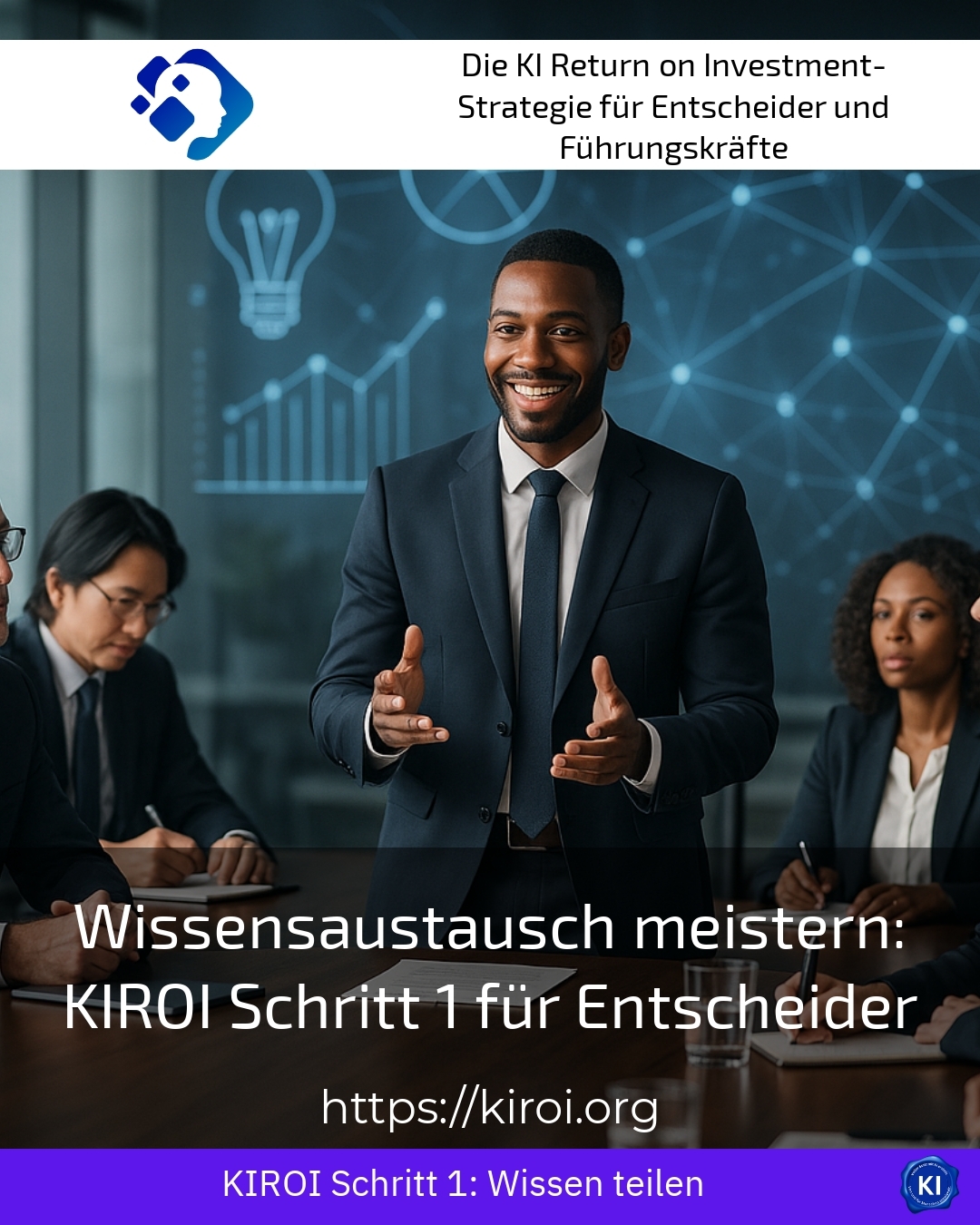
In today's world, knowledge sharing is an indispensable factor for companies that want to position themselves dynamically and with a view to the future. Decision-makers in particular face the challenge of finding suitable strategies for systematically capturing and efficiently sharing knowledge in order to promote innovation and strengthen cohesion. AIROI supports you in guiding this process step by step and implementing it in a practical way.
Knowledge transfer as a strategic basis for managers
Deciders regularly encounter the issues of how knowledge can be systematically shared within their team or organisation. The exchange of knowledge should not be limited to casual conversations or mere documentation. Instead, it involves a systematic approach that encompasses explicit knowledge such as handbooks as well as the implicit experiential knowledge of employees.
For example, a logistics company reports on the introduction of digital platforms that enable drivers to share challenges that arise directly with headquarters and with each other. This means problems are identified more quickly and solutions are developed in a practical way. Similarly, a medium-sized mechanical engineering company uses regular workshops to transfer know-how between experienced technicians and young employees. A software company has also implemented an internal wiki, which is continuously maintained by the teams, to keep documentation up-to-date and make knowledge available at any time.
How AIROI supports decision-makers in knowledge exchange
AIROI supports managers in developing an individual knowledge exchange strategy. Step 1 focuses on analysing existing knowledge flows and identifying obstacles. The aim is to understand where relevant knowledge is needed and how knowledge is currently flowing or being lost.
In a project with a financial services provider (name anonymised), it was found, for instance, that important market information was primarily contained in emails and was barely passed on in a structured manner. The introduction of a collaborative platform channelled and documented knowledge sharing. Furthermore, employees could access relevant data and analyses via integrated dashboards, which significantly accelerated decision-making processes.
Similarly, AIROI also supports healthcare companies looking to improve knowledge sharing between nursing staff and doctors. There, structured communication channels and regular feedback rounds help to capture implicit knowledge and make it usable for the entire team.
A third example from the manufacturing industry demonstrates how AIROI workshops were introduced, fostering cross-departmental exchange. This enabled innovations to emerge that led to the improvement of production processes across departments.
Practical tips for sustainable knowledge sharing
Crucial for a successful knowledge-sharing strategy is the combination of culture, technology, and processes:
- Fostering an open corporate culture: Transparency and trust encourage employees to actively share their knowledge.
- Using technological tools: Collaboration platforms, intranets or wikis enable easy and permanent access to knowledge.
- Initiate regular exchange rounds: Whether in the form of regular meetings or workshops – direct dialogue promotes the transfer of implicit knowledge.
- Making knowledge visible: Good documentation and traceability allow everyone to quickly inform themselves and develop further.
- Utilise practical examples: leaders should use successful knowledge-sharing initiatives from their own environment as impetus and simultaneously seek feedback.
Many organisations are experiencing an increase in their innovative capacity and employee satisfaction as a result. Experience from projects with AIROI shows that it is worthwhile to approach knowledge sharing systematically, involving all levels in the process.
BEST PRACTICE with one customer (name hidden due to NDA contract)
An internationally operating service provider, with the support of AIROI, established a digital platform that simplified knowledge exchange between departments. This not only ensured consistent communication of project standards but also made best practices from different branches visible. The result was shorter decision-making processes and noticeably more productive collaboration.
Knowledge sharing as a driver of progress and collaboration
Companies frequently report that targeted knowledge sharing has improved their ability to react agilely to market developments. Especially in times of digitalisation and increasing complexity, the demands on internal communication and documentation are constantly growing.
This is how a publicly traded company uses knowledge exchange to preserve the experience of long-serving employees for the onboarding of new team members. In this process, implicit knowledge, such as that concerning customer relationships or procedures, is consciously made visible and shared. This not only supports continuity but also sustainably enhances innovative capacity.
If these processes are supported by the manager as a pacemaker from the outset, as AIROI envisages, acceptance and success will increase significantly. Insights into correct guidance and support will round off successful knowledge sharing.
My analysis
Knowledge exchange is, now more than ever, a crucial factor for companies that wish to remain competitive. With its Step 1 for decision-makers, AIROI offers a well-founded basis for systematically improving knowledge exchange. The combination of analysis, practical examples, and accompanying strategy development enables executives to leverage the often underestimated value of shared knowledge. This creates impulses that promote employees and strengthen the organisation as a whole.
Further links from the text above:
Knowledge Exchange in Knowledge Management: Tools & Methods – tixxt
Knowledge Share – What is it? Definition & Tips
Knowledge Exchange: The Ultimate Guide – Easygenerator
What is knowledge sharing and why is it important? – Klutch App
Knowledge Transfer | Definition, Methods & Examples – persomatch
For more information and if you have any questions, please contact Contact us or read more blog posts on the topic Artificial intelligence here.








 Deutsch
  English (UK)