
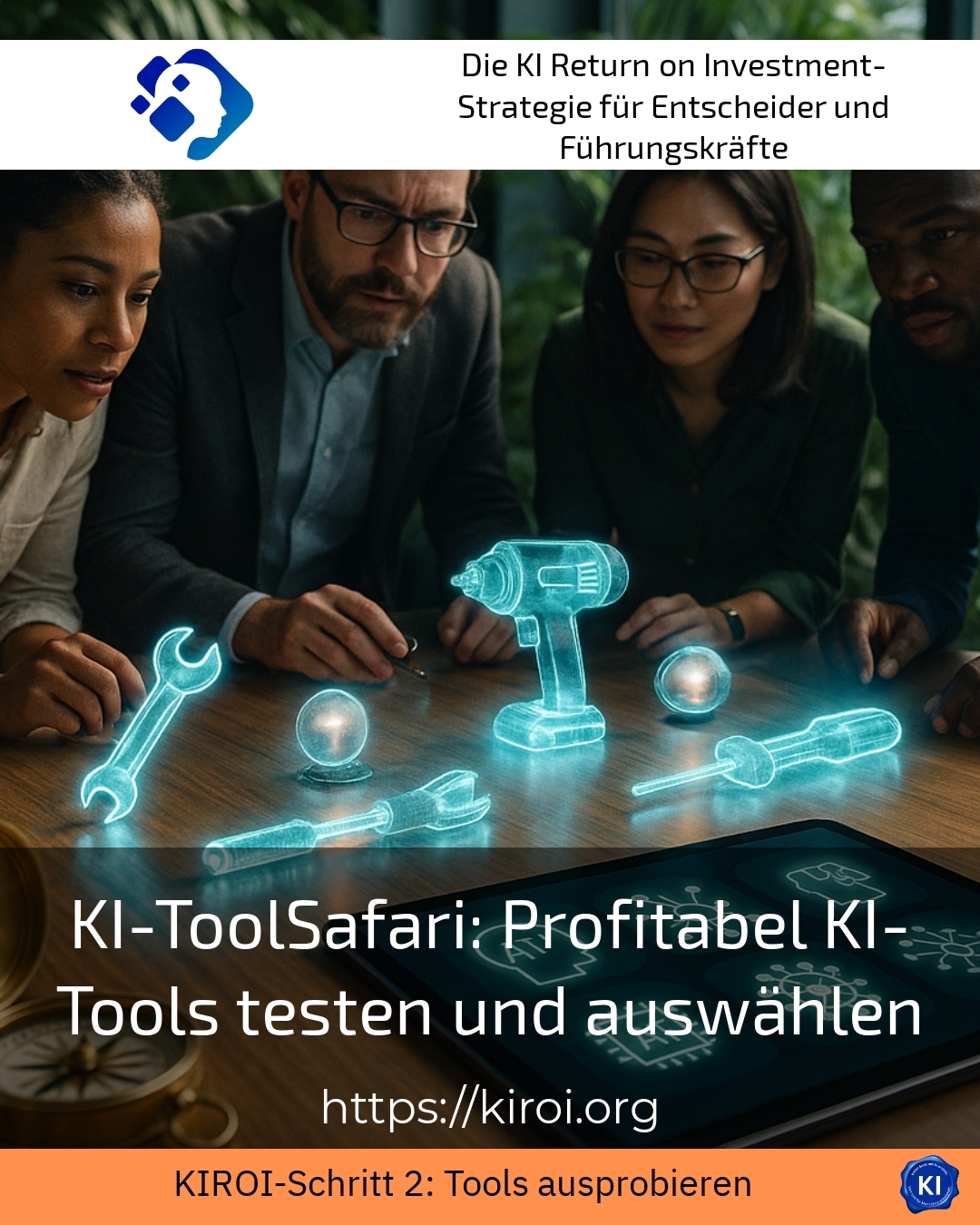
The digital transformation is fundamentally changing almost every sector of the economy. Companies are faced with an overwhelming array of intelligent tools. AI Tool Safari can help identify the right solutions systematically and profitably. But how do decision-makers navigate this jungle of possibilities? Which criteria distinguish valuable innovations from costly missteps? These questions are currently occupying executives in all industries intensely.
The structured path through the technology jungle
The systematic evaluation of digital tools requires a well-thought-out strategy. Many organisations fall into costly traps in this regard. They acquire licenses for applications that later gather dust, unused. Alternatively, they miss out on forward-thinking technologies altogether. A structured AI Tool Safari provides a remedy and orientation here.
In the manufacturing sector, for example, progressive companies rely on predictive maintenance systems. These analyse machine data in real time and reliably predict failures. One automotive supplier was able to significantly reduce its unplanned downtime through such systems [1]. The logistics sector, on the other hand, benefits from intelligent route optimisations and automated warehouse management systems. Financial service providers, in turn, use advanced algorithms for fraud detection and risk analysis.
The retail sector is also transforming rapidly through personalised recommendation systems. Large retail corporations are reporting significant increases in sales through algorithmic product suggestions. At the same time, intelligent pricing tools are continuously optimising profit margins. This diversity of possible applications highlights the need for a systematic approach.
Best practice with a AIROI customer
A medium-sized mechanical engineering company from southern Germany faced the challenge of making its production processes more efficient. Management had already contacted several suppliers and received various presentations. However, a neutral assessment of the different solution approaches was entirely lacking. As part of a supported evaluation phase, we collaboratively identified the company's actual pain points. It became apparent that production itself was not the main problem. Rather, insufficient information flows between departments were causing considerable friction. This insight fundamentally shifted the focus of technology selection. Instead of expensive production control software, the company implemented a collaborative knowledge management platform. This reduced investment costs by almost half compared to the original plan. At the same time, interdepartmental collaboration improved noticeably and sustainably.
Evaluation criteria for sustainable technology decisions
The selection of suitable digital tools is based on various dimensions. Technical capability is just one aspect among many. Factors such as integration capability into existing system landscapes are equally important. Furthermore, scalability and long-term development prospects play a crucial role.
For example, in the healthcare sector, strict data protection requirements must be met. Hospitals and practices require solutions with certified security standards [2]. The pharmaceutical industry relies on algorithms to accelerate drug research. Here, precision and scientific validation are among the decisive selection criteria. Insurance companies, in turn, prioritise processing speed in claims settlement.
A professional AI Tool Safari also takes soft factors into account systematically. User-friendliness often determines later acceptance within the company. Training costs and change management requirements significantly influence the overall costs. Many projects fail not because of the technology itself. They fail due to a lack of preparation of the affected employees.
Economic viability considerations in the AI tool safari
The profitability of technology investments requires realistic calculations. Exaggerated promises from suppliers should be critically examined. Companies often report longer implementation phases than originally assumed. The full realisation of efficiency gains often takes several years of continuous optimisation.
Energy supply companies use intelligent grid management systems for load balancing. The amortisation of such investments typically extends over several operating years. Telecommunications providers rely on automated customer service systems with varying degrees of success. Some implementations measurably improve customer satisfaction. Others lead to frustration and increased churn rates among sensitive customer groups.
The construction industry is increasingly experimenting with digital planning tools and simulations. This allows architects and engineers to recognise and correct planning errors early on [3]. Transport companies continuously optimise their fleet utilisation through algorithms. Agriculture relies on precision farming with sensor-based decision aids. All these application areas show the enormous potential of intelligent technologies.
Best practice with a AIROI customer
A trading company with several branches in German-speaking countries wanted to modernise its inventory planning. The previous forecasting methods were based on simple statistical procedures and empirical values. The company contacted various technology providers and received ambitious promises. Sales increases of twenty per cent and more were projected. In the transruption coaching, we analysed the company's actual data foundations together. It turned out that the data quality had considerable deficiencies. Without prior cleaning and structuring, any intelligent system would produce wrong decisions. We therefore recommended a two-stage approach with an upstream data management project. While this procedure extended the timescale until full implementation, it laid a solid foundation for sustainable improvements in the future. After completion of both phases, the company reported reduced overstocks and fewer out-of-stock situations. Customer satisfaction also noticeably improved due to higher product availability.
Implementation strategies and success factors
The actual introduction of new technologies requires careful planning and implementation. Pilot projects enable controlled learning in a manageable scope. Companies should initially select limited areas of application for testing. Successful pilots can subsequently be expanded to other areas of the company.
Media companies are using intelligent systems for content creation and personalisation. News portals are experimenting with automated sports reporting and financial analysis. The creative industry is employing image generators and design assistants. Marketing departments are continuously optimising their campaigns through data-driven analysis [4].
Public administration is digitising citizen services gradually and carefully. Authorities must meet special requirements for transparency and traceability in this process. Educational institutions are increasingly integrating adaptive learning systems into their curricula. HR managers are using matching algorithms for candidate pre-selection. These examples impressively illustrate the breadth of possible applications.
Risk management and ethical considerations
Every technology decision involves inherent risks and uncertainties. Data protection compliance is a fundamental requirement in European markets. Algorithms can contain and exacerbate unintended biases. Companies are responsible for fair and transparent decision-making processes.
Banks must carefully examine discrimination risks in credit decisions. Personnel selection systems require regular audits for fairness and equal opportunities. Medical diagnostic tools need extensive validation before clinical use. Case law is evolving dynamically in this area.
A responsible AI Tool Safari Integrates ethical assessments from the outset. Supplier audits and certifications provide initial guidance on trustworthiness. Contracts should clearly regulate liability issues and responsibilities. Training makes employees aware of a critical, reflective approach to technology.
Best practice with a AIROI customer
A financial services company planned to introduce an automated customer classification system. The technology was intended to prioritise customer enquiries and dynamically adapt service levels. During our joint analysis, we identified potential fairness issues in the proposed algorithm. Certain customer groups would be systematically disadvantaged by the planned criteria. The company had not considered this dimension in its internal evaluation. We collaboratively developed an extended requirements catalogue with explicit fairness metrics. The subsequent market analysis under these changed conditions led to a different selection of providers. The system ultimately implemented was also equipped with a monitoring dashboard. This allows for continuous monitoring for undesirable biases during ongoing operation. The company thus positioned itself as a responsible user of technology in its industry.
Future prospects and continuous development
The technology landscape is developing at breathtaking speed. What is considered advanced today can be outdated tomorrow. Companies therefore need flexible strategies and architectures. Modular system landscapes enable individual components to be exchanged as needed.
The automotive industry is working intensively on autonomous driving systems of various levels of advancement. Chemical producers are optimising their processes through digital twins and simulations. The textile industry uses demand forecasts for more sustainable production planning [5]. Real estate companies are relying on intelligent building management systems for energy efficiency.
Regular technology scouting activities keep companies up to date. Partnerships with research institutions provide access to the very latest developments. Innovation labs and incubators promote experimental learning in protected environments. These approaches sustainably support proactive technology design.
My AIROI Analysis
The systematic evaluation and selection of intelligent technologies is developing into a core competency for future-proof organisations. A professionally conducted evaluation combines technical expertise with strategic foresight. It considers not only functional requirements but also organisational frameworks comprehensively. Success depends significantly on the quality of preparation and support.
Our experiences repeatedly reveal certain patterns of success. Companies that clearly define their goals make better technology decisions. A realistic assessment of their own data maturity reliably prevents costly false starts. Involving affected employees from the outset significantly increases later acceptance.
At the same time, we often observe stumbling blocks in corporate projects. Overblown expectations regularly lead to disappointment and project cancellations. A lack of resources delays implementations and significantly reduces benefits. Missing governance structures cause uncontrolled growth and operational security risks.
Transruption coaching positions itself as valuable support for such transformation projects. We provide impetus for a structured approach without forcing pre-defined standard solutions. Every company brings individual circumstances and goals. This uniqueness requires tailor-made evaluation approaches and implementation strategies. Our clients report feeling more confident in their technology decisions. They feel better informed and are able to negotiate more effectively with providers.
Further links from the text above:
[1] McKinsey – Maintenance Prediction Insights
[2] BfArM – Digitalisation in Healthcare
[3] buildingSMART Germany – Digital Construction
[4] Bitkom – Artificial Intelligence in Business
[5] Fraunhofer – Research Field Artificial Intelligence
For more information and if you have any questions, please contact Contact us or read more blog posts on the topic Artificial intelligence here.









 Deutsch
  English (UK)