
Why do highly qualified executives fail precisely when they have to make the most important strategic decisions of their careers?
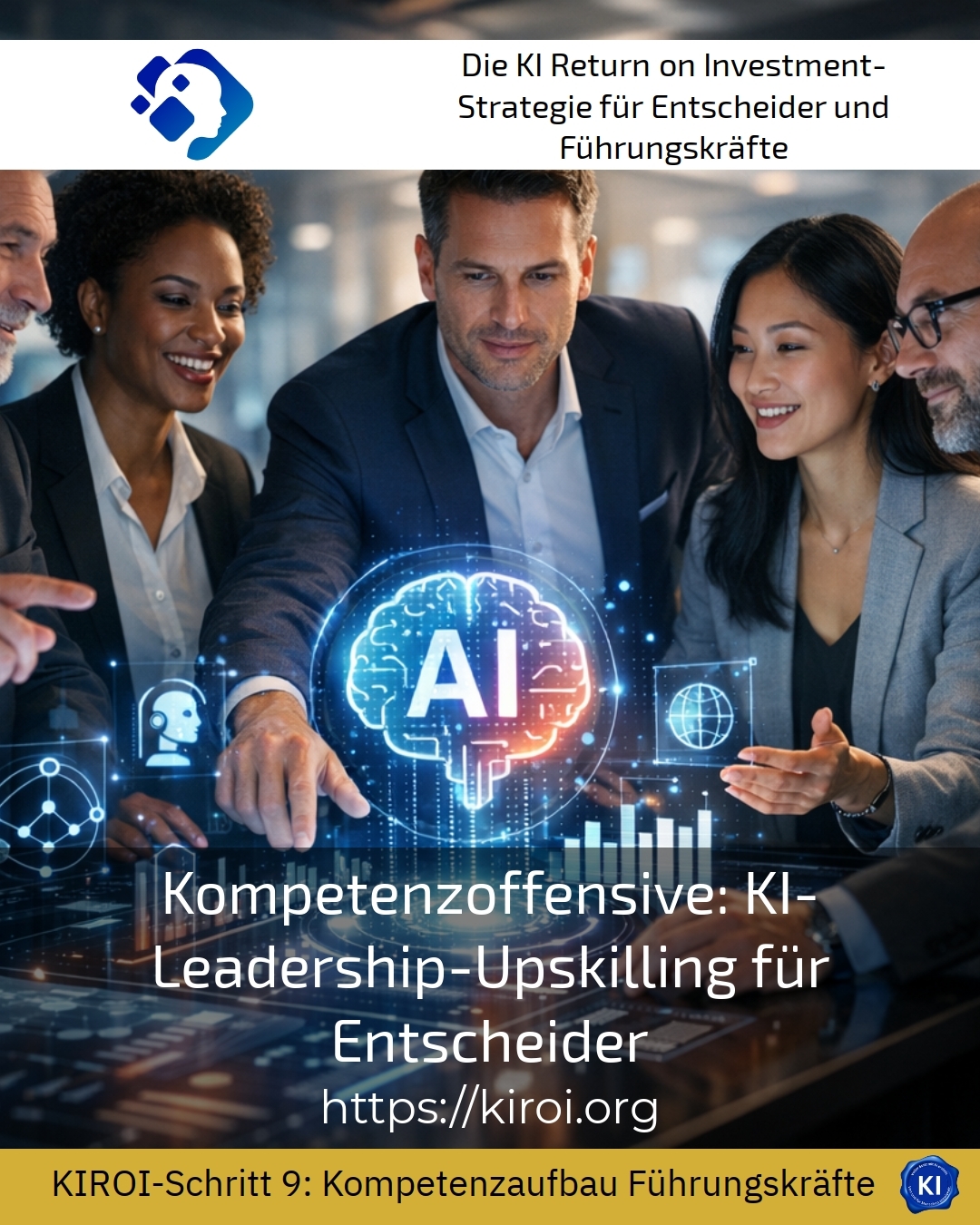
The answer to this question often lies not in a lack of experience or expertise, but in a fundamental gap that has grown dramatically in recent years. Competence offensive: AI leadership upskilling for decision-makers It describes precisely the transformation process that today determines the sustainable success of organizations. Leadership figures face the challenge of evaluating and implementing technologies whose functioning they understand only superficially. This situation creates uncertainty, delays necessary investments, and jeopardizes the long-term competitiveness of entire companies. The good news, however, is that there are targeted training formats that can fill this very specific skill gap.
Understanding the new reality in boardrooms
Decision-makers in modern organizations face unprecedented complexity. The speed of technological developments far exceeds traditional learning cycles. At the same time, boards of directors, investors, and employees expect informed statements about the digital direction. This expectation often clashes with the reality that many executives completed their education at a time when machine learning still represented a niche topic in computer science.
A manager in the manufacturing industry recently reported his uncertainty when evaluating a predictive maintenance system. He simply could not reconcile the technical promises of the provider. A human resources executive in the financial sector described similar experiences when introducing automated recruitment processes. She could not answer the question herself whether algorithms actually make more fair decisions. Such situations are increasing in all industries and company sizes.
The consequences of this knowledge gap manifest themselves on multiple levels simultaneously. Projects are either launched prematurely or delayed unnecessarily long. Budgets are spent on the wrong technologies, while truly transformative solutions are overlooked. Employees lose confidence in the future viability of their leadership. These dynamics reinforce each other and can drive organizations into a downward spiral.
Best practice with a AIROI customer
A medium-sized mechanical engineering company with approximately 800 employees faced the decision to invest significant sums in intelligent production control. The board felt completely overwhelmed by the various provider promises and was unable to make a well-informed choice. As part of a structured process, we first developed a fundamental understanding among all board members of the relevant technology concepts. Subsequently, we jointly developed evaluation criteria that took into account both technical and business aspects. The executives learned to ask critical questions and to distinguish between provider claims. At the end of the process, the company was able to select a solution that optimally suited its own requirements. The investment decision was based for the first time on genuine understanding rather than blind trust. The board particularly valued the newfound sovereignty in discussions with technology partners and supervisory boards.
Competence offensive: AI leadership upskilling as a strategic necessity
The systematic development of leadership competencies in the technology sector fundamentally differs from traditional training formats. Traditional seminars often provide isolated knowledge of facts without any connection to strategic reality. Effective leadership development requires a holistic approach that integrates theory with practical experience. Competence offensive: AI leadership upskilling for decision-makers On the other hand, technological basic understanding is combined with immediate applicability in leadership everyday life.
The requirements for modern leaders have fundamentally changed. A chief financial officer must now understand how algorithms analyze financial data and create forecasts. A marketing manager should be able to assess which personalization strategies are ethically acceptable. The production manager needs insights into the possibilities and limits of autonomous systems. These requirements require specific learning formats.
Clients often report a sense of overwhelm in the face of the information flood on the topic. They do not know which sources they can trust and which trends are actually relevant. This lack of direction leads to action blocks or impulsive decisions. Both of these reactive patterns can have significant negative consequences for organizations.
Design learning formats for different leadership levels
Designing more effective training formats requires a careful analysis of the target group and their specific challenges. Executives and managing directors need different focus areas than department heads or project managers. The top management level must, above all, be able to make strategic decisions and take responsibility for investment decisions.
An insurance industry board member described his difficulties in evaluating board reports on automated underwriting processes. He was unable to assess the risks presented and felt that he was not suited to his supervisory role. A retail manager reported similar challenges with investment proposals for recommendation systems. She did not know which questions to ask to assess the quality of the proposals.
Transruptions coaching accompanies executives through precisely such projects and challenges. The support ranges from the provision of technological fundamentals to the joint development of decision frameworks. The focus is always on practical applicability, because abstract knowledge alone does not change leadership behavior.
Best practice with a AIROI customer
The supervisory board of a regional banking group recognized that its members were increasingly relying on the board for technical advice rather than making their own assessments. This dependence was understandably troubling, because the supervisory board could no longer properly exercise its oversight function. Together, we developed a compact training program specifically for board members without a technical background. The content focused on practical issues such as assessing the risk of algorithmic bias in lending or evaluating data protection implications in customer analysis. After six moderated workshops, the participants reported a significant increase in sovereignty in supervisory board meetings. They were now able to ask critical questions and independently assess risks. All participants agreed that the quality of strategic discussions had improved significantly.
Practical implementation of the competence offensive in organizations
The successful implementation of leadership upskilling programs requires more than just booking training sessions. Organizations must first conduct an honest assessment of their existing competencies. This analysis should be conducted without assigning blame, as knowledge gaps are completely normal given the rapid developments.
A logistics company with several thousand employees conducted an anonymous survey of its executives. The results showed significant differences in technology understanding between the different levels of the hierarchy. Interestingly, many executives significantly overestimated their own knowledge. In a similar survey, a pharmaceutical company discovered that uncertainty about digital topics increased with increasing levels of leadership rather than decreasing.
After the initial assessment, the development of customized learning paths follows. These should combine different formats to accommodate different learning preferences. Compact workshops are suitable for imparting basic knowledge, while individual coaching allows for individual deepening. Peer-learning groups promote the exchange of experience between leaders with similar challenges.
Constructively overcome barriers and resistance
The introduction of upskilling programs for decision-makers regularly encounters resistance. Many executives perceive it as an admission of weakness to acknowledge the need for further training. Others see no time in their busy schedules for additional learning activities. These barriers must be taken seriously and actively addressed.
One telecommunications company solved the time problem by integrating learning modules into existing management committees. Instead of additional meetings, regular board meetings were supplemented with compact knowledge updates. A trading company used leadership meetings to hold intensive workshops on technology topics. This integration within familiar formats significantly reduced the perceived additional workload.
Stigmatization of ignorance can be broken down through role models. When executives openly discuss their own learning processes, it encourages other leaders to reflect on themselves. A CEO in the energy sector reported at a staff meeting about his initial difficulties understanding algorithms. This openness was highly appreciated by the organization.
Sustainable integration into the leadership culture
Individual training measures only have limited effect if they are not embedded in a culture of continuous learning. The Competence offensive: AI leadership upskilling for decision-makers must be understood as a continuous process rather than a one-time initiative. Technological developments are advancing, and with them, the competencies of leadership must also evolve.
Successful organizations establish regular reflection formats for their leadership teams. These create space for the exchange of information about technological developments and their strategic implications. One automotive supplier introduced monthly technology dialogues in which external experts explain current trends. An insurance group uses quarterly workshops to jointly evaluate new application areas.
The anchoring in goal agreements and development discussions underscores the importance of continuous competence development. Leaders should regularly reflect on which new skills they have acquired and which learning goals they are pursuing next. This systematization prevents the topic from being lost in day-to-day business activities.
Best practice with a AIROI customer
An international audit firm recognized the strategic importance of technology expertise for its partner model. Traditionally, the career path from audit assistant to partner had not yet been systematically considered from a technological perspective. Together, we developed a new competency framework that explicitly integrates digital leadership skills. Partners must now demonstrate that they can competently support technology projects for clients. For existing partners, a comprehensive training program with various learning paths has been designed. Participation initially took place on a voluntary basis, but the positive response led to high engagement. After one and a half years, clients reported a significantly improved quality of advice in digital transformation projects. The firm was also able to win new mandates that explicitly required technology expertise.
My AIROI Analysis
The systematic development of technology competencies among decision-makers has proven to be a critical success factor for organizational transformations. My experience from numerous accompanying projects clearly shows that technical understanding at the leadership level is no longer an optional additional qualification but has become a core competency. Executives who ignore this development not only risk their own effectiveness but also endanger the future viability of their organizations.
The good news from my practice is that upskilling processes are possible at any age and at any initial level of proficiency. Readiness to learn weighs heavier than technical knowledge. Executives who honestly acknowledge and actively address their own gaps in competence develop an amazingly rapid understanding of relevant technology concepts. This development strengthens their self-confidence and measurably improves the quality of their decisions.
It seems particularly important to me to embed individual learning processes within organizational structures. Individual competent leaders can make little difference if the surrounding culture does not value digital competence. The transformation therefore has to take place simultaneously at multiple levels: on individuals, in teams, and within the overall organization. Only then will the critical mass of technological understanding necessary for sustainable change be created. Competence offensive: AI leadership upskilling for decision-makers describes exactly this holistic approach, which not only informs leaders but actually transforms them [1].
Further links from the text above:
[1] AIROI Master Plan for Strategic Leadership Development
For more information and if you have any questions, please contact Contact us or read more blog posts on the topic Artificial intelligence here.







 Deutsch
 English (UK)