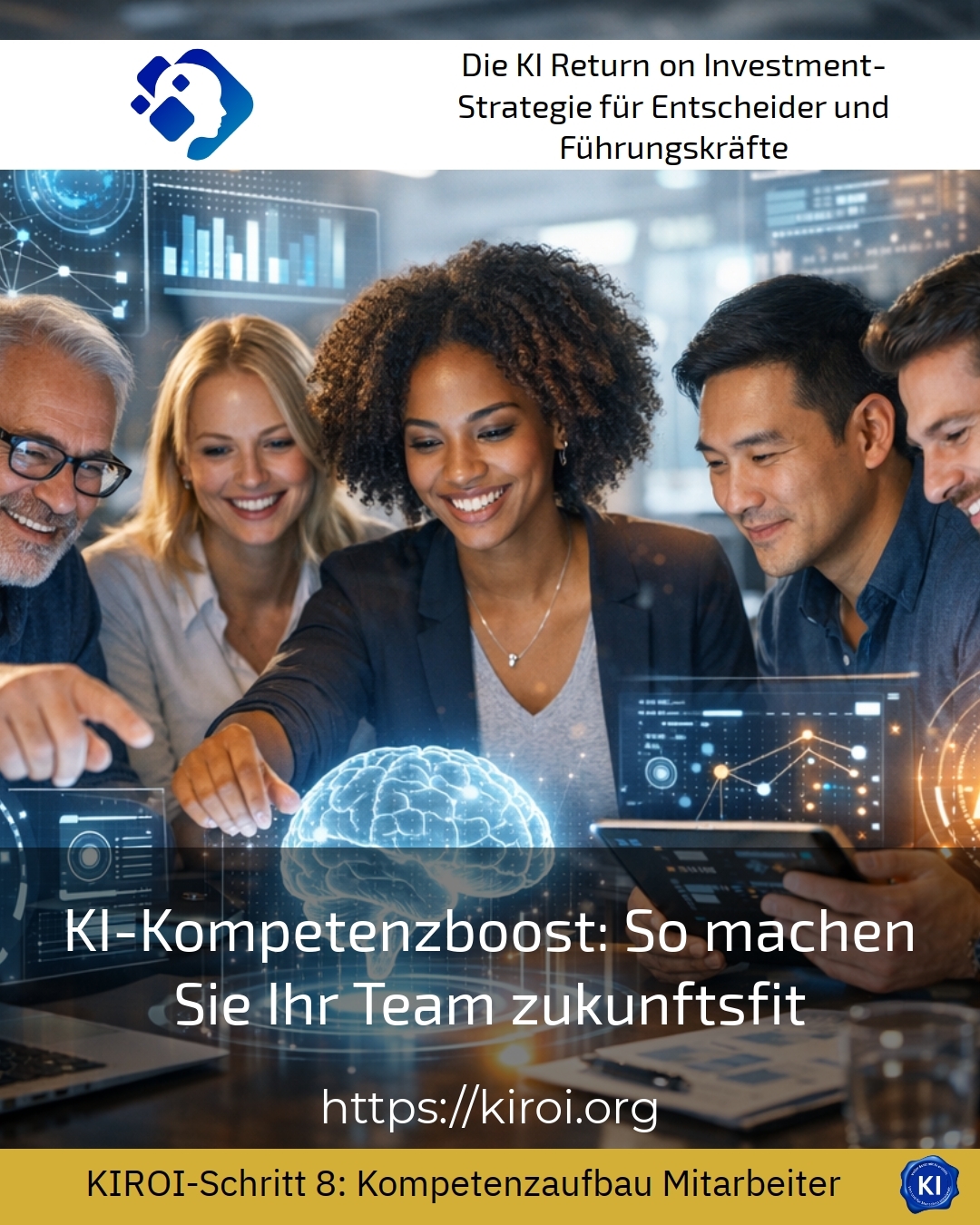
Have you ever wondered why some teams seem to effortlessly keep up with the rapid technological developments, while others, despite having identical starting conditions, lose their grip and become increasingly under pressure?
The answer often lies in a systematic approach. AI Skills Boost, The employee is not only being trained superficially, but is being prepared in a profound way for the challenges of the coming years. In a world where intelligent systems increasingly take on routine tasks and support decision-making processes, the ability to collaborate constructively with these technologies becomes the decisive competitive factor for companies of all sizes. This is no longer just about technical understanding. Rather, a comprehensive transformation of working methods is at the center, touching both strategic and operational levels and requiring fundamental changes in corporate culture.
Why the AI skills boost is becoming indispensable now
The current situation on the labor market clearly shows that organizations suffer significant disadvantages without systematically developing their teams. Studies from renowned research institutions demonstrate that companies can significantly increase their productivity with systematic competency development programs [1]. These findings are hardly surprising given how fundamentally work processes change through the use of intelligent tools.
Clients often report a certain level of overwhelm during counseling sessions due to the multitude of new possibilities. They describe situations in which teams face seemingly unsolvable questions. How do we integrate automated analysis tools meaningfully into existing workflows? Which tasks are suitable for handing over to intelligent systems? And most importantly: How do we engage skeptical employees on this journey?
Transruptions coaching accompanies companies precisely in such projects and provides impulses for sustainable change processes. The focus is not on the technology itself, but on the human being with its individual strengths and development potential. After all, it is the competence of the employees that ultimately determines whether technological investments actually generate the expected added value or end up as costly misinvestments.
Best practice with a AIROI customer
A medium-sized company in the manufacturing sector faced the challenge of systematically preparing its workforce to handle data-driven decision-making systems. The initial situation was characterized by considerable skepticism among the long-standing employees, who saw their expertise threatened by the new technologies. Together, we developed a multi-stage program that initially aimed to achieve understanding and acceptance, before concrete application scenarios were developed. The management received intensive training in moderating change processes. In parallel, we identified so-called multipliers in various departments who acted as bridge builders between technology and the workforce. After six months, a significantly more positive attitude towards the new tools emerged. The employees began to independently introduce improvement suggestions and developed creative solutions for their specific work areas. The decisive success factor was the consistent involvement of all involved from the very beginning.
Strategic dimensions of competence development
A sustainable AI Skills Boost it requires a differentiated approach to the various levels within the organization. The top management level primarily requires strategic competence to be able to realistically assess opportunities and risks. Middle management, on the other hand, must develop operational implementation skills while simultaneously acting as a mediator between strategy and execution. The professionals at the grassroots level, in turn, benefit from practical application knowledge that facilitates their specific work routine.
This multi-layered approach distinguishes successful transformation projects from superficial training initiatives that rarely have a lasting effect. Take, for example, the introduction of analysis tools for process optimization in a manufacturing company. The management must understand the strategic benefits that arise and the investments that are required. The production management needs knowledge about how to integrate the new systems into existing processes. The machine operators must learn to handle the new interfaces and interpret the generated insights.
Another example is the field of quality assurance. Here, intelligent image recognition systems can support and complement visual inspection of products. The skilled workers are not replaced, but rather relieved of their workload, allowing them to focus on more complex assessments. However, this requires them to understand the functioning of the systems and their limitations. Only then can they identify and correct errors in the automation [2].
The AI Competence Boost as a Cultural Change
Technical training alone is not enough to truly make teams future-ready. Rather, it requires a profound cultural change, establishing experimentation and continuous learning as central values. Companies that cultivate such a learning culture often show significantly higher rates of innovation and employee satisfaction than comparable organizations with more traditional structures.
In practice, this means that mistakes must be understood as learning opportunities, rather than as failures of individual employees. For example, a mechanical engineering company introduced regular retrospectives in which teams could openly discuss failed experiments with new technologies. This openness led to a significant increase in innovation readiness. Employees dared to take more risks because they no longer had to fear negative consequences.
A logistics service provider, in turn, established so-called innovation circles, where employees from different hierarchical levels collaborated on application cases for intelligent systems. The warehouse worker brought valuable perspectives with him, as did the IT specialist or the sales manager. This democratization of the innovation process not only produced better solutions but also broader acceptance of change.
Best practice with a AIROI customer
A retail company with multiple branches approached us with the problem that the implementation of an intelligent inventory management system faced significant resistance from branch managers. The long-standing executives felt their competence was in question and blocked the implementation in various ways. Our approach was to first systematically identify and take seriously the underlying fears and concerns. In moderated workshops, the branch managers themselves developed criteria for a successful implementation and defined areas where their human expertise remained indispensable. This participation fundamentally changed the dynamics. From adversaries, they became co-creators who brought valuable improvement suggestions. The technical system was thus adapted better to the actual needs. The branch managers actively assumed the role of ambassadors towards their teams. The entire implementation process was significantly shortened through the early involvement of those affected in the design of the change.
Practical implementation of the AI competence boost in various areas
The specific design of competency development programs naturally varies significantly depending on the industry and the size of the company. Nevertheless, overarching success factors that are universally applicable can be identified. These include first and foremost a realistic assessment of the existing competencies and the actual development needs. Many organizations overestimate or underestimate the skills of their teams and therefore plan beyond reality [3].
In the manufacturing sector, for example, it is often the case that experienced skilled workers already possess intuitive process knowledge that can be valuable when supplemented by data-driven analysis. The challenge lies in connecting this implicit knowledge with the insights of intelligent systems. A machine tool manufacturer developed a mentoring program to achieve this, in which young, technology-savvy employees worked with experienced specialists and learned from each other.
In the service sector, however, communication and analytical skills are often key. A auditing firm systematically trained its employees in using automated audit tools. They placed particular emphasis on ensuring that human judgment was not replaced but supported by the machine-assisted work. The auditors were able to focus on critical areas, instead of manually performing routine audits.
In healthcare, intelligent assistance systems are also gaining increasing importance. A group of clinics implemented training programs that trained medical staff in using diagnostic support systems. Critical evaluation skills were particularly important. The professionals learned when they could follow the recommendations of the systems and when additional human expertise was required.
Measurable success through systematic development
The effectiveness of competency development programs can be quantified, although some effects may not be visible until the medium term. Companies with systematic development approaches report increases in productivity and reduced error rates in automated processes. Additionally, qualified employees often experience lower turnover, because they perceive these development opportunities as valuable investments in their professional future [4].
For example, an automotive supplier documented that after introducing a comprehensive training program, the downtime on automated production lines decreased significantly. Employees were able to fix minor malfunctions independently and recognized potential problems earlier. This preventive competence proved to be more valuable than purely reactive maintenance by external specialists.
A financial services provider, in turn, found that trained teams were able to respond more quickly and precisely to customer requests because they effectively used the available analytical tools. Customer satisfaction increased measurably, and processing times were significantly reduced. These successes justified the initial investments in competency development multiple times.
Best practice with a AIROI customer
A medium-sized machine manufacturer approached us with the question of how to successfully integrate predictive maintenance systems without demotivating maintenance teams or devaluing their expertise. Together, we developed a three-stage approach that first provided an understanding of the underlying technology, then developed practical use cases, and finally involved the teams in further developing the systems. The maintenance specialists quickly realized that their experience remained indispensable to properly interpret the systems’ predictions. They became valuable input for improving the algorithms by documenting error alerts and identifying patterns that the automated systems did not detect. After one year, there was a significant improvement in plant availability while simultaneously increasing employee satisfaction. The teams no longer viewed the new tools as a threat, but as helpful support for their demanding work. This example illustrates impressively how important the early involvement of those affected is for the success of technological change projects.
My AIROI Analysis
Coaching numerous transformation projects has shown me that the success of a AI competence boosts It depends largely on the attitude of the top management. If executives and management teams understand competence development as a strategic investment and do not view it as a necessary evil, entirely different dynamics emerge in the organizations. Teams sense this attitude and react accordingly, either positively or negatively to change impulses.
What I find particularly remarkable is the realization that technical training alone rarely leads to success. The cultural dimension of transformation often proves to be the decisive factor for success. Companies that establish a learning culture and understand mistakes as opportunities for development achieve more sustainable results than those that rely solely on technical instruction. This observation is repeatedly confirmed in a wide variety of industries and company sizes.
Transruptive coaching can provide valuable impulses in such complex change processes and help organizations find their own solutions. In this context, I do not see my role as a problem solver but as a facilitator who asks questions and opens up perspectives. The competence for sustainable change ultimately lies with the teams themselves. They simply need to be awakened and encouraged.
My analysis also shows that the temporal dimension is often underestimated. Real development of competence requires time and continuity. One-time training measures quickly fail, while regular learning impulses and practical application opportunities have a lasting effect. Organizations should therefore plan realistic time horizons and not rush for quick successes that later prove to be unsustainable. The path to a future-proof organization is a marathon, not a sprint.
Further links from the text above:
[1] McKinsey Insights on People and Organisational Performance
[2] Fraunhofer Society on Artificial Intelligence
[3] World Economic Forum: The Future of Jobs Report
[4] Bitkom: Artificial Intelligence in Companies
For more information and if you have any questions, please contact Contact us or read more blog posts on the topic Artificial intelligence here.






 Deutsch
 English (UK)