kiroi.org

KIROI - Artificial Intelligence Return on Invest
The AI strategy for decision-makers and managers

Business excellence for decision-makers & managers by and with Sanjay Sauldie

KIROI - Artificial Intelligence Return on Invest: The AI strategy for decision-makers and managers

KIROI - Artificial Intelligence Return on Invest: The AI strategy for decision-makers and managers

Start » Mastering Innovation Strategy: KIROI Step 7 for Your Business
29 August 2025

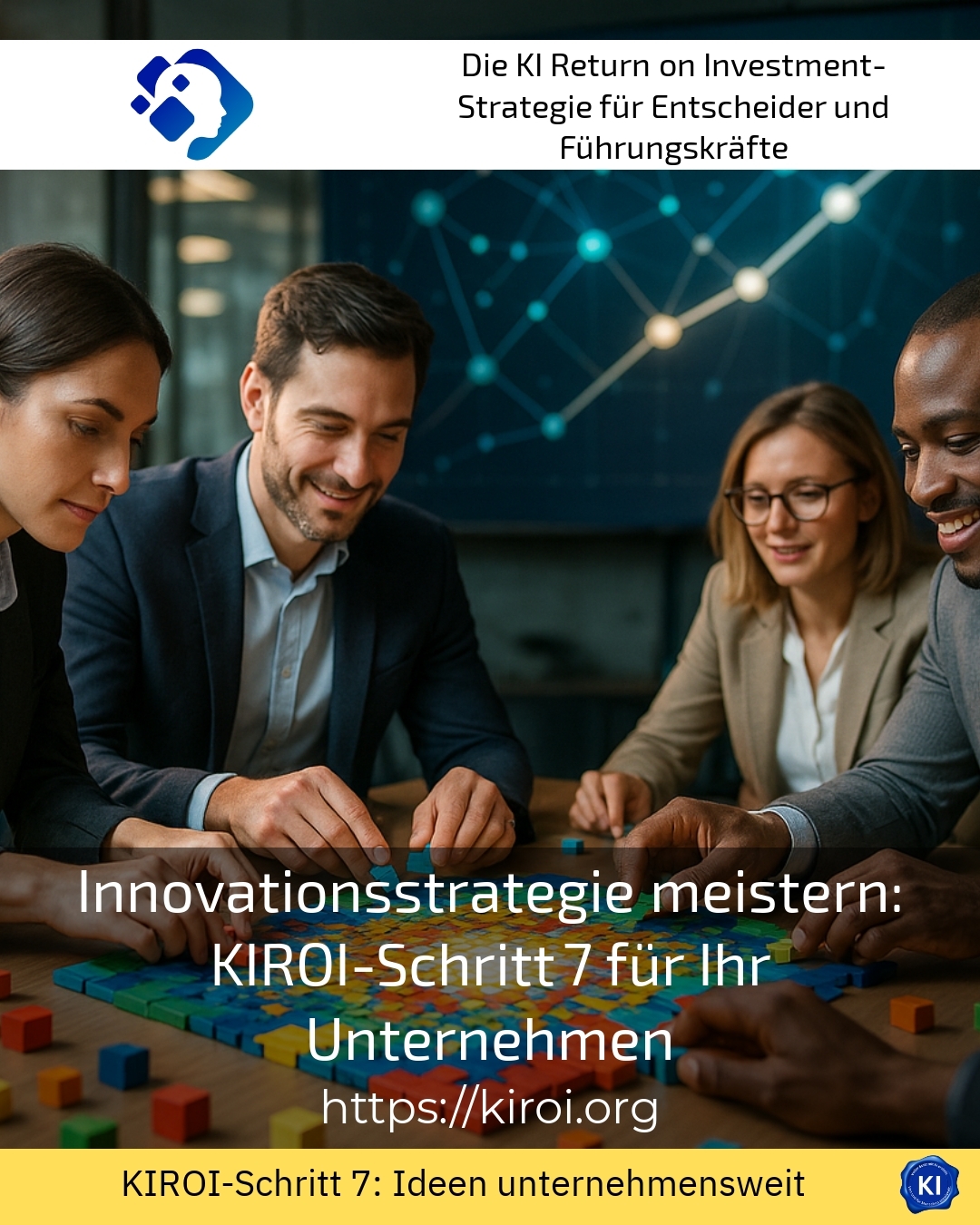
Mastering Innovation Strategy: KIROI Step 7 for Your Business

4.7
(1217)

Fostering innovation through cross-departmental collaboration

A successful innovation strategy requires that fresh impetus does not arise in isolation. Many companies report that their biggest challenge is to profitably transfer ideas and new technologies across different departments. Cross-functional approaches enable synergies to be exploited and the overall effectiveness of innovations to be increased. Sharing resources, knowledge transfer, and mutual inspiration are key aspects that often lead to sustainable improvements.

For example, a manufacturing company that has developed an automated solution for the production line can scale this technology by integrating further departments such as warehouse logistics or quality control. This not only benefits central production, but also other areas receive an efficiency boost through smart networking. The marketing department could also use data early on in this way to plan product launches more precisely. Experience shows that such networking frequently opens up new areas of activity that were not previously recognisable.

Another example can be found in financial services companies. Here, innovative algorithms for risk assessments are not only used for risk evaluation but also for customer advisory services and portfolio management. This results in holistic strategies that better meet dynamic market demands. This illustrates that the targeted further use of ideas in other departments significantly strengthens innovative power.

KIROI BEST PRACTICE at company XYZ (name changed due to NDA contract) In this example, a consumer goods company has extended new AI-based analyses, originally developed for the supply chain, to the customer service domain. The data and insights gained helped to optimise service processes and significantly increase customer satisfaction. It became clear that crossing departmental boundaries was what enabled the innovation to deliver its full added value.

The Role of Artificial Intelligence in Innovation Strategy

Artificial intelligence often acts as a catalyst for innovation today because it enables data-driven approaches that would not be feasible in traditional processes. In addition to automation, AI can help to gain new insights, recognise patterns early on, or adapt processes dynamically. However, it is also becoming clear that the hurdles in companies lie primarily in cultural change and cross-departmental collaboration.

Companies often approach us with questions about how to efficiently introduce AI into departments with limited previous connectivity, or how new solutions will be adopted by employees. An accompanying process, in which the needs of all areas are considered and coordinated, provides sustainable support here. Clients often report that precisely this moderation and a structured, yet flexible, implementation roadmap are crucial for success. This strengthens the innovation strategy's robustness and acceptance.

For example, a media company uses AI to analyse content and better understand user preferences. The acquired insights are then incorporated not only into editorial planning but also into advertising and sales strategies. This cross-departmental collaboration increases the success rate of targeting the audience and has a direct impact on economic success.

KIROI BEST PRACTICE at ABC (name changed due to NDA contract) Another use case comes from the field of mechanical engineering, where AI-powered predictive maintenance was originally intended to improve upkeep. Following its successful introduction, this technique was transferred to the development department. There, data analysis helped to optimise new product designs more effectively and to identify sources of error early on, thereby accelerating innovation cycles.

Drivers of sustainable change in organisations

Innovation strategies benefit from a holistic view of the company. Those who think across departments will find that familiar challenges in one area can be more easily solved by solutions from another. Furthermore, employee motivation increases when they are part of a larger innovation process and see tangible progress.

In practice, this means that innovation management uses teams and departments that would not normally interact much and gives them space for joint idea development. This creates new momentum, often resulting from the interplay of different perspectives. For example, the IT department can provide valuable insights that are helpful for process optimisation in production, or sales experience can assist in the design of service concepts.

KIROI BEST PRACTICE at DEF (name changed due to NDA contract) A cross-disciplinary team was formed within a service company, which regularly held cross-departmental innovation workshops. These workshops resulted in several process innovations that improved service quality while simultaneously reducing costs. The involvement of diverse specialist departments was crucial for success.

My analysis

To implement an effective innovation strategy, it is crucial to specifically manage the generation and distribution of ideas within a company. The challenge lies not only in applying individual innovations where they originate. Instead, companies should systematically examine the extent to which technologies or insights can also bring benefits to other departments. This not only promotes efficient use of resources but also increases the acceptance and impact of innovations. Accompanying support through structured coaching in the areas of artificial intelligence and innovation management can help to break down internal barriers and provide impetus for sustainable change. Clients often report an increased degree of innovation and more dynamism through such integrative approaches.

Further links from the text above:

[1] KIROL Step 7: Ideas for Other Departments – Promoting Cross-Departmental AI Use

[4] Step 7 of the KIROI Strategy: Practical Examples

[7] Introduction to Artificial Intelligence according to the requirements of the EU AI Act

For more information and if you have any questions, please contact Contact us on or read further blog posts on the topic Artificial Intelligence Blog here.
How useful was this post?

Click on a star to rate it!

Average rating 4.7 / 5. Vote count: 1217

No votes so far! Be the first to rate this post.

Spread the love

transruption.org

The digital toolbox for
the digital winners of today and tomorrow

Business excellence for decision-makers & managers by and with Sanjay Sauldie

transruption
transruption

transruption: The digital toolbox for
the digital winners of today and tomorrow

Start » Mastering Innovation Strategy: KIROI Step 7 for Your Business
29 August 2025

Mastering Innovation Strategy: KIROI Step 7 for Your Business

4.7
(1217)

Fostering innovation through cross-departmental collaboration

A successful innovation strategy requires that fresh impetus does not arise in isolation. Many companies report that their biggest challenge is to profitably transfer ideas and new technologies across different departments. Cross-functional approaches enable synergies to be exploited and the overall effectiveness of innovations to be increased. Sharing resources, knowledge transfer, and mutual inspiration are key aspects that often lead to sustainable improvements.

For example, a manufacturing company that has developed an automated solution for the production line can scale this technology by integrating further departments such as warehouse logistics or quality control. This not only benefits central production, but also other areas receive an efficiency boost through smart networking. The marketing department could also use data early on in this way to plan product launches more precisely. Experience shows that such networking frequently opens up new areas of activity that were not previously recognisable.

Another example can be found in financial services companies. Here, innovative algorithms for risk assessments are not only used for risk evaluation but also for customer advisory services and portfolio management. This results in holistic strategies that better meet dynamic market demands. This illustrates that the targeted further use of ideas in other departments significantly strengthens innovative power.

KIROI BEST PRACTICE at company XYZ (name changed due to NDA contract) In this example, a consumer goods company has extended new AI-based analyses, originally developed for the supply chain, to the customer service domain. The data and insights gained helped to optimise service processes and significantly increase customer satisfaction. It became clear that crossing departmental boundaries was what enabled the innovation to deliver its full added value.

The Role of Artificial Intelligence in Innovation Strategy

Artificial intelligence often acts as a catalyst for innovation today because it enables data-driven approaches that would not be feasible in traditional processes. In addition to automation, AI can help to gain new insights, recognise patterns early on, or adapt processes dynamically. However, it is also becoming clear that the hurdles in companies lie primarily in cultural change and cross-departmental collaboration.

Companies often approach us with questions about how to efficiently introduce AI into departments with limited previous connectivity, or how new solutions will be adopted by employees. An accompanying process, in which the needs of all areas are considered and coordinated, provides sustainable support here. Clients often report that precisely this moderation and a structured, yet flexible, implementation roadmap are crucial for success. This strengthens the innovation strategy's robustness and acceptance.

For example, a media company uses AI to analyse content and better understand user preferences. The acquired insights are then incorporated not only into editorial planning but also into advertising and sales strategies. This cross-departmental collaboration increases the success rate of targeting the audience and has a direct impact on economic success.

KIROI BEST PRACTICE at ABC (name changed due to NDA contract) Another use case comes from the field of mechanical engineering, where AI-powered predictive maintenance was originally intended to improve upkeep. Following its successful introduction, this technique was transferred to the development department. There, data analysis helped to optimise new product designs more effectively and to identify sources of error early on, thereby accelerating innovation cycles.

Drivers of sustainable change in organisations

Innovation strategies benefit from a holistic view of the company. Those who think across departments will find that familiar challenges in one area can be more easily solved by solutions from another. Furthermore, employee motivation increases when they are part of a larger innovation process and see tangible progress.

In practice, this means that innovation management uses teams and departments that would not normally interact much and gives them space for joint idea development. This creates new momentum, often resulting from the interplay of different perspectives. For example, the IT department can provide valuable insights that are helpful for process optimisation in production, or sales experience can assist in the design of service concepts.

KIROI BEST PRACTICE at DEF (name changed due to NDA contract) A cross-disciplinary team was formed within a service company, which regularly held cross-departmental innovation workshops. These workshops resulted in several process innovations that improved service quality while simultaneously reducing costs. The involvement of diverse specialist departments was crucial for success.

My analysis

To implement an effective innovation strategy, it is crucial to specifically manage the generation and distribution of ideas within a company. The challenge lies not only in applying individual innovations where they originate. Instead, companies should systematically examine the extent to which technologies or insights can also bring benefits to other departments. This not only promotes efficient use of resources but also increases the acceptance and impact of innovations. Accompanying support through structured coaching in the areas of artificial intelligence and innovation management can help to break down internal barriers and provide impetus for sustainable change. Clients often report an increased degree of innovation and more dynamism through such integrative approaches.

Further links from the text above:

[1] KIROL Step 7: Ideas for Other Departments – Promoting Cross-Departmental AI Use

[4] Step 7 of the KIROI Strategy: Practical Examples

[7] Introduction to Artificial Intelligence according to the requirements of the EU AI Act

For more information and if you have any questions, please contact Contact us on or read further blog posts on the topic Artificial Intelligence Blog here.

How useful was this post?

Click on a star to rate it!

Average rating 4.7 / 5. Vote count: 1217

No votes so far! Be the first to rate this post.

Spread the love

Other content worth reading:

Mastering Innovation Strategy: KIROI Step 7 for Your Business

written by:

Keywords:

#InnovationDurchAchtsamkeit #artificial intelligence #Wissenstransfer

Follow me on my channels:

Questions on the topic? Contact us now without obligation

Contact us

[wpforms id="331781" title="false"]

More articles worth reading

    Leave a comment