
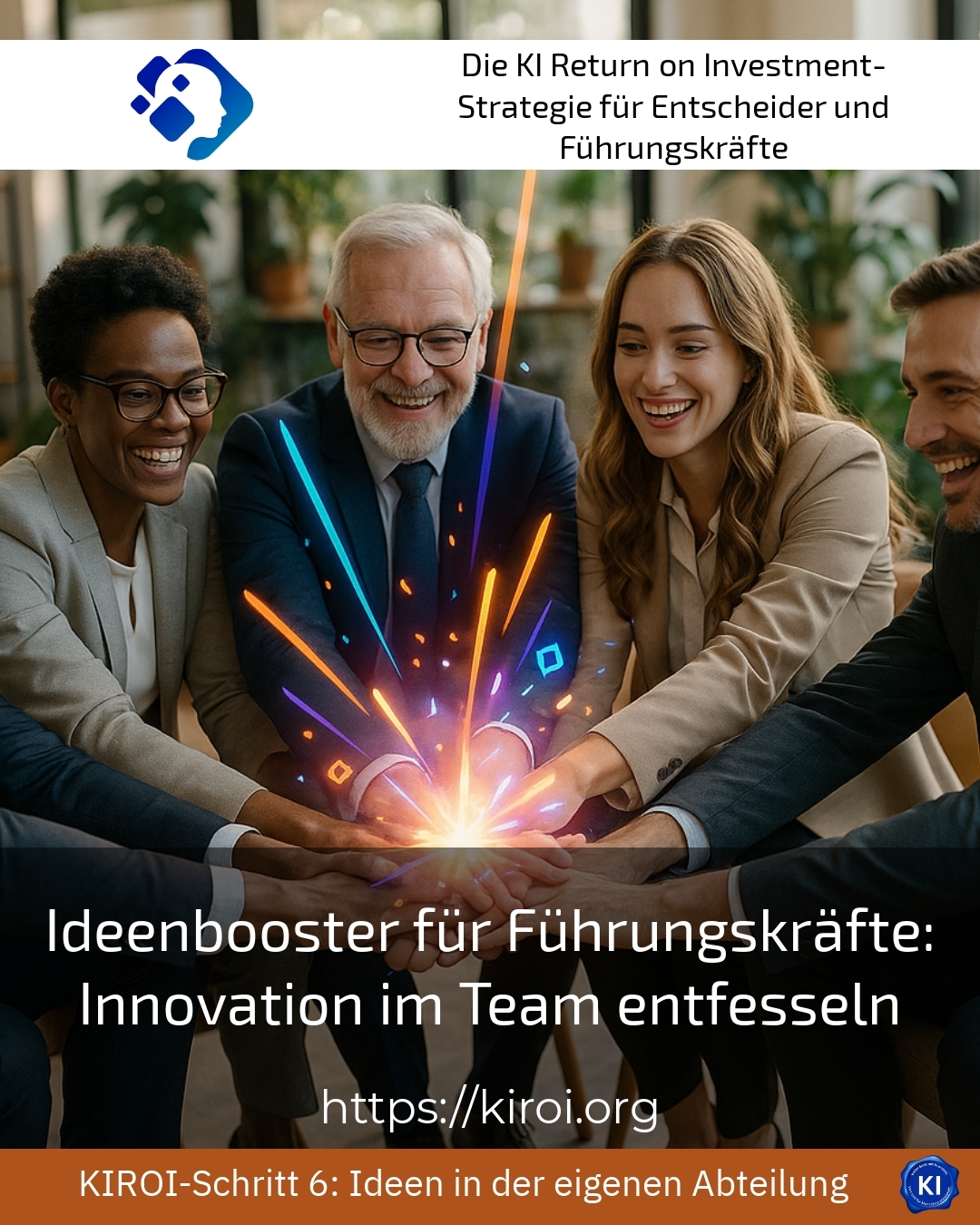
Imagine your team develops ideas that could transform your entire company. Yet these ideas remain unspoken because no one asks for them. This is precisely where the Ideas booster for leaders and fundamentally changes the rules of the game. Leaders who understand how to unlock creative potential create sustainable competitive advantages. This is not about spectacular, one-off actions. Rather, innovation arises through systematic support and well-thought-out structures. Many managers come to me with precisely this concern: they sense that their team could achieve more. But they do not know which levers to pull. transruptions coaching supports you with precisely these projects and provides valuable impetus for change.
Why traditional leadership approaches are reaching their limits
The world of work has changed radically in recent years, presenting leaders with completely new challenges. Hierarchical structures that once provided stability and direction now frequently prove to be a brake on innovation. Employees expect participation and want to be able to contribute their creativity. At the same time, the pressure to respond more quickly and agilely to market changes is increasing. In this situation, many clients report a feeling of being overwhelmed. They want to create spaces for creativity, yet they lack the time for strategic realignment.
An automotive supplier faced the challenge of developing new product lines. The engineers worked according to proven patterns and shied away from unconventional approaches. It was only when management actively established spaces for experimentation that groundbreaking concepts emerged. A pharmaceutical company had made similar experiences when developing new active ingredients. The researchers needed freedom without immediate pressure to succeed. A mechanical engineering company, in turn, revolutionised its product range through interdisciplinary teams. These examples clearly show that managers must actively shape the framework conditions.
The idea booster for managers as a strategic tool
Innovation does not happen by chance, but requires systematic support and wise guidance from experienced coaches. The Ideas booster for leaders helps you to initiate creative processes within the team [1]. This is not a rigid concept, but rather adaptive methods. These methods adapt to your specific corporate culture and industry. transruptions coaching supports leaders in the sustainable implementation of such structures.
Clients frequently report that they finally understand why previous approaches failed. A telecommunications provider had spent years unsuccessfully trying to establish innovation workshops. The workshops remained one-offs with no lasting impact on everyday work. Only the systematic integration of creativity impulses into regular work processes brought about the breakthrough. Through similar approaches, an energy supplier developed entirely new business models in the field of renewable technologies. A logistics company fundamentally optimised its supply chains through employee ideas [2].
Best practice with a AIROI customer
A medium-sized technology company in the field of industrial sensor technology approached our team with an urgent concern. The management had noticed that despite highly qualified employees, hardly any new product ideas had been generated. Internal brainstorming sessions regularly fizzled out and led to frustration for all involved. As part of the transruption coaching, we first analysed the existing communication structures and decision-making pathways within the company. It became clear that a strongly pronounced negative culture around failure was stifling creative impulses in the bud. Employees did not dare to voice unfinished ideas because they feared negative consequences. Together with the management level, we developed a multi-stage programme to transform the corporate culture. First, we established protected spaces for experimentation in which failure was explicitly permitted and even celebrated. We then trained team leaders in appreciative communication and constructive feedback for innovative proposals. After six months, the number of submitted suggestions for improvement had tripled. Two of these ideas have already resulted in concrete product developments that are now close to market launch.
Psychological Safety as a Foundation for Creative Processes
Without psychological safety, every approach to creativity remains ineffective and fizzles out without sustainable results [3]. Employees must feel that their ideas are welcome and taken seriously. This requires a fundamental change in attitude among many managers in the company. Criticism must be formulated constructively and must never feel personally hurtful.
A chemical company transformed its research department through consistent work on its blame culture. Previously, failed experiments were regarded as failures and sanctioned accordingly. Today, they are considered valuable sources of learning and are systematically documented. A financial services provider achieved similar changes in the product development area for new investment strategies. A medical technology manufacturer established regular Failure Fridays for the open exchange of setbacks.
Practical methods for the idea booster for managers
Theory alone is not enough, which is why concrete tools and methods are indispensable for success. The Ideas booster for leaders covers a range of proven techniques that deliver measurable results. These include structured creativity sessions as well as informal exchange formats between different departments.
Design Thinking has proven particularly effective in many companies and promotes user-centred innovation. A consumer goods manufacturer used it to develop completely new packaging concepts within a few weeks. A software company successfully used the method to redesign its user interfaces. A textile producer opened up entirely new fields of application for technical fabrics using Design Thinking.
The reverse brainstorming method also yields surprising results in practice [4]. Instead of asking how problems can be solved, you first ask how to make them worse. This shift in perspective frees up thinking and frequently leads to unconventional approaches to solutions.
Digital tools to support creative processes
Modern technologies can significantly accelerate and democratise creative processes if used correctly. Collaboration platforms enable asynchronous brainstorming across time zones and locations. Artificial intelligence can serve as a sparring partner for initial draft ideas and open up new perspectives.
An international electronics corporation uses digital whiteboards for distributed product development with great success. Teams in different countries work seamlessly on shared concepts without any loss of time. An insurance company employs special idea management software for continuous improvement processes. A construction company is experimenting with virtual reality for collaborative project planning with clients.
Best practice with a AIROI customer
A long-established family business in the precision mechanics sector was facing a generational handover with significant challenges. The succeeding generation wanted to open the company up to digital business models and modernise innovation processes. At the same time, the valuable experiential knowledge of long-standing employees needed to be preserved and integrated. Closely accompanied by transruptions-Coaching, we developed a tandem programme for intergenerational collaboration. Experienced specialists were paired with young talents in mixed innovation teams and worked together on future projects. This combination of traditional expertise and fresh digital skills proved exceptionally fruitful. The older employees felt valued and enthusiastically contributed their expertise. The younger team members benefited from decades of industry experience and practical know-how. Within one year, three patentable product innovations emerged from this collaboration. In addition, the working atmosphere measurably improved and staff turnover fell by more than twenty per cent. Today, the company is regarded as a role model for successful knowledge transfer between generations within the industry.
The role of the leader as an enabler of innovation
Leaders must fundamentally rethink their role if they want to unleash creative potential within the team. The traditional manager who gives instructions and monitors results is becoming obsolete. Instead, the role of enabler and mentor is gaining increasing importance in modern organisations.
An aviation company transformed its entire leadership culture towards servant leadership with impressive results. Today, managers see themselves as service providers for their teams and clear obstacles out of the way. A semiconductor manufacturer established similar principles in its development departments with great success. A food manufacturer actively promotes entrepreneurial thinking through internal venture capital for employee ideas [5].
Overcoming resistance and engaging sceptics
Not all team members will immediately welcome changes and show enthusiasm for new approaches. The Ideas booster for leaders also considers how to deal with resistance and pessimists. Sceptics often have valid objections that should be taken seriously and contain valuable insights.
A steel corporation had positive experiences with deliberately involving critical voices in innovation projects. Their critical perspective prevented unrealistic planning and significantly improved the feasibility of ideas. A transport logistics company established the role of devil’s advocate in all major decision-making bodies. A machine tool manufacturer systematically uses constructive criticism for the quality assurance of innovation proposals.
Ensuring the sustainability of innovation processes
One-off bursts of creativity quickly fizzle out without being sustainably anchored in the company's working structures. Successful innovation therefore requires systematic integration into everyday business operations and continuous cultivation. Rituals and routines help to establish creative thinking as the norm and maintain it over the long term.
A glass company made weekly innovation hours compulsory for all departments, with great success. A paper manufacturer established quarterly innovation days featuring external input and cross-industry exchange. A plastics processor rewards creative proposals with time budgets for employees to develop them further independently.
My AIROI Analysis
Mentoring numerous managers across a wide range of industries has provided me with valuable insights into successful innovation processes. Three factors consistently prove to be crucial for the sustainable success of creativity initiatives. Firstly, teams require psychological safety as an essential foundation for the open exchange of ideas and constructive collaboration. Secondly, leaders must actively transform and model their role from controller to enabler. Thirdly, innovation requires structural embedding rather than sporadic, one-off actions without lasting impact within the company.
Leaders frequently significantly underestimate the time required for cultural changes in their organisations. True transformation does not happen in weeks, but requires continuous work over months and years. transruptions coaching reliably supports you along this path with stimuli, reflection and tried-and-tested methods. The investment in a creative team culture pays off in the long term through higher employee satisfaction and competitiveness. Companies that invest in an innovation culture today sustainably secure their future viability for upcoming challenges.
Further links from the text above:
[1] Harvard Business Review – Innovation Management
[2] McKinsey – Eight Essentials of Innovation
[3] Forbes – Psychological Safety in the Workplace
[4] Interaction Design Foundation – Brainstorming Techniques
[5] MIT Sloan – How to Build a Culture of Innovation
For more information and if you have any questions, please contact Contact us or read more blog posts on the topic Artificial intelligence here.









 Deutsch
  English (UK)