
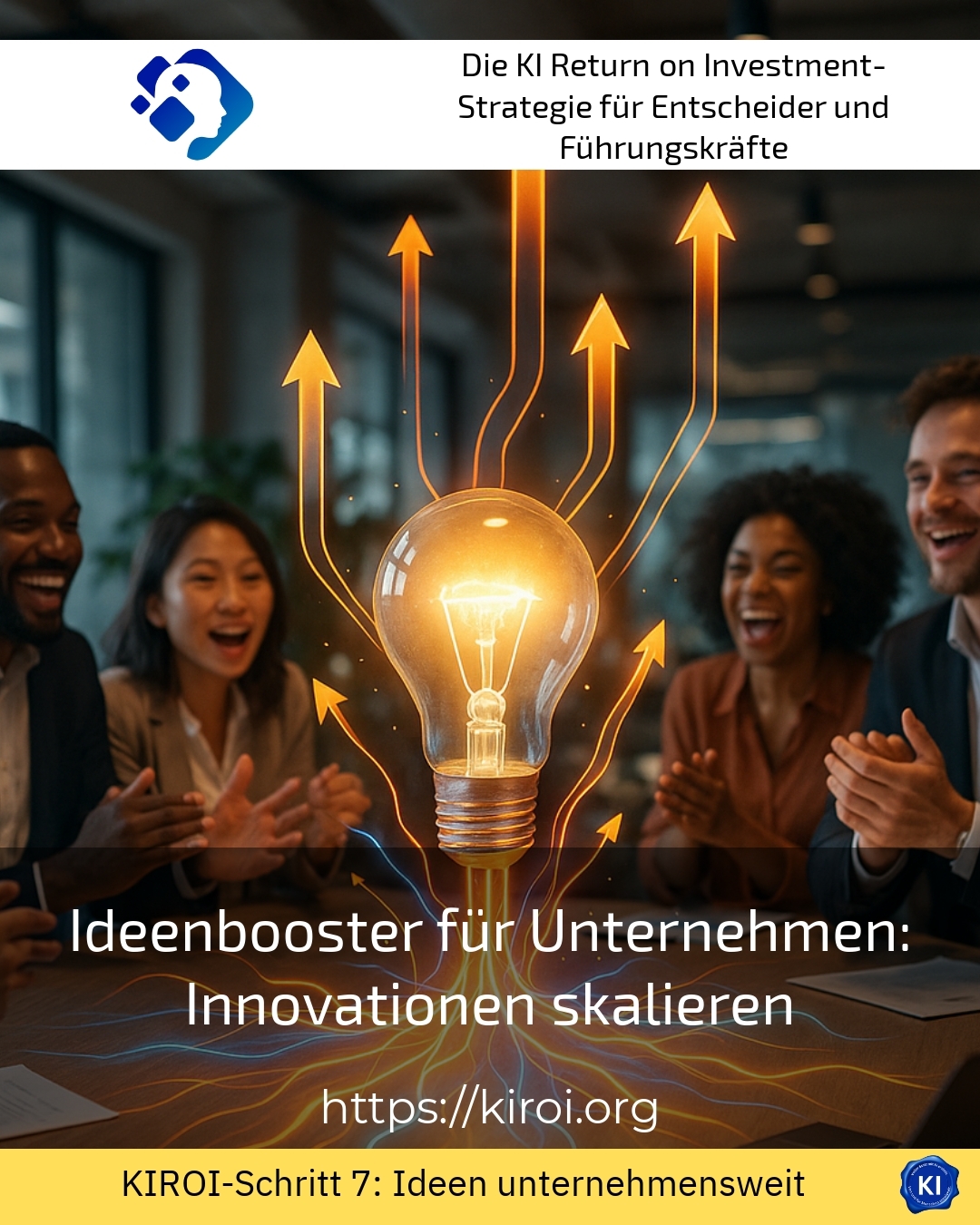
Imagine your organisation has countless creative minds, but their ideas get shelved because no one knows how to systematically develop them. This is precisely where the concept of a Business idea boosters One that not only fosters individual flashes of inspiration but also guides entire innovation streams into orderly channels. The challenge lies in not leaving creative impulses to chance, but in strategically channelling and scaling them. Because only then do viable business models emerge from isolated ideas, securing long-term competitive advantages.
Why the classic approach is no longer sufficient
Many organisations still rely on tried-and-tested methods for idea generation. Brainstorming sessions, suggestion schemes and occasional workshops are part of the standard repertoire. However, these tools quickly reach their limits. They usually only reach a small circle of employees. Furthermore, there is often a lack of systematic follow-up for promising concepts. A manufacturing company in mechanical engineering, for example, reported that over seventy percent of all submitted suggestions were never evaluated. A financial service provider found that its best ideas came from employees who never participated in official creativity sessions. A logistics company realised that decentralised teams developed excellent suggestions for improvement, but these never reached headquarters.
These examples highlight a fundamental problem. The traditional approach does not scale. It neither considers the spatial distribution of modern organisations nor the diversity of perspectives. That's why many are looking for new ways to fully unlock the creative potential of their workforce. Business idea booster can support in closing these gaps and systematically driving innovation.
The role of digital tools in boosting business ideas
Digital platforms open up entirely new possibilities for collecting and evaluating ideas. They enable suggestions to be captured, categorised, and further developed in real time. For example, a medium-sized automotive supplier implemented a cloud-based solution that allows all employees to submit ideas. These are automatically assigned to the responsible specialist departments. A retail company uses artificial intelligence to evaluate incoming suggestions for relevance and feasibility. A pharmaceutical group relies on gamified elements to increase the participation of its researchers.
These technological solutions offer numerous advantages. They create transparency regarding the status of each submitted idea. They enable fair evaluation by multiple instances. They document the entire development process seamlessly. However, they do not replace the human factor. Technology can support and accompany, but it cannot replace the strategic foresight that is required for true breakthroughs.
Best practice with a AIROI customer
An internationally operating technology company faced the challenge of better leveraging the innovative strength of its globally distributed development teams. The previous structures resulted in many valuable ideas being lost because they never reached the decision-makers. As part of transruption coaching, we supported the company in redesigning its innovation processes. Together, we developed a multi-stage architecture that links local idea workshops with global evaluation committees. Employees received clear criteria by which they could classify their suggestions themselves. Regional innovation officers acted as bridge-builders between the teams and company management. After implementation, those responsible reported a significant increase in submitted concepts. It was particularly pleasing that employees from departments that had never participated before also became active. The quality of the submissions improved measurably because employees now understood what information was required for a well-founded evaluation. The company was able to identify several promising projects that would never have become visible without this new structure.
Cultural prerequisites for successful innovation programmes
Technology and processes alone are not enough. Company culture plays a crucial role in the success of any innovation project. Employees must feel safe to voice even unconventional ideas. They need the assurance that their contributions are valued. An insurance company conducted regular error tolerance workshops to foster this openness [1]. An energy provider established a mentoring programme where experienced leaders support young talent in developing their concepts. A telecommunications provider set up dedicated time slots where employees are allowed to work on their own projects.
These cultural measures create the fertile ground on which creative impulses can flourish. They signal to the workforce that inventiveness is not only tolerated but actively desired. Leaders play a key role in this. They must embody what they expect from their teams. Only then can an authentic culture of innovation emerge.
From idea to implementation: scaling as a central challenge
The biggest hurdle often doesn't lie in the idea generation itself. Many organisations have a rich pool of suggestions for improvement and innovation concepts. The real difficulty lies in systematically developing and scaling promising approaches. A consumer goods manufacturer had over two hundred documented product ideas, yet only three of them reached market maturity [2]. A software company realised that its developers created excellent prototypes, but these were never integrated into the product portfolio. A construction company collected suggestions for process optimisation for years without them ever being systematically evaluated.
These examples show that the Business idea booster must not end with mere collection. It must map the entire lifecycle of an innovation. This includes evaluation, prioritisation, resource allocation and implementation. Only when all these phases are systematically designed can good ideas truly turn into successful products or services.
Evaluation criteria and prioritisation methods
Structured assessment requires clear criteria. These should encompass both quantitative and qualitative aspects. Strategic fit, market potential, technical feasibility, and resource requirements are among the most important dimensions. A chemical company developed an assessment matrix that assigns a specific weight to each criterion [3]. A medical device manufacturer established a two-stage process, in which expert professionals judge first, followed by a strategy committee. A retail group regularly involves customers in the assessment of new service concepts.
These methods help to objectify subjective assessments. They create transparency and acceptance. Employees gain a better understanding of why certain suggestions are pursued and others are not. This strengthens trust in the entire process.
Best practice with a AIROI customer
A family-run industrial company wanted to fundamentally modernise its innovation process without endangering the established company culture. Management recognised that much of the valuable experience from long-serving employees was not being systematically utilised. During transruption coaching, we jointly developed a multi-stage approach that combines traditional knowledge of experience with modern methods. First, we conducted structured interviews with experienced specialists to document implicit knowledge. Subsequently, we organised intergenerational workshops where younger employees contributed their technological expertise. The combination of both perspectives proved to be extremely fruitful. Innovative ideas emerged that neither group could have developed alone. Management reported that this process not only delivered concrete results but also strengthened cohesion within the company. Older employees felt valued, while younger colleagues benefited from their wealth of experience. The company now plans to establish this approach in all departments.
The Business idea booster as a strategic instrument
Innovation must not be an end in itself. It must always be aligned with the overarching corporate strategy. An effective idea booster links creative impulses with strategic goals. It ensures that resources are deployed where they create the greatest benefit. An aviation company consistently aligned its innovation activities with its sustainability goals. A furniture manufacturer focused on ideas that contribute to its intended internationalisation. A food producer prioritised concepts that strengthen its positioning in the premium segment.
This strategic direction gives the entire innovation programme a clear focus. Employees know which types of suggestions are particularly welcome. The evaluation committees have a binding framework for their decisions. Management can measure the contribution of innovation management to strategy implementation.
Measurement and continuous improvement
What isn't measured, can't be improved. This wisdom also applies to innovation programmes. Successful organisations define key performance indicators (KPIs) with which they assess the effectiveness of their measures. The number of ideas submitted, the participation rate, the lead time from submission to implementation, and the economic success of concepts that are put into practice are among the common metrics. A mail-order company analyses quarterly which departments the most successful suggestions originate from [4]. A tool manufacturer compares the innovation performance of different sites. A service company regularly surveys its employees on their satisfaction with the innovation process.
These measurements provide valuable insights. They show where the programme is working well and where improvements are needed. They enable a continuous learning process, which constantly develops innovation management as a whole.
My AIROI Analysis
The systematic promotion and scaling of creative impulses represents one of the central challenges for modern organisations. My experience from numerous support projects shows that success depends on several factors that must interlock. Firstly, organisations need a clear vision of the role creativity should play in their strategy. Without this clarity, all operational measures remain ineffective. Secondly, the technological and organisational prerequisites must be created to collect, evaluate and implement ideas. This requires investment in digital tools, but also in the training of employees and managers. Perhaps the most important factor, however, is the corporate culture. It determines whether employees actually contribute their creative thoughts or prefer to keep them to themselves. A culture of openness, trust and constructive tolerance of errors cannot be established overnight. It requires continuous work and consistent role modelling by the leadership level.
Through transruptions coaching, I help organisations to view these different dimensions holistically and bring them into alignment. Clients often report that this structured approach has enabled them to unlock the full potential of their workforce for the first time. The examples described here show that very different industries can benefit from a systematic approach. The key is for each organisation to find its own path that suits its specific situation and culture. Standard solutions rarely work. Instead, individual concepts are needed, developed together with the stakeholders.
Further links from the text above:
[1] Harvard Business Review – Innovation Management
[2] McKinsey – The Eight Essentials of Innovation
[3] BCG – Most Innovative Companies
[4] MIT Sloan Management Review – Innovation
For more information and if you have any questions, please contact Contact us or read more blog posts on the topic Artificial intelligence here.








 Deutsch
  English (UK)