
Staff competence development as the key to sustainable company success
At the heart of successful leadership lies targeted employee competency development. It is not an end in itself, but contributes significantly to performance, innovation, and team satisfaction. Increasingly, leaders report seeking support during change processes, technology introductions, or the digitalisation of company communication. This is where transruption coaching comes in, supporting companies with projects related to employee competency development – always with a focus on individual needs and strategic goals.
The following highlights the so-called KIROI Step 8, which is specifically aimed at leaders, and shows how active skills development can be purposefully designed. Experiences, methods, and good practices from various sectors, such as industry, IT, healthcare, and services, are incorporated.
Employee Competency Development: From Analysis to Implementation
The starting point for employee competence development begins with a clear analysis. What competencies are currently in place? What will be needed in the future? Leaders in particular benefit when they don't just observe their employees, but use targeted surveys, workshops, or 360° feedback to identify potential [9].
Industry example: An engineering company carried out a skills analysis with its production team. This evaluated not only technical abilities but also process understanding and communication skills. The result was the introduction of interdisciplinary training sessions that not only impart knowledge but also promote collaboration.
Example from IT: A software company has introduced a competence profile for its developers. In addition to technical skills, enthusiasm for innovation, willingness to learn, and resilience in dealing with errors have been identified as important factors. Regular reflection sessions and peer feedback contribute to competence development here.
Example from the services sector: A marketing agency uses a digital tool to visualise progress on training and micro-learning units. This allows managers to see at a glance where targeted interventions can be made.
Employee competence development in practice
Employee skills development is best achieved when understood as an ongoing process. This requires appropriate methods, such as on-the-job training, mentoring, coaching, or innovative learning formats like blended learning [5]. It is crucial that learning objectives are agreed upon with employees and regularly reviewed – this fosters a culture of continuous development, supported by mutual assistance and the exchange of experience [1].
Example from logistics: A freight forwarding company has introduced a job rotation programme. Employees switch to other departments for a few weeks to gain new perspectives and share knowledge. This not only strengthens expertise but also promotes team dynamics.
Example from the healthcare sector: A hospital has institutionalised interdisciplinary case conferences. Here, nurses, doctors and therapists exchange their knowledge, collectively reflect on challenges and develop practical solutions. Such formats support continuous professional development in daily work.
Example from education: A university has set up a peer-learning programme for lecturers. In small groups, they give each other feedback on their teaching sessions and jointly develop new teaching methods.
Impulses for Leaders: The KIROI Step 8
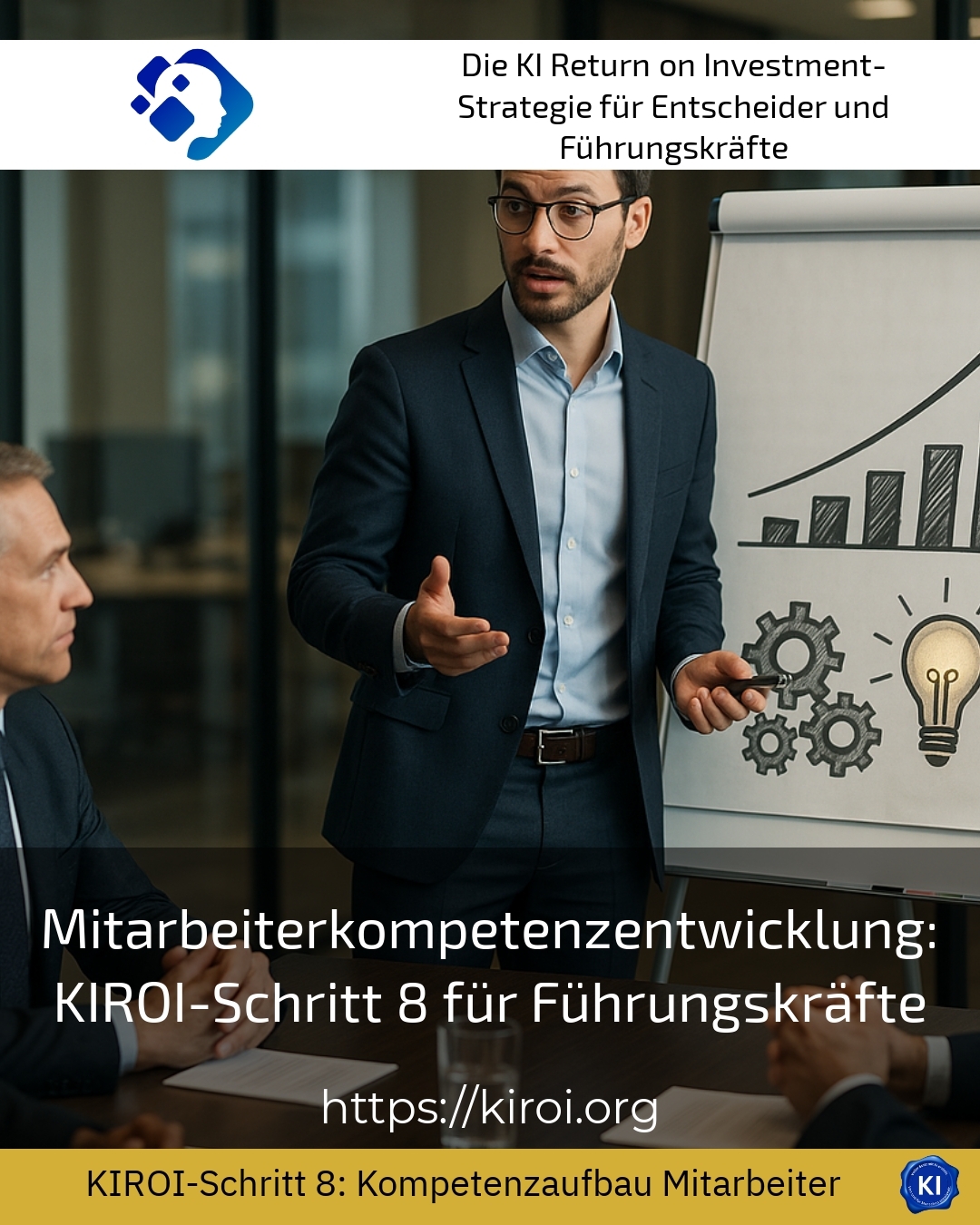
Step 8 of KIROI is explicitly aimed at leaders who want to sustainably strengthen their teams. The core of this step is actively supporting competence development – from defining goals and selecting appropriate measures to evaluating successes. Leaders act as catalysts and learning companions, ensuring transparency and creating space for development.
Example from the manufacturing industry: A senior manager in the automotive sector has established regular reflection meetings with their team. Together, successes are celebrated, learning objectives are reviewed, and new challenges are identified. This fosters an open feedback culture that promotes motivation and engagement.
Example from the IT industry: A department head uses agile methods to manage skills development. In retrospectives, not only project results, but also learning progress are discussed. New technologies are tested collaboratively, and mistakes are understood as opportunities for learning.
Example from retail: A branch manager specifically promotes the self-responsibility of her employees. She delegates tasks, supports processes, and regularly provides constructive feedback. This develops the team's skills and increases the employees' identification with their workplace.
Example from the public sector: An authority uses a combination of in-person training and e-learning. This allows employees to learn flexibly and apply their knowledge directly in their daily work. Managers actively support this by scheduling learning time and making successes visible.
BEST PRACTICE with one customer (name hidden due to NDA contract) A medium-sized company in the renewable energy sector faced the challenge of preparing its teams for new digital processes. Together with transruptions-coaching, a tailored skills development programme was designed to meet the needs of all hierarchy levels. First, key future skills were identified in workshops, followed by targeted training sessions, digital learning formats, and team coaching. The establishment of internal mentoring, where experienced employees shared their knowledge with new colleagues, proved particularly valuable. Managers received specific training to support skills development in their daily work and to act as role models. After twelve months, the company reported significantly increased innovative strength, higher employee satisfaction, and improved inter-departmental collaboration.
My analysis
Employee skills development is not a flash in the pan, but a long-term success factor for companies. Those who proactively support their teams not only strengthen individual performance, but also the innovative strength and resilience of the entire company. KIROI Step 8 impressively demonstrates how leaders can actively shape and guide this process – always with an eye on employee needs and the strategic goals of the organisation.
Employee skills development is most successful when understood as a shared responsibility. Leaders, HR professionals, and teams work hand in hand, employ suitable methods, and foster a culture of lifelong learning. This creates strong teams that actively shape change and ensure sustainable company success.
For more information and if you have any questions, please contact Contact us or read more blog posts on the topic Artificial intelligence here.
Further links from the text above:
Career Bible: Competence Development – Definition and Methods
Personalberatung.de: Competence Development – Significance and Methods
AG5: Skills Development in Practice











 Deutsch
  English (UK)