
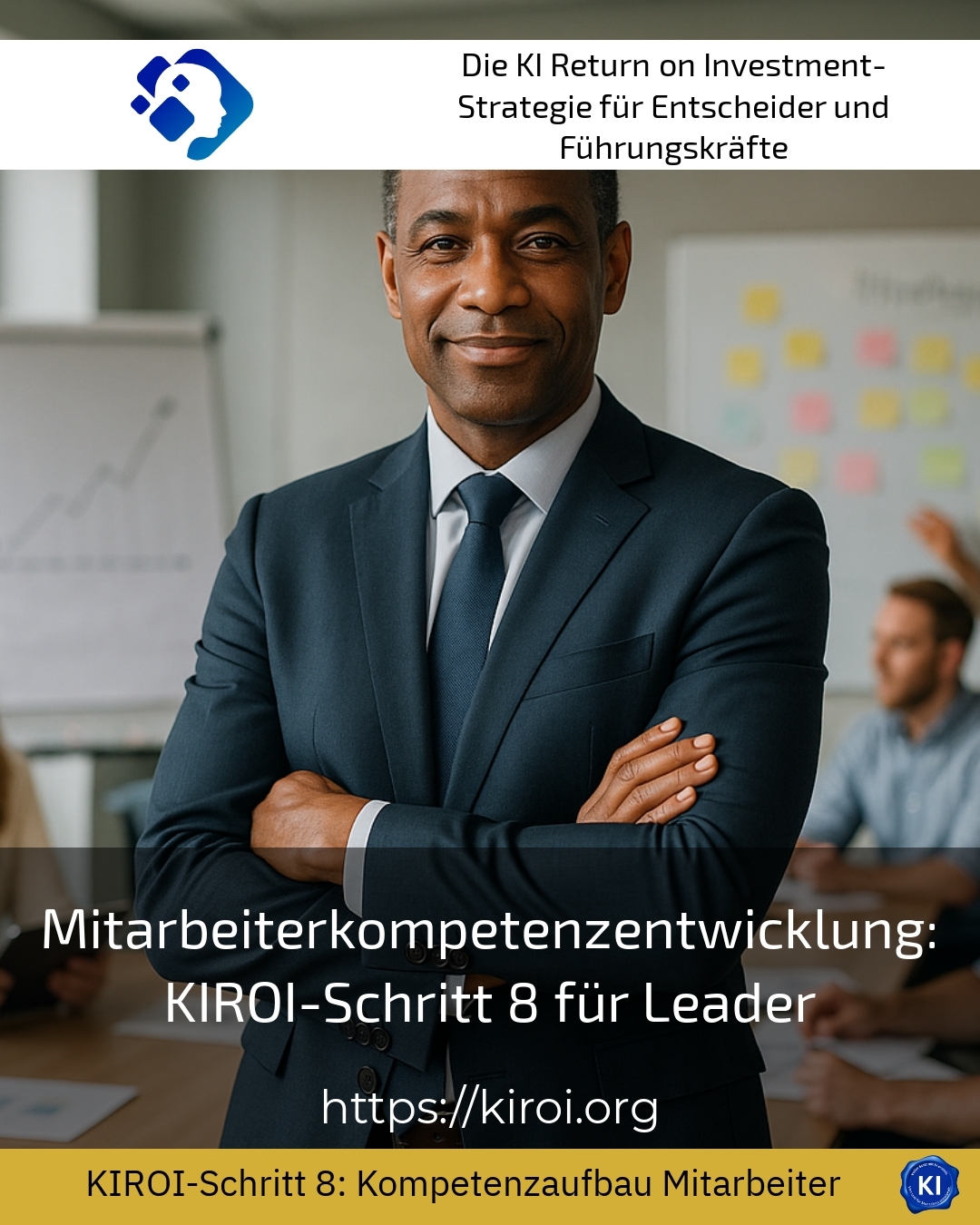
Employee competence development is a central building block for the sustainable success of leaders. The eighth step of the AIROI model for leaders focuses on the targeted support of development processes. This step supports leaders in guiding employees on their individual competence journey, thereby increasing performance and satisfaction within the team.
Employee Competency Development: A Strategic Approach for Leaders
Employee competency development requires managers to be able to identify potential and initiate suitable development measures. In addition to traditional training, these include modern methods such as coaching or project-based learning. This allows competencies to be not only taught theoretically, but above all, developed in a practical way.
For example, manufacturing companies use job rotation to employ staff from diverse backgrounds and build versatile skills. In the IT sector, many firms rely on e-learning combined with practical coding projects to efficiently develop complex skills. In the service industry, regular feedback sessions and coaching enable targeted skills development.
The role of leaders in AIROI Step 8
In the eighth step, leaders act as active mentors and facilitators. Their role is to encourage employees to engage in self-reflection and collaboratively define individual learning goals. It is helpful to regularly evaluate development steps and make successes visible. This fosters a culture of continuous learning and motivation.
A practical example is a medium-sized metalworking company: the team leader introduced regular one-to-one meetings to identify personal strengths and development areas. This allowed for targeted training to be initiated, which strengthened not only technical but also social skills.
A further example is a financial service provider that systematically coached its managers. The leaders received tools to support their teams in a tailored way and to better recognise development potential. This led to a noticeable improvement in employee satisfaction and team dynamics.
In the manufacturing sector, a company reported on how project work was used as part of employee competency development. Employees from different specialist areas took on responsibility for cross-departmental projects, expanding their methodological and social skills.
Methods and tools for supporting competence development
As part of the eighth AIROI step, the use of different methods is recommended. These include on-the-job training, which enables direct transfer of knowledge into practice. Coaching and mentoring, which promote personal development through individual support, are equally important.
Practical examples from the IT sector illustrate how agile coaching formats contribute to increasing self-organisation and problem-solving skills. In retail, mastermind groups are often used, where employees share their knowledge and motivate each other to develop new skills.
Digital learning platforms also play an important role. A well-known logistics company used a combined blended learning strategy, which connects face-to-face seminars with e-learning modules. This enabled the development of both technical and methodological skills independently of time and place.
BEST PRACTICE with one customer (name hidden due to NDA contract)
A bespoke employee development programme was implemented at an international technology company. Managers were trained to identify and specifically nurture the individual potential within their teams. Regular workshops and feedback sessions accompanied the process. The flexible combination of coaching, project work, and digital learning enabled employees to continuously develop their skills and apply them in practical ways.
Practical tips for employee competence development
For leaders, it makes sense to create clear structures for employee skills development and to encourage regular exchange. A first step can be the analysis of individual needs through discussions or questionnaires. Based on this, measures can be planned that strengthen both technical knowledge and social and methodological skills.
It is important not to rely solely on formal training, but to consciously create learning opportunities in everyday work, such as taking on new responsibilities or collaborating in cross-functional teams. This makes development processes authentic and practical, which motivates employees more.
Furthermore, it is worthwhile to establish a feedback culture. Regular, constructive feedback helps to make progress visible and to define new areas for learning. This way, employee competence development is perceived as a continuous process that also allows for changes and adjustments.
My analysis
Employee competence development is a multifaceted process that is effectively supported by chapter eight of the AIROI Model for Leaders. Through targeted guidance and methodological diversity, leaders can provide impetus that fosters individual employee development. Practical learning formats and an open feedback culture play a crucial role in this.
The combination of formal and informal learning processes helps to sustainably and purposefully build competencies. This strengthens not only professional skills but also social and methodological competencies, which are important for complex work life. Overall, employee competency development creates valuable conditions for making teams future-proof and motivated.
Further links from the text above:
Competence development: definition + successful examples [1]
11 Staff Development Methods & Benefits [2]
What is competency development? – teamazing Lexicon [3]
For more information and if you have any questions, please contact Contact us or read more blog posts on the topic Artificial intelligence here.








 Deutsch
  English (UK)