
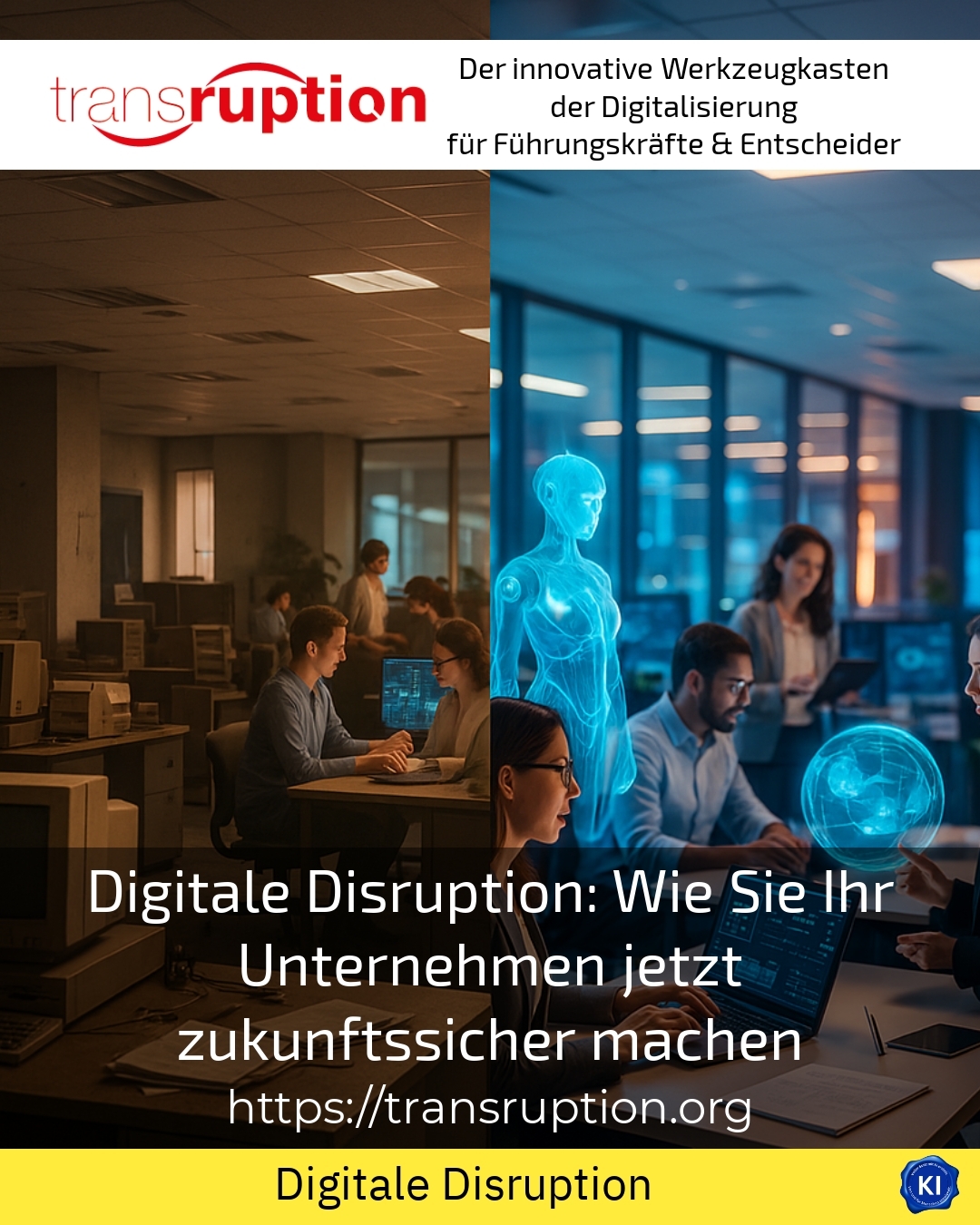
The business world is changing rapidly. New digital technologies and innovative business models are fundamentally influencing traditional industries. We call this process of radical change Digital Disruption. Companies like Netflix, Uber and Airbnb have turned entire industries upside down. They show that those who don't adapt will be pushed aside. Digital Disruption is no longer a distant scenario – it's happening now. But the good news is: you can act proactively and make your company future-proof.[1]
What exactly is digital disruption?
Digital disruption describes the fundamental reshaping of markets through digital innovation. New technologies and business models replace established solutions. This transformation goes beyond simple digitisation. Entirely new value chains emerge. Classic processes are questioned or dissolve.
A crucial distinction exists between digital transformation and digital disruption. Digital transformation tends to describe continuous improvements to existing processes. Digital disruption, on the other hand, signifies radical change and, in some cases, even the dissolution of traditional business models.[7] Disruption creates entirely new markets. It often offers customers greater advantages than traditional products.[5]
Three types particularly shape digital disruption:
Disruptive technologies radically change products or services. Artificial intelligence and the Internet of Things are such technologies. Disruptive business models affect the way companies create value. The subscription model for software is an example. Disruptive innovation describes the introduction of new ideas. These create entirely new markets or revolutionise existing ones.[3]
Why Digital Disruption is Crucial for Your Business
Companies are under more pressure than ever before. Digital disruption is forcing established players to act. Those who fail to recognise the signs of the times will lose market share. New competitors are emerging faster and more flexibly. They are using digital technologies more effectively.[1]
However, the opportunities are greater than the risks. Companies that understand and leverage digital disruption gain competitive advantages. They remain relevant and profitable. However, adapting to digital disruption requires conscious action. Structural changes are necessary. Openness to innovation is essential. Space for one's own innovations must be created.[5]
Successful examples from various sectors
Retail: How Amazon Revolutionised the Shopping World
Amazon is a prime example of successful digital disruption in retail.[10] The company developed a digital platform that allows customers to shop online and order products quickly. Amazon continuously optimised business processes. The supply chain was automated using robotics and artificial intelligence.[4]
Other retail chains initially reacted hesitantly. Then they realised action was necessary. Rewe, for example, is focusing on its online ordering service.[6] Customers can shop digitally and save time. Lidl and Aldi Nord are following this path. Target, the second-largest retail company in the USA, introduced a mobile app.[8] The company collects valuable customer data and uses it for personalised offers. Over 27 million shoppers use the app. The success was clearly evident: over 5 billion dollars in revenue per year.[8]
Entertainment and Media: Netflix and the Streaming Revolution
Netflix demonstrates how digital disruption transforms entire industries.[6] The company started in 1997 as an online video library. It sent DVDs and Blu-rays to customers. In 2007, more than one billion DVDs were sent out. But Netflix recognised the opportunity. The company launched its streaming service in the same year. This innovation replaced the previous business model.[6]
The music industry experienced something similar with Spotify. The platform revolutionised how people consume music. Traditional sales models became less important. Subscription models became the new norm. These examples show that disruptive companies rethink customer experiences.
Mobility and Transport: Drive Now and Urban Transformation
Drive Now by BMW is a prime example of digital disruption in the mobility sector.[6] The car-sharing service relies entirely on a mobile application. Customers locate vehicles on their smartphones. They book cars and pay directly through the app. Until September 2014, Drive Now used analogue membership cards. Digitisation eliminated administrative fees. Usage became simpler and more convenient for consumers.[6]
Uber fundamentally challenged the taxi business.[9] The platform connects drivers and passengers digitally. Traditional taxi services had to react. Many disappeared entirely from the market or adapted.
Financial Services: How Digital Disruption is Changing Banks
The banking sector is undergoing profound changes due to digital disruption. [1] Fintech companies like Revolut are challenging traditional banks. They offer mobile applications and digital services. Classic banking practices are being re-evaluated. [1]
Deutsche Bank responded to this challenge. It digitised its processes and developed a comprehensive platform. Customers gain access to all banking services digitally. The bank uses artificial intelligence to better understand customer needs. Personalised offers are developed.[4] SURA, a multinational financial services company, coordinated several highly effective initiatives in parallel.[2] Digital innovation, office restructuring and regulatory changes required cultural adaptation. Cross-border employee engagement was crucial.[2]
Industry and Logistics: Transformation through Technology
Industry and logistics are also subject to digital disruption. Mateco, a leading provider of rental equipment, modernised systems and processes in five countries. Rapid growth had caused regional complexity. Success depended on employees in different markets adopting new ways of working.
BEST PRACTICE at the customer (name hidden due to NDA contract): A global food company launched a multi-year transformation. Six old platforms were replaced by a unified SAP solution. The transformation encompassed finance, procurement, and supply chain management. Over 500 users were affected. Midway through the rollout, the company had to integrate a newly acquired business. The complexity increased significantly. Despite this, digital disruption remained a consistent strategy. The result was a modernised and more efficient corporate structure.
PTS Logistics conducted the world's first trial with Microsoft HoloLens in project logistics.[14] With this step forward, the company secured important competencies. The company positions itself as innovative to clients. ArcelorMittal, a steel giant, uses a strategy with small units. This approach also works well for medium-sized companies.[14]
Strategies for securing the future through digital disruption
1. Identify and analyse trends early
Recognising trends is fundamental. Companies should constantly analyse how digital technologies are changing existing industries. [5] This requires systematic market observation. Competitors and new market entrants must be monitored.
Disruptive technologies often emerge in niche markets. They are initially underestimated. Established players frequently ignore them. Large organisations should establish a system. This system continuously monitors market changes. This allows them to react faster than competitors. Digital disruption thus becomes an advantage rather than a threat.
2. Develop cultural openness to innovation
Digital disruption requires a different corporate culture. Employees must embrace change, not fear it. Innovation must be rewarded. Risk-taking should be encouraged. Mistakes are seen as learning opportunities.
Leaders play a key role. They must embody change. Communication about change is essential. Employees need to understand the 'why'. Training and support are necessary. Without cultural adaptation, technical projects often fail.
3. Strategically deploying digital technologies
Digital disruption thrives on technology. But not every technology is suitable for every business. Cloud technology enables scalability and flexibility. Artificial intelligence optimises business processes. It develops new products and personalised services.[1]
Adobe demonstrates the potential. The company switched to a SaaS business model. Cloud technology was introduced. The staff strategy was innovatively designed. The result was a significant competitive advantage.[12] Technology should be linked to business strategy. It's not about technology for its own sake. It's about solving real business problems.
4. Rethinking business models
Digital disruption often means fundamentally rethinking business models. Netflix switched from DVD rentals to streaming. The subscription model became the new norm. Revenue streams changed fundamentally. But the benefits for customers grew enormously.[6]
Your company should ask yourselves: How can we create value differently? What new revenue streams are possible? How can we serve customers better? These questions lead to innovative business models. Digital disruption offers great opportunities here.
5. Implementing Change Management Professionally
Large-scale digital transformations require professional change management. UKG, a global HR solutions provider, unified company systems for 12,000 employees after a major merger. Redundant platforms and fragmented processes hampered performance. A comprehensive ERP conversion became a strategic priority.
Human-centred approaches are crucial. Staff communication must be clear and continuous. Resistance to change should be taken seriously. Training and support are required. Without good change management, technical projects often fail, even though the technology is good.
Practical steps for your business
Step 1: Check digital readiness
Before major changes, the status quo should be clarified. A Digital Readiness Check determines the level of digital maturity. [7] This shows: Where does your company stand today? What capabilities are available? Where are there gaps? This analysis forms the basis for a strategy.
Step 2: Create small units for innovation
Not all companies need massive budgets for digital disruption. ArcelorMittal shows it: small units can bring great success.[14] Innovation labs or agile teams can test new ideas. Rapid failure and learning become possible. The insights gained can then be transferred to the entire organisation.
Step 3: Put the customer focus at the heart of it
Digital disruption arises because new solutions serve customers better. Target understood this. The mobile app collects customer data. This data reveals preferences, shopping habits, popular products. These insights enable better offers. Customer satisfaction increased, and revenue grew.
Your company should think similarly. Well











 Deutsch
  English (UK)