
Why do so many corporate departments fail to implement innovative ideas, even though the resources are available and the employees appear committed?
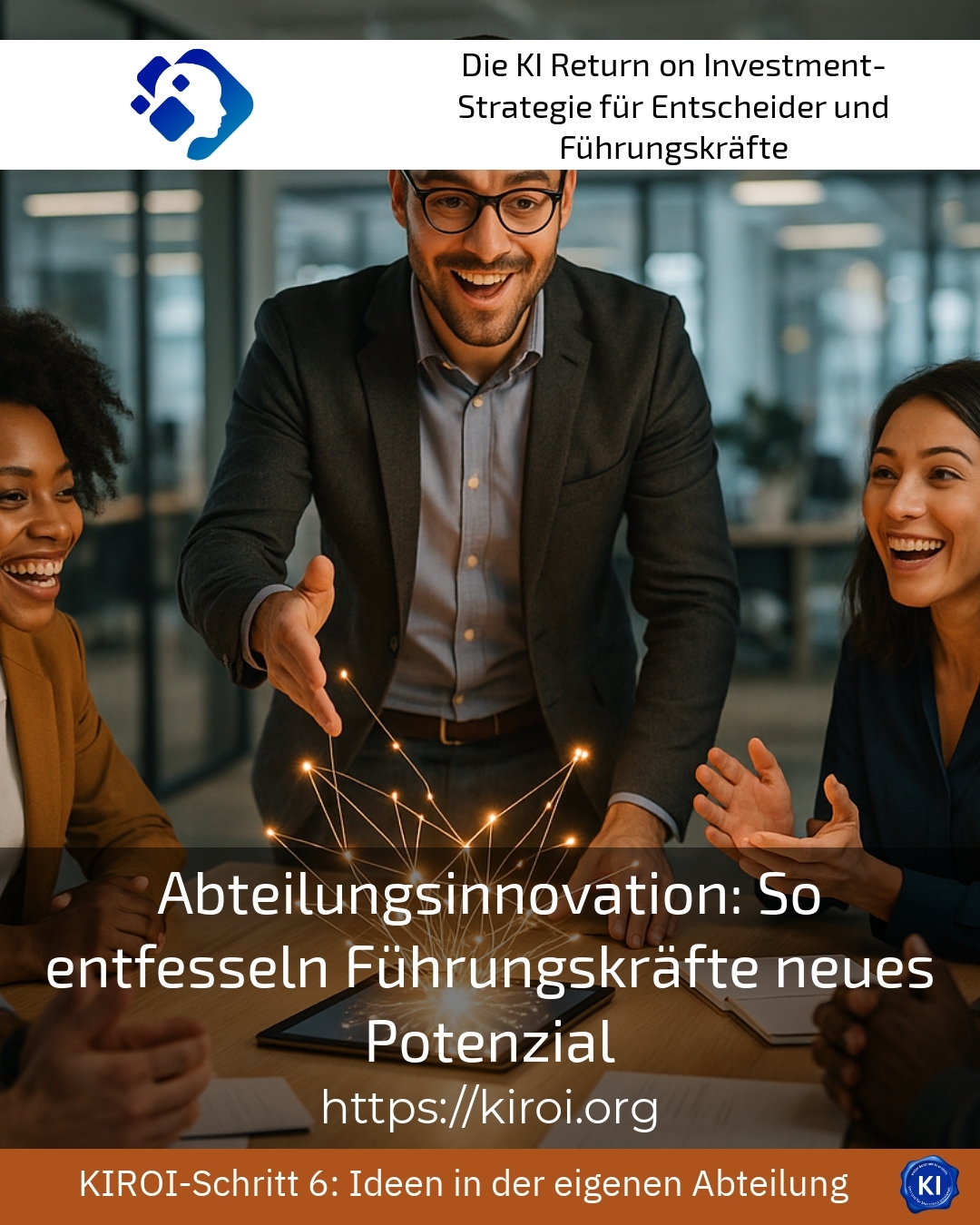
This question occupies managers in almost all industries. The answer often lies in the way Departmental Innovation is understood and practised. Many organisations view renewal as a one-off project. In doing so, they underestimate the systemic interrelationships between leadership culture, team dynamics and technological transformation. Nowadays, it is no longer sufficient to optimise individual processes or introduce new software. Instead, what is needed is a holistic approach that puts people at the centre while intelligently exploiting digital opportunities.
Recognising and overcoming the hidden barriers
Leaders face a paradoxical situation. On the one hand, executive boards demand continuous improvements and ground-breaking innovations. On the other hand, established structures and unspoken resistance make every attempt at change difficult. For example, a medium-sized mechanical engineering company only realised through external support that the production management was subconsciously blocking every digital innovation. The cause was not a lack of competence, but the fear of losing control. Similar patterns can be seen in the finance departments of large corporations, where automation projects regularly stall. An insurance company reported that three successive digitalisation initiatives failed. Only an in-depth analysis of the team dynamics revealed the actual obstacles.
The logistics industry also provides insightful examples of this issue. An international freight forwarder invested substantial sums in an intelligent warehouse management system. However, the employees barely used it and instead resorted to familiar Excel lists. The management initially interpreted this as resistance to technology. In reality, there was a lack of psychological safety and clear communication of the benefits.
Best practice with a AIROI customer
A traditional trading company with over three hundred employees turned to us because the purchasing department was working inefficiently despite modern systems. The manager had already carried out two reorganisations without achieving lasting improvements. In transruption coaching, we first analysed the informal power structures within the team. It turned out that an experienced clerk was unofficially influencing all important decisions. The official hierarchy existed practically only on paper. Together, we developed an approach that actively involved this person and acknowledged her expert knowledge. At the same time, we established new communication formats that promoted transparency and clarified responsibilities. Within six months, process speed improved by over forty percent. Employee satisfaction increased significantly, and staff turnover fell measurably. This example illustrates how important it is to look beneath the surface and understand systemic connections.
Departmental innovation as cultural change
Many leaders view renewal primarily as a technical issue. They focus on tools, methods and processes. However, this perspective falls short. True transformation begins in the minds and hearts of people. A pharmaceutical company learned this lesson in a striking way. The research department received state-of-the-art laboratory equipment and powerful analytical software. Nevertheless, development times for new active ingredients stagnated. Progress only materialized when the company fundamentally redesigned the collaboration between different expert groups.
The automotive industry provides further instructive examples of cultural change. An electronic systems supplier was faced with the challenge of introducing agile methods. The engineers had worked in rigid hierarchies for decades. The shift to self-organised teams required intensive support and patience. An energy supplier had similar experiences when restructuring its customer service department. The introduction of AI-powered chatbots failed several times due to employee resistance. Only when management sought dialogue and took fears seriously did the integration succeed.
The role of the leader in departmental innovation
Leaders frequently underestimate their own influence on change processes. Their behaviour sends hundreds of signals to the team every day. These signals are closely observed and interpreted. Through coaching, a head of department in the food industry realised that his non-verbal communication was unconsciously holding back innovation. When employees presented new ideas, he would reflexively fold his arms. This body language signalled rejection, even though he verbally professed openness. After consciously changing his posture, the suggestions for improvement from the team multiplied.
A telecommunications company implemented a structured innovation programme for middle management levels. Participants learned to create creative spaces and foster psychological safety. A textile manufacturer supported its production managers with individual coaching sessions. The managers reflected on their own beliefs about change and control. This self-awareness enabled a more authentic leadership style.
Best practice with a AIROI customer
A female healthcare CEO sought support because her administrative department seemed chronically overloaded. Despite additional posts and budget increases, the situation did not improve. As part of transruption coaching, we initially developed a detailed picture of the actual work processes. In doing so, we discovered numerous redundant procedures and unclear responsibilities. The CEO also recognised her own behavioural patterns that contributed to the overload. She tended to pull operational decisions towards herself rather than delegating them. Through targeted impulses and regular reflection sessions, she changed her leadership style step by step. The department independently developed optimisation proposals and implemented them. Sickness absence fell by a third within a year. The quality of the work results increased at the same time. Clients frequently report that such transformations only become possible through external support.
Technology as an enabler rather than an end in itself
Digital tools offer enormous opportunities for department innovation. They can automate routine tasks and provide valuable data for decision-making. However, technology alone rarely leads to sustainable improvements. For example, a construction company invested in a complex project management platform. The software promised complete transparency across all construction sites. After two years, however, only thirty percent of the site managers were using the system regularly. The implementation was technically successful, but failed on a human level.
The banking sector is showing similar patterns in the digitalisation of internal processes. A regional credit institution implemented an AI-based system for credit assessments. The clerical staff mistrusted the automated recommendations and checked every case manually. The hoped-for efficiency gains failed to materialise. A media company introduced collaborative working platforms to speed up editorial work. The journalists perceived the constant networking as surveillance and withdrew. Only when the company accompanied the rollout with change management measures did the employees accept the new tools.
Integrate artificial intelligence sensibly
AI applications are fundamentally transforming numerous business areas [1]. Leaders face the task of deploying these technologies profitably. The point is not to replace human labour, but to meaningfully complement it. A chemical company uses machine learning to optimise laboratory experiments. Scientists receive data-backed suggestions for promising research directions. A logistics company employs AI for route optimisation and saves considerable transport costs. A retailer uses intelligent algorithms to analyse purchasing behaviour and dynamically adjust its product range.
These examples illustrate the potential of artificial intelligence for operational improvements [2]. At the same time, such projects require sensitive support for the employees affected. The introduction of AI frequently arouses fears of job loss. Transparent communication and active involvement can alleviate these concerns. Managers should clearly communicate which tasks the technology will take over and which will remain with humans.
Sustainable change through systemic guidance
One-off training sessions or isolated consulting projects rarely achieve lasting impact. True transformation requires continuous guidance and reflection. transruptions coaching clearly positions itself as a partner in such long-term change projects. The approach combines technological understanding with psychological expertise. Leaders receive impulses that are both strategically and humanly sound.
An industrial company utilised this support over a period of two years. The production department underwent a comprehensive transformation from hierarchical to self-organised structures. Regular coaching sessions supported managers with emerging challenges. A service company combined transruption coaching with agile methods. The sales department developed new ways of working and significantly increased its closing rates. A technology company systematically supported its middle management in building innovative team cultures [3].
Best practice with a AIROI customer
A mid-sized mechanical engineering company faced the challenge of making its design department fit for the future. The experienced engineers worked using tried-and-tested methods and showed little interest in new technologies. At the same time, young newcomers were pushing for modern working methods and digital tools. This tension led to conflicts and significantly slowed down projects. In transruptions coaching, we developed an intergenerational approach. Experienced staff were deployed as mentors for technical knowledge. Younger colleagues took on the role of digital scouts and introduced new tools. This mutual appreciation broke the deadlock and enabled genuine knowledge exchange. The department jointly developed new standards for collaboration. Within a year, the average project duration was reduced by a quarter. Employee satisfaction reached record highs in the company's history. This example shows how important it is to focus on interpersonal dynamics during technical changes.
My AIROI Analysis
The presented examples and insights illustrate a central point. Successful renewal of business areas requires far more than technical solutions or structural adjustments. It demands a deep understanding of human dynamics and systemic interrelations. Leaders who strive for sustainable change should broaden their perspective. The primary question is not which technology should be introduced. Rather, it is about how people can be empowered to seize new opportunities and grow together.
The AIROI methodology provides a structured framework for such transformation processes. It combines analytical precision with people-centred support. Leaders are given concrete tools alongside space for personal development. The practical examples shown reveal recurring patterns. Resistance to change is usually rooted in unspoken fears and unclear communication structures. Technology can amplify problems if the human dimension is neglected. Conversely, digital tools only unfold their full potential when people use them with confidence.
In my work, I repeatedly observe that leaders believe they have to choose between technological progress and human care. This false dichotomy paralyses many organisations. The truth lies in integrating both perspectives. Successful departments combine technological excellence with psychological safety. They create spaces where experiments are permitted and mistakes are regarded as learning opportunities. Leaders who tread this path genuinely unleash new potential. They enable their teams to surpass themselves and achieve the extraordinary.
Further links from the text above:
[1] McKinsey: The Economic Potential of Generative AI
[2] Harvard Business Review: Artificial Intelligence
[3] Gartner: Digital Transformation
For more information and if you have any questions, please contact Contact us or read more blog posts on the topic Artificial intelligence here.







 Deutsch
 English (UK)