
Departmental Innovation: Focusing on Increasing Efficiency and Fostering Creativity
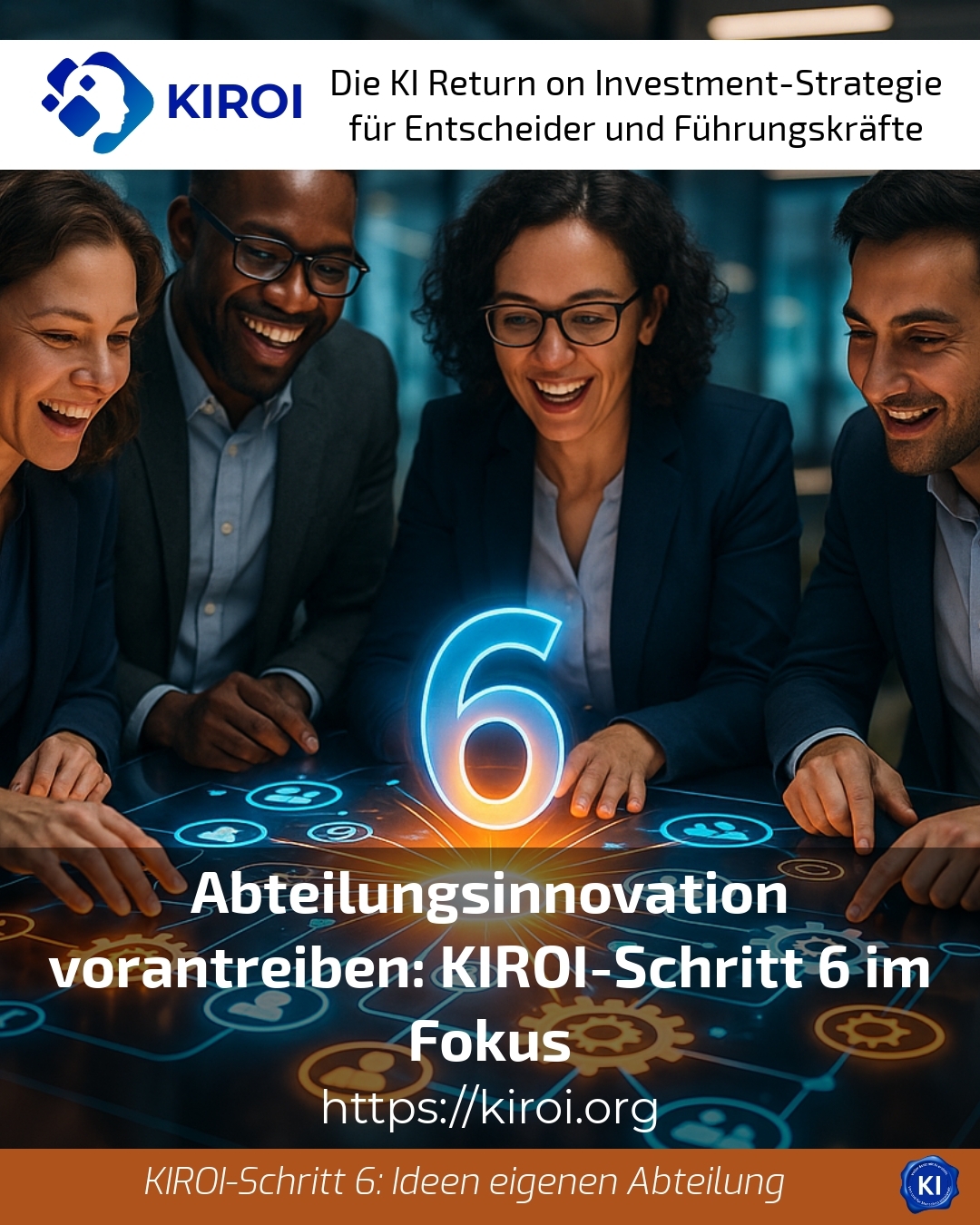
Departmental innovation is a central building block for companies that want to remain competitive. This involves specifically developing new ideas within individual departments and implementing them sustainably. With the right support, such as that offered by the sixth step of the AIROI strategy, teams can be assisted in recognising their individual potential and using it in a practical way, without being overwhelmed.
Giving an Impulse – How Departmental Innovation Succeeds
In departmental innovation, it is important to provide employees with sources of inspiration and tools to drive innovation in a targeted manner. Particularly in technically oriented fields, AI-powered sensor solutions can help to improve product quality and reduce downtime. In sales, the analysis of customer data enables the creation of personalised offers, which generate higher customer loyalty. Similarly, the HR department can find better opportunities in AI-supported selection processes to find suitable applicants and promote employee motivation.
Practical examples from various industries
AIROI BEST PRACTICE at ABC (name changed due to NDA contract) In the production department, the error rate has been significantly reduced through the use of intelligent sensor technology. This has led to a considerable decrease in unplanned downtimes, which has noticeably increased efficiency. In parallel, employees have been trained to effectively use the new systems and contribute their own suggestions for improvement.
AIROI BEST PRACTICE at DEF (name changed due to NDA contract) The sales team was supported by targeted analysis of customer data. The AI tools helped to create precise customer profiles, allowing for personalised offers to be tailored and thus placed more successfully. The process showed that departmental innovation has a direct impact on revenue here.
KI-ROIs: Best Practice at Company GHI (Name changed due to NDA) In the HR department, AI-powered tools were introduced for applicant selection. This not only facilitated pre-selection but also led to better matching between candidates and job profiles. As a result, the employees were able to dedicate themselves more effectively to their core tasks. The departmental innovation was therefore perceived as a success.
Support and sustainable implementation as key
The sustainable implementation of innovations within one's own department often cannot be achieved solely through technical solutions. Rather, it requires support that also takes cultural and organisational aspects into account. Idea development workshops strengthen the creativity of the workforce and promote the acceptance of new approaches. Pilot projects can test feasibility before a larger rollout, thus minimising uncertainties.
Examples of accompanying measures
Regular workshops empower employees to contribute and further develop their own ideas collaboratively. Accompanying training sessions impart necessary competencies in the use of new AI applications. In this way, not only is know-how expanded, but also the willingness to change is fostered.
AIROI Best Practice at Company JKL (Name changed due to NDA agreement) In the finance department, a continuous innovation process has been established through interactive workshops. Employees were able to actively contribute their own suggestions, which significantly improved the quality of the new AI solutions. This participatory support proved to be crucial for the project's success.
MNO's Best Practices (Name changed due to NDA) The introduction of new AI-powered tools in the sales department was accompanied by targeted training. This helped to overcome technical hurdles and gave employees confidence in using the new tools. The support enabled rapid and sustainable acceptance.
Leveraging departmental innovation to enhance competitiveness
Companies that strategically foster departmental innovation create decisive advantages for themselves. Improving internal processes, developing new services, and increasing employee engagement all contribute to enhancing innovative power. This allows companies to react more flexibly to market changes and improve their competitive position.
The AIROI strategy offers structured support in its sixth step, assisting companies in implementing their departmental innovation with a focus on AI technology. This isn't about quick fixes, but about sustainable development that brings everyone involved along. Clients often report that these impulses foster new ways of thinking and enable innovative results.
My analysis
Departmental innovation is not a given. It requires targeted stimulation, ongoing support, and the involvement of all employees. Only then can ideas be generated that are practically implementable and have a long-term impact. The AIROI steps promote this approach by providing a clear framework while simultaneously allowing scope for creative development. Companies that embark on this path can expect improved efficiency and increased innovative capacity.
Further links from the text above:
[1] Achieving departmental innovation: Step six to the top idea with AIROI
[3] AI as a threat or an opportunity in times of skills shortages?
[5] KI ROI Step 6: Your Own Department – AI to Increase Efficiency and Innovation
For more information and if you have any questions, please contact Contact us on or read further blog posts on the topic Artificial Intelligence Blog here.






 Deutsch
  English (UK)