
Why are some teams able to develop groundbreaking innovations while others have been stagnating for years and the existing potential remains untapped?
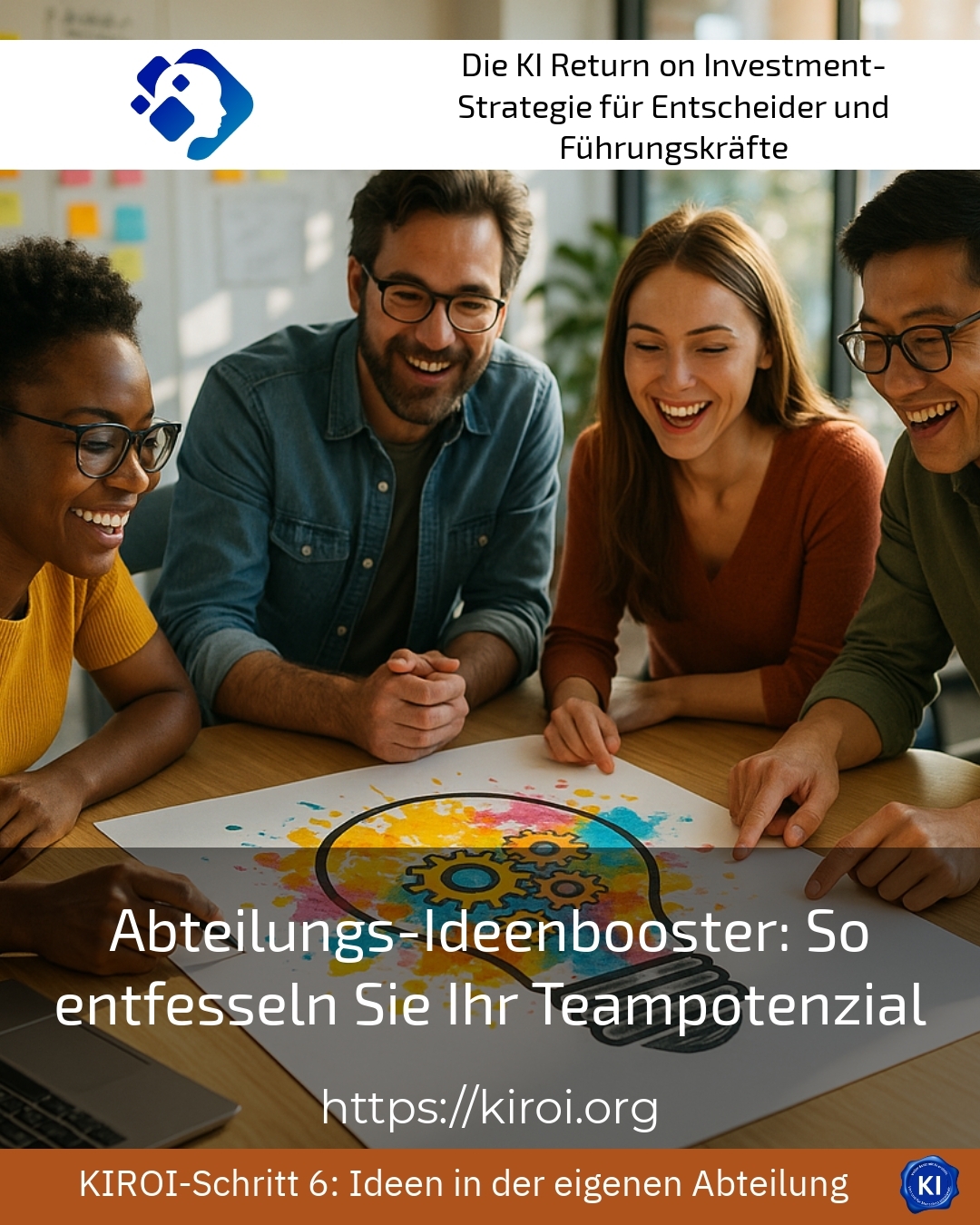
This question concerns executives in almost every organization. The Departmental Idea Booster offers a structured approach to unlocking creative potential. Clients often report a lack of resources in their departments. Collaboration stagnates, and innovative ideas are lost in the day-to-day business. Yet within every team lies an enormous reservoir of ideas and solutions. With the right impulses, this potential can be activated and transformed into measurable results. Transruptions coaching accompanies companies precisely during this transformation and supports them on their journey towards a vibrant innovation culture.
Recognize the hidden power in your departments
Many organizations systematically underestimate the creative abilities of their employees. In manufacturing companies, for example, machine operators bring valuable improvement suggestions every day. These ideas relate to process optimizations, quality improvements, and cost savings. However, structures are often lacking to capture and develop these impulses. A logistics service provider noticed that warehouse workers knew more efficient picking routes than management. This insight led to a complete redesign of the internal idea channels. In retail, on the other hand, sales staff have direct contact with customers and valuable market insights. They recognize trends earlier than any market research study. Departmental Idea Booster helps to systematically tap into such sources of knowledge and make them usable for the entire organization.
The challenge lies in creating psychological safety and breaking down hierarchical barriers. Employees need to feel that their contributions are valued. In a pharmaceutical company, this insight led to regular cross-departmental innovation circles. Researchers, production workers, and sales representatives suddenly exchanged ideas on an equal footing. The results significantly exceeded all expectations.
Best practice with a AIROI customer
A medium-sized machine engineering company from southern Germany approached us with a specific request for transruptive coaching. The development department had been working in isolation from other departments for months, producing solutions that were beyond the market. As part of the coaching, we first analyzed the existing communication structures and identified key gaps. Subsequently, we established a weekly idea format in which service technicians directly shared their field experience with the designers. The technicians knew exactly where machines in practical use showed weaknesses and which customer requirements had remained unfulfilled. Within six months, three patent-worthy improvements were created in existing product lines. The development time for new features was reduced by almost a third. Particularly noteworthy was the change in the overall corporate culture. Employees began to seek out cross-departmental discussions and bring forward ideas on their own initiative. Management reported a noticeably increased level of motivation and a new sense of belonging. This transformation impressively demonstrates how structured support can bring about lasting changes.
Boost creativity with the department idea booster
Creativity does not arise in an empty space; it requires a fertile environment. Financial service providers, for example, rely on time-limited innovation sprints with clear target goals. In these, employees from different departments work together on defined problems. One insurance company used this approach to develop new digital customer services. The combination of IT expertise, sales knowledge, and claims processing experience led to innovative solutions. The value of interdisciplinary collaboration is also impressively evident in healthcare. Nurses, doctors, and administrative staff work together to develop more efficient patient pathways. These examples illustrate that the Departmental Idea Booster It can be effective across industries.
The key is finding the right balance between structure and freedom. Too much leeway stifles creative impulses at their inception. On the other hand, too much freedom leads to disorientation and endless discussions. One automotive supplier found the right mix by conducting moderated workshops with open phases. Participants initially received a clear problem definition and background information. Then followed a phase of free brainstorming without evaluation. Only after that were ideas structured, evaluated, and prioritized. This approach enabled both wild leaps of the imagination and concrete implementation plans.
Practical methods for the department idea booster in everyday life
Implementing creative methods requires both intuition and perseverance. In the food industry, for example, so-called reverse brainstorming has proven itself. Teams deliberately ask how they could make a product worse. From these absurd ideas, surprisingly often valuable improvement ideas emerge. A beverage manufacturer discovered a weakness in its packaging logistics in this way. The software industry often uses hackathons to develop new features in a concentrated manner. Programmers, designers, and product managers work closely together. In the construction industry, regular lessons-learned rounds have become established. After each project, teams reflect together on successes and areas for improvement. These industry-specific approaches can be adapted accordingly.
Transruptions coaching helps organizations select and implement the appropriate methods. Often, clients come to us with the desire for more innovation and dynamism. They report on stagnant structures and a lack of willingness to change within their teams. Together, we analyze the specific situation and develop customized solutions. We take into account corporate culture, industry conditions, and individual team dynamics alike. This holistic approach distinguishes professional coaching from standardized consulting concepts.
Best practice with a AIROI customer
An internationally operating trading company sought support in revitalizing its innovation culture. The headquarters had introduced various ideas management tools, but their usage remained far behind expectations. As part of our support, we first conducted discussions with employees at all levels of the hierarchy. It became apparent that many perceived the digital system as a bureaucratic obstacle rather than an opportunity for participation. We recommended a hybrid solution that combined personal exchange sessions with digital documentation. The branches were given freedom to design their local idea formats. At the same time, we established an overarching network for the exchange of particularly promising concepts. A branch manager from a medium-sized city then developed the concept of the customer whisperers. Experienced sales staff systematically collected customer feedback and prepared it for product development and marketing. This idea spread throughout the entire company within a few months and became an integral part of the innovation strategy. Employee satisfaction increased measurably because employees now directly experienced the effectiveness of the initiative.
Overcoming resistance and achieving lasting change
Any change initially generates resistance, and that is completely normal. In the energy industry, for example, traditional structures encounter disruptive market developments. Employees with decades of experience feel uncertain about new working methods. A city utility experienced fierce discussions when introducing agile methods. Older engineers questioned the added value of daily short meetings and retrospectives. Only when younger colleagues could demonstrate practical success did the mood gradually change. In the banking sector, similar dynamics are evident in the digitalization of internal processes. Long-time employees fear a loss of competence and a decline in meaning. The media industry, in turn, struggles with the transition from print to digital and the associated restructuring processes.
The key to overcoming such resistance lies in transparent communication and genuine involvement. People are more likely to support changes if they can co-create them. Departmental Idea Booster offers exactly this opportunity for active participation. Instead of imposing changes from above, innovations emerge from within the organization itself. A telecommunications company made very positive experiences with a comprehensive process reorganization. Employees independently developed proposals for improving their work processes. The implementation rate was significantly higher than with previous top-down initiatives. This observation is consistent with our experiences from numerous mentoring projects.
The role of leaders in the departmental idea booster
Leaders play a central role in activating team potential. They set the framework and signal what is desirable through their behavior. In the chemical industry, a department manager experienced a moment of enlightenment during a workshop. He realized that he had unconsciously dismissed ideas regularly from his employees. His quick assessments and critical questions had created a tacit agreement within the team. After this realization, he consciously practiced active listening and appreciative feedback. The change was noticeable to all involved and led to a new openness within the team. In mechanical engineering, a team leader reported similar experiences during the transition to participatory leadership. She had to learn to relinquish control and understand mistakes as learning opportunities. In the hotel industry, the importance of role modeling for service quality and innovation readiness becomes evident.
Transruptions coaching intensively supports leaders in this personal development journey. We provide guidance on new leadership approaches and together reflect on behavioral changes. This is not about learning techniques, but about a shift in perspective. Leadership becomes about enabling rather than controlling, which teams have found to be very positive. This transformation takes time, patience, and professional support alike.
My AIROI Analysis
The systematic activation of team potential is one of the most effective levers for organizational development ever. Our analysis shows that companies with established idea structures can react significantly more adaptively to market changes. They have a broader repertoire of solution approaches and can respond more quickly to new challenges. AIROI The methodology always considers the interplay of people, processes, and technology holistically [1]. Artificial intelligence can support idea processes, but the actual creativity remains human and irreplaceable. In practice, we observe that the combination of human intuition and technological support yields particularly strong results.
Success depends on consistent implementation over an extended period of time. One-time workshops quickly become ineffective, while continuous support leads to lasting changes. Organizations should have realistic expectations and be patient in the cultural change process. However, the investment is worth it several times over, because engaged teams with activated potential are more productive and happier. They identify themselves more strongly with their work and contribute to the company’s success. At the same time, turnover and sick leave are demonstrably reduced in companies with a positive innovation culture [2]. These connections underscore the strategic importance of structured talent development. We therefore recommend establishing idea promotion as a permanent component of corporate management.
Further links from the text above:
[1] AIROI-Methodology and Masterclass
[2] Gallup Workplace Engagement Studies
For more information and if you have any questions, please contact Contact us or read more blog posts on the topic Artificial intelligence here.






 Deutsch
 English (UK)