
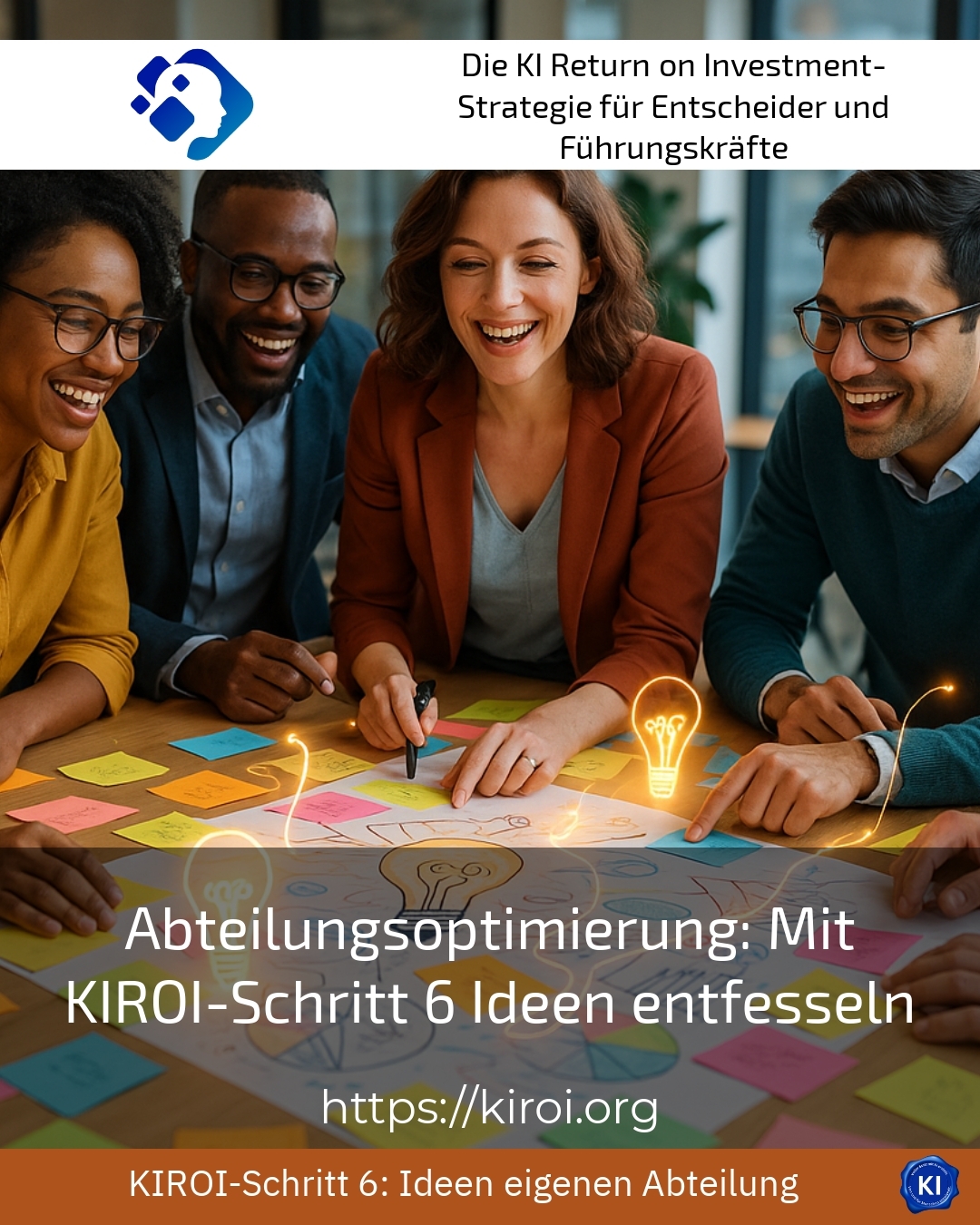
Department optimisation is a crucial process for sustainably increasing efficiency and innovative strength within a company. The AIROI method, in particular, offers a structured path to tackle this precisely. In the sixth step of this strategy, a special focus unfolds on unleashing and specifically directing ideas and creativity within teams. This allows existing potential to be leveraged while simultaneously developing new approaches that lead to improved results in the long term.
Department optimisation with AIROI Step 6: Systematically unleash ideas
The sixth step of the AIROI method supports teams in achieving structured idea generation. This is not just about spontaneous suggestions, but about a targeted, moderated process that combines creativity with analytical tools. With methods such as brainstorming, the morphological box, or the Ishikawa diagram, ideas are collected, analysed and evaluated. This ensures that only those suggestions that offer real added value for the respective department are implemented.
In practice, this approach finds versatile application: a marketing team, for example, uses step 6 to go beyond standard campaigns with new customer acquisition concepts. Likewise, a financial service provider uses the method to shorten processes and minimise errors in the back office through digital automation approaches. A mechanical engineering company, in turn, combines the AIROI method with Six Sigma to sustainably establish quality innovations in production.
BEST PRACTICE with one customer (name hidden due to NDA contract) A medium-sized manufacturing company was able to significantly improve team communication between planning and production through the supported implementation of Step 6 in the AIROI method. In moderated workshops, ideas for avoiding production downtimes were developed and combined with AI sensor technology. The result was a sustainable reduction in scrap and downtime.
Practical tips for successful idea development
For departmental optimisation with AIROI Step 6 to be truly effective, companies should establish some key framework conditions:
- Establish an open communication culture where employees can share their ideas without hesitation.
- Employ creativity techniques such as brainstorming or mind mapping in a targeted manner to incorporate diverse perspectives.
- Ensure regular feedback cycles so that collected ideas are not left unused, but are reviewed, adapted and implemented.
- Assemble interdisciplinary teams to incorporate diverse expertise and experience into the innovation process.
- Using modern AI-powered tools that help to quantitatively evaluate and prioritise ideas.
These impulses not only strengthen innovative capacity but also increase acceptance among all stakeholders. This is because clients frequently report that the involvement and the process itself are at least as important as the concrete solution.
In an HR department, for example, the implementation of AIROI Step 6 led to the development of targeted further training programmes. The teams identified bottlenecks in the recruitment process and proposed automated screening procedures, which are now improving the quality of applicant selection.
In sales, data-driven analyses, managed via Step 6, enable a better understanding of customer preferences, thereby allowing for more targeted adjustment of offer packages. This frequently results in increased conversion rates and sustainable customer relationships.
Cross-departmental synergies with AIROI Step 6
Departmental optimisation is particularly beneficial when the ideas generated do not remain isolated within a single unit but are further developed in collaboration with other departments. For example, a mechanical engineering production process can benefit from input from IT for digital sensor technology or from purchasing for material optimisation.
A well-known example illustrates how a marketing team, in collaboration with the IT department and using AIROI, developed new data-driven approaches for customer segmentation in step 6. These measures led to a more efficient budget allocation and more precise targeting.
My analysis
Department optimisation is a continuous process that can be significantly supported through the targeted use of methods such as AIROI Step 6. This step offers teams a structured way to systematically generate, evaluate, and pragmatically implement ideas. The combination of creativity techniques, analytical tools, and moderated support not only enables short-term improvements but also fosters a sustainable culture of innovation. It clearly shows that open communication, interdisciplinary collaboration, and the use of modern technologies are crucial success factors. Those who consider these impulses often achieve a noticeable increase in productivity, better quality in processes, and higher employee motivation – central goals of any departmental optimisation.
Further links from the text above:
Optimising your department: Step 6 to innovative ideas with AIROI [2]
Departmental optimisation through targeted impulses: AIROI Step 6 [4]
Department Optimisation: With AIROI Step 6 to Idea Power [6]
Process optimisation: Everything you need to know [5]
For more information and if you have any questions, please contact Contact us or read more blog posts on the topic Artificial intelligence here.








 Deutsch
  English (UK)