kiroi.org

KIROI - Artificial Intelligence Return on Invest
The AI strategy for decision-makers and managers

Business excellence for decision-makers & managers by and with Sanjay Sauldie

KIROI - Artificial Intelligence Return on Invest: The AI strategy for decision-makers and managers

KIROI - Artificial Intelligence Return on Invest: The AI strategy for decision-makers and managers

Start » Department optimisation with KIROI: Step 6 for strong ideas
1 July 2025

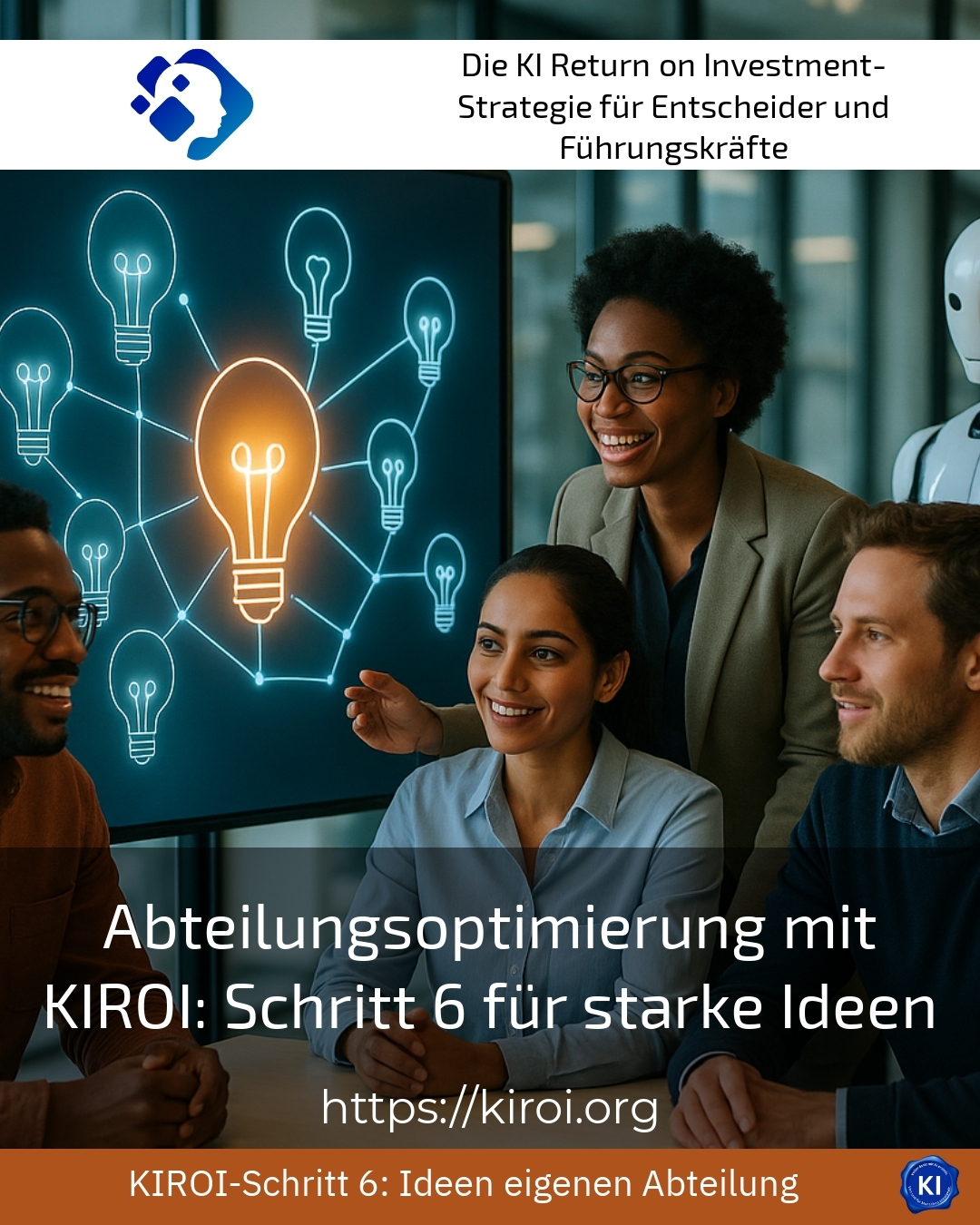
Department optimisation with KIROI: Step 6 for strong ideas

4.2
(946)

Department optimisation is a crucial step for companies to make their workflows more efficient and increase competitiveness. Especially in the phase where strong ideas are developed, such as in the sixth step of a systematic optimisation process, the value of targeted impulses and insights becomes apparent. With the right support, processes can be facilitated and projects advanced with precision. This is how sustainable success can be achieved.

Departmental Optimisation: Impulses for Creative Solutions

Developing strong ideas for departmental optimisation requires a structured approach. Many companies rely on proven methods of Continuous Improvement Process (CIP) or the use of creativity techniques for this purpose. Examples can be found in manufacturing, where the Ishikawa diagram is used to systematically analyse problem causes, or in IT departments, which visualise and redesign weaknesses with the help of digital tools. Teams in the customer service sector also frequently report that small but targeted changes made through workshops have a significant impact.

BEST PRACTICE with one customer (name hidden due to NDA contract) The Customer Service Department identified recurring bottlenecks in query processing during a workshop. Using a 635 method, numerous creative solution proposals were gathered and then prioritised. This allowed processes to be restructured and agile teams to be formed, who now react more quickly and flexibly.

In addition to brainstorming, it's important that employees are actively involved. Because changes are only effective if they are understood and supported. Department optimisation therefore supports this by promoting communication and creating participation formats. Another example can be found in manufacturing companies: there, the 5S method makes order and cleanliness practical by setting clear standards and thus shortening processes. This not only creates efficiency but also motivation.

Method diversity as a success factor in departmental optimisation

In the sixth step, combining various methods is recommended for generating and testing strong ideas. Lean management approaches, for instance, help to identify and eliminate waste. Six Sigma supports the evaluation of process variations for their effectiveness with measurable key figures. Design Thinking, as a creative methodology, encourages working in interdisciplinary teams and the rapid development of prototypes. This opens up new perspectives for unusual solutions and innovative approaches.

BEST PRACTICE with one customer (name hidden due to NDA contract) In production planning, Six Sigma was used to reduce fluctuations in the material flow. The DMAIC method facilitated the analysis of causes and the targeted implementation of measures. The result was a noticeable simplification of the process as well as an increase in product quality.

In contrast, in service companies, managers report that Design Thinking workshops generate concrete project ideas that can often be tested directly. This results in models that can be implemented step-by-step later, rather than just insisting on theoretical concepts. Departmental optimisation acts as a process facilitator, supporting the teams both methodically and emotionally.

Department Optimisation in Practice: Tips for Strong Ideas

For the successful completion of the sixth step, idea strengthening, a structured roadmap is recommended:

  • Use participatory methods such as workshops to integrate as many perspectives as possible.
  • Visualise processes using tools such as flowcharts or cause-and-effect diagrams to make challenges apparent.
  • Prioritise ideas based on criteria such as feasibility, impact, and resource requirements.
  • Encourage open communication, including about potential concerns and risks.
  • Clearly and comprehensibly document the developed concepts for all stakeholders.

BEST PRACTICE with one customer (name hidden due to NDA contract) A medium-sized IT company used a combination of Lean Management and Continuous Improvement (KVP) to develop and consolidate ideas for optimising internal IT service processes. Involving employees at all levels helped to find practical solutions and increase acceptance for changes.

Departmental optimisation supports this approach precisely by providing impetus, fostering the reflection process, and communicating transparently about goals and expectations. This creates a healthy space in which creative and practical ideas can flourish.

My analysis

Departmental optimisation is more than a buzzword – it is a multifaceted process that significantly contributes to company success through the development of strong ideas in the sixth step. Whether using data-based methods such as Six Sigma, participatory approaches in continuous improvement (KVP), or creative methods like Design Thinking: the diversity of possibilities enables individual solutions for different sectors and tasks.

It is important that departmental optimisation is understood as support and management that assists teams and managers with implementation. Only in this way can ideas be transformed into sustainable improvements. Teams often report positive experiences when initiatives are professionally supported and communicated in an open process.

Thus, departmental optimisation represents a key lever for the long-term healthy development of an organisation.

Further links from the text above:

Process Optimisation: Definition, Goals, Phases, Procedure – IPH Hannover
Process Optimisation: How it Works + Practical Example – Personio
Process optimisation: Everything about the topic – Lexware
Process Optimisation: Definition, Methods & Implementation – Reese GmbH
Process Optimisation: Definition, Methods, Examples – StepStone
Process Optimisation – THA

For more information and if you have any questions, please contact Contact us or read more blog posts on the topic Artificial intelligence here.
How useful was this post?

Click on a star to rate it!

Average rating 4.2 / 5. Vote count: 946

No votes so far! Be the first to rate this post.

Spread the love

transruption.org

The digital toolbox for
the digital winners of today and tomorrow

Business excellence for decision-makers & managers by and with Sanjay Sauldie

transruption
transruption

transruption: The digital toolbox for
the digital winners of today and tomorrow

Start » Department optimisation with KIROI: Step 6 for strong ideas
1 July 2025

Department optimisation with KIROI: Step 6 for strong ideas

4.2
(946)

Department optimisation is a crucial step for companies to make their workflows more efficient and increase competitiveness. Especially in the phase where strong ideas are developed, such as in the sixth step of a systematic optimisation process, the value of targeted impulses and insights becomes apparent. With the right support, processes can be facilitated and projects advanced with precision. This is how sustainable success can be achieved.

Departmental Optimisation: Impulses for Creative Solutions

Developing strong ideas for departmental optimisation requires a structured approach. Many companies rely on proven methods of Continuous Improvement Process (CIP) or the use of creativity techniques for this purpose. Examples can be found in manufacturing, where the Ishikawa diagram is used to systematically analyse problem causes, or in IT departments, which visualise and redesign weaknesses with the help of digital tools. Teams in the customer service sector also frequently report that small but targeted changes made through workshops have a significant impact.

BEST PRACTICE with one customer (name hidden due to NDA contract) The Customer Service Department identified recurring bottlenecks in query processing during a workshop. Using a 635 method, numerous creative solution proposals were gathered and then prioritised. This allowed processes to be restructured and agile teams to be formed, who now react more quickly and flexibly.

In addition to brainstorming, it's important that employees are actively involved. Because changes are only effective if they are understood and supported. Department optimisation therefore supports this by promoting communication and creating participation formats. Another example can be found in manufacturing companies: there, the 5S method makes order and cleanliness practical by setting clear standards and thus shortening processes. This not only creates efficiency but also motivation.

Method diversity as a success factor in departmental optimisation

In the sixth step, combining various methods is recommended for generating and testing strong ideas. Lean management approaches, for instance, help to identify and eliminate waste. Six Sigma supports the evaluation of process variations for their effectiveness with measurable key figures. Design Thinking, as a creative methodology, encourages working in interdisciplinary teams and the rapid development of prototypes. This opens up new perspectives for unusual solutions and innovative approaches.

BEST PRACTICE with one customer (name hidden due to NDA contract) In production planning, Six Sigma was used to reduce fluctuations in the material flow. The DMAIC method facilitated the analysis of causes and the targeted implementation of measures. The result was a noticeable simplification of the process as well as an increase in product quality.

In contrast, in service companies, managers report that Design Thinking workshops generate concrete project ideas that can often be tested directly. This results in models that can be implemented step-by-step later, rather than just insisting on theoretical concepts. Departmental optimisation acts as a process facilitator, supporting the teams both methodically and emotionally.

Department Optimisation in Practice: Tips for Strong Ideas

For the successful completion of the sixth step, idea strengthening, a structured roadmap is recommended:

  • Use participatory methods such as workshops to integrate as many perspectives as possible.
  • Visualise processes using tools such as flowcharts or cause-and-effect diagrams to make challenges apparent.
  • Prioritise ideas based on criteria such as feasibility, impact, and resource requirements.
  • Encourage open communication, including about potential concerns and risks.
  • Clearly and comprehensibly document the developed concepts for all stakeholders.

BEST PRACTICE with one customer (name hidden due to NDA contract) A medium-sized IT company used a combination of Lean Management and Continuous Improvement (KVP) to develop and consolidate ideas for optimising internal IT service processes. Involving employees at all levels helped to find practical solutions and increase acceptance for changes.

Departmental optimisation supports this approach precisely by providing impetus, fostering the reflection process, and communicating transparently about goals and expectations. This creates a healthy space in which creative and practical ideas can flourish.

My analysis

Departmental optimisation is more than a buzzword – it is a multifaceted process that significantly contributes to company success through the development of strong ideas in the sixth step. Whether using data-based methods such as Six Sigma, participatory approaches in continuous improvement (KVP), or creative methods like Design Thinking: the diversity of possibilities enables individual solutions for different sectors and tasks.

It is important that departmental optimisation is understood as support and management that assists teams and managers with implementation. Only in this way can ideas be transformed into sustainable improvements. Teams often report positive experiences when initiatives are professionally supported and communicated in an open process.

Thus, departmental optimisation represents a key lever for the long-term healthy development of an organisation.

Further links from the text above:

Process Optimisation: Definition, Goals, Phases, Procedure – IPH Hannover
Process Optimisation: How it Works + Practical Example – Personio
Process optimisation: Everything about the topic – Lexware
Process Optimisation: Definition, Methods & Implementation – Reese GmbH
Process Optimisation: Definition, Methods, Examples – StepStone
Process Optimisation – THA

For more information and if you have any questions, please contact Contact us or read more blog posts on the topic Artificial intelligence here.

How useful was this post?

Click on a star to rate it!

Average rating 4.2 / 5. Vote count: 946

No votes so far! Be the first to rate this post.

Spread the love

Other content worth reading:

Department optimisation with KIROI: Step 6 for strong ideas

written by:

Keywords:

#Abteilungsoptimierung #Big Data #compliance #Datenintelligenz #Design Thinking #Ethikrichtlinien #InnovationDurchAchtsamkeit #KVP #artificial intelligence #Lean Management #Sustainability #Prozessverbesserung #SmartData #Unternehmenskultur #Verantwortungsketten

Follow me on my channels:

Questions on the topic? Contact us now without obligation

Contact us

[wpforms id="331781" title="false"]

More articles worth reading

    Leave a comment