
The term Decision Boundary originates from the fields of Artificial Intelligence and Big Data. It plays an important role when computer programmes are intended to make decisions independently, for example, in image recognition or in intelligent assistant systems.
A decision boundary, in German „Entscheidungsgrenze“, describes in data analysis the line or surface that separates different groups from each other. Imagine you want to predict whether an email is spam or not based on certain characteristics. The decision boundary is the invisible dividing line that the computer program draws to distinguish all spam emails from normal emails.
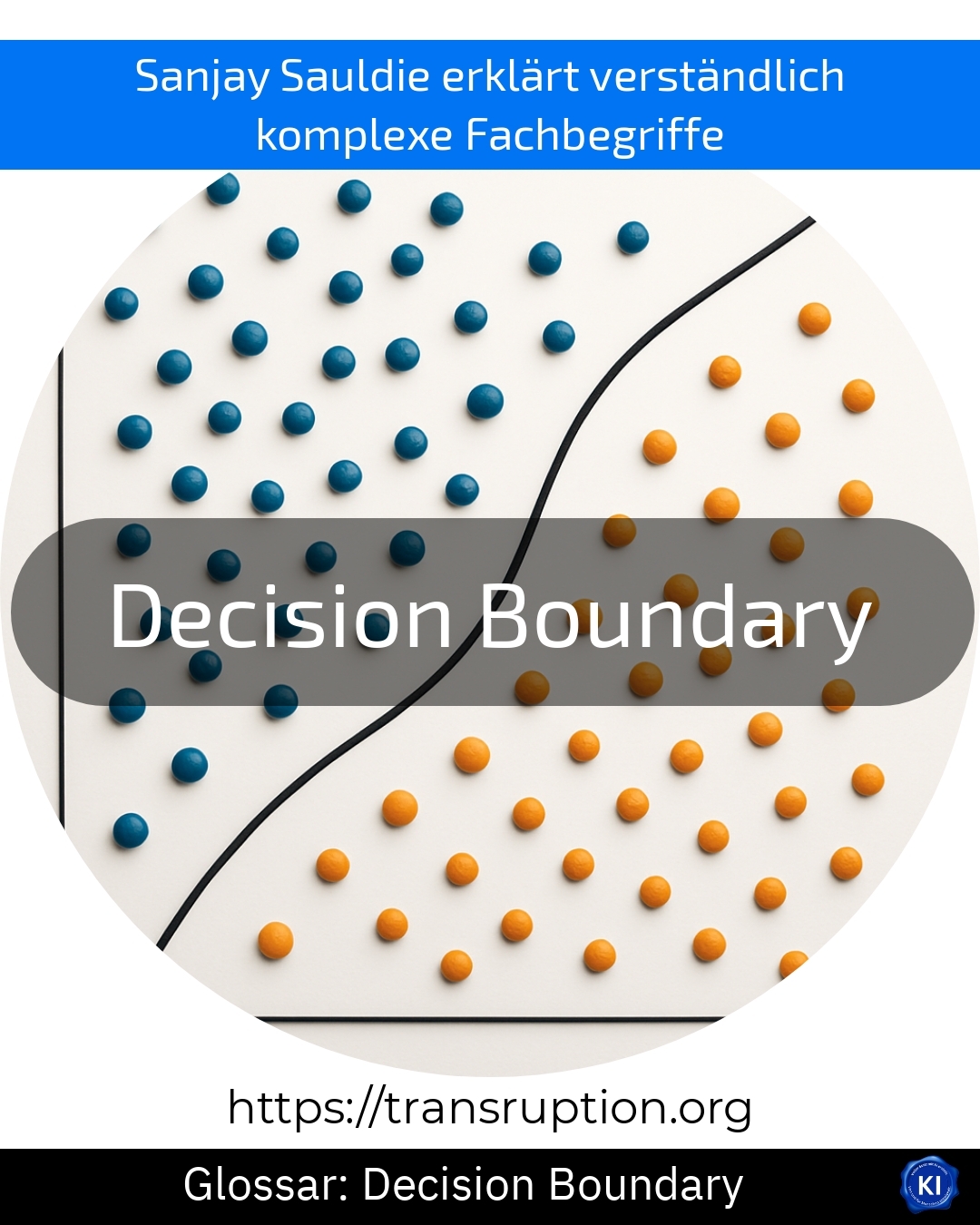
A vivid example: You have a map with red and blue dots. The task of artificial intelligence is to find the best possible dividing line so that all the red dots lie on one side and all the blue ones on the other. This boundary itself is the decision boundary.
The better the decision boundary is defined, the more accurately a system can classify new data and make reliable decisions. This makes it particularly important for applications in Artificial Intelligence and Big Data.











 Deutsch
  English (UK)