
Why are so many companies drowning in their own mountains of data, while others are able to extract genuine competitive advantages from the exact same information?
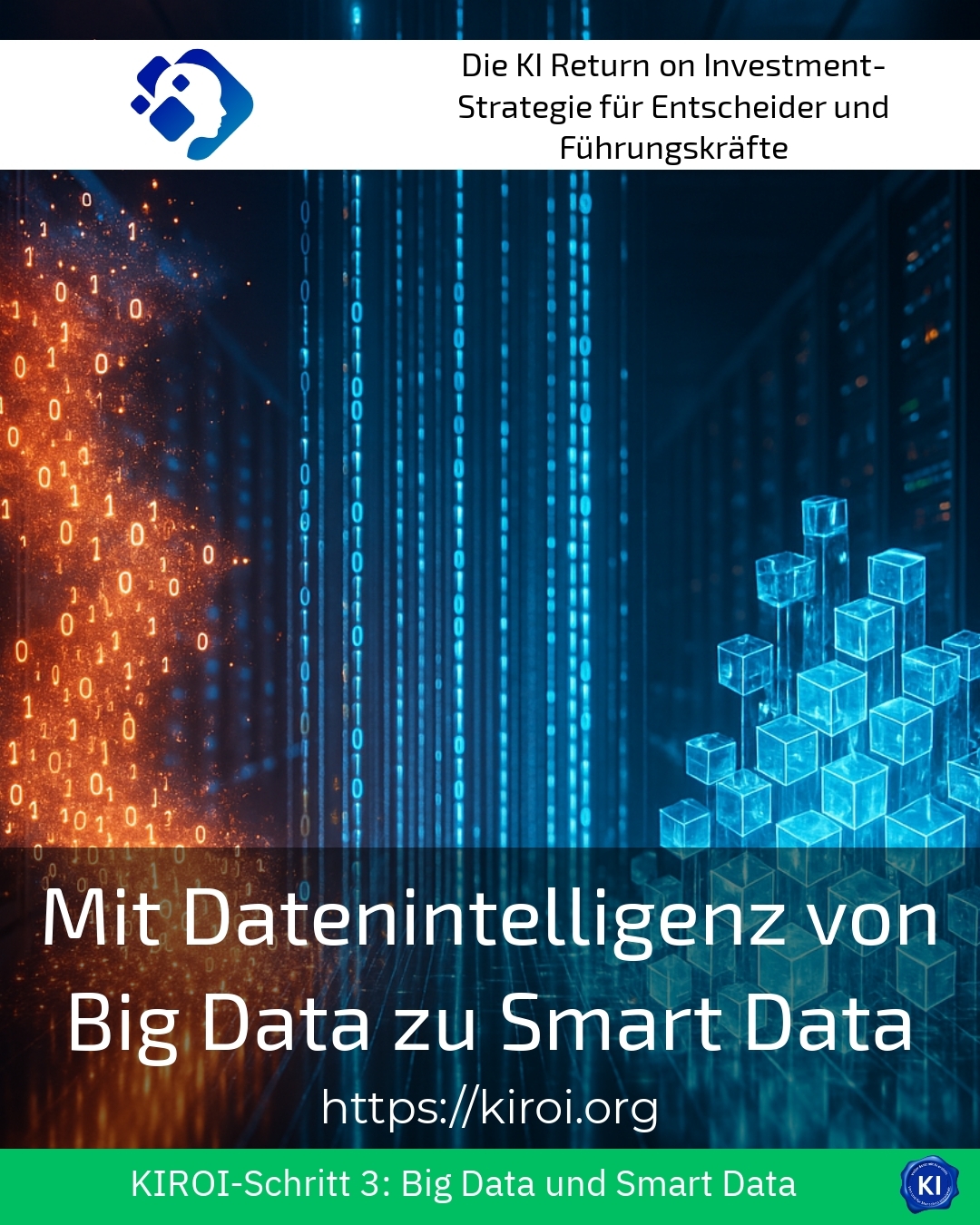
The answer lies in a transformation that has only just begun. The path with data intelligence from Big Data to Smart Data describing a paradigm shift that goes far beyond mere technology. Companies today are gathering more information than ever before in human history. Yet quantity alone does not create added value. Rather, it is about extracting relevant insights from the flood of data. These insights must then be translated into concrete actions. This is precisely where a new form of guidance comes in. transruptions coaching supports organisations in this transformation. In the process, impulses are generated that enable sustainable change.
Understanding the challenge of the modern information deluge
Every day, around 2.5 trillion bytes of new information are generated worldwide [1]. This unimaginable quantity completely overwhelms traditional analysis methods. Many business leaders report similar experiences in their organisations. They have systems that continuously capture data. Nevertheless, they often lack the ability to derive actionable recommendations from it. For example, a medium-sized machine builder records sensor data from its production facilities. A logistics company collects movement data for its entire vehicle fleet. A retail chain analyses buying behaviour across hundreds of locations simultaneously. However, the common denominator remains the same: pure data collection does not yet provide usable insights.
The problem often lies not in the technology itself. It lies in the missing strategic alignment of data usage. Companies invest in modern storage systems and high-performance servers. However, they forget to formulate the right questions first. Which decisions are the collected insights actually supposed to support? Which processes can be optimised through better insights? These fundamental considerations are frequently left by the wayside.
Best practice with a AIROI customer
An internationally active automotive supplier faced a massive challenge in the area of quality assurance. Over the years, the company had collected measurement data from production without systematically evaluating it. The volume of data grew continuously to several terabytes per month. At the same time, complaint rates for certain product lines rose significantly. As part of the support provided by transruptions coaching, an initial comprehensive inventory was carried out. This revealed that relevant correlations between production parameters and subsequent quality problems existed. However, these had never been systematically analysed. Together, the team developed a strategy for the intelligent filtering of raw data. Only truly relevant measurement metrics were prioritised. Within six months, the company was able to identify quality issues much earlier. According to internal reports, the complaint rate fell by more than a third. This success was not based on new technology, but on a changed approach to existing resources.
With data intelligence from Big Data to Smart Data: The transformation process
The path to intelligent data structures does not follow a standardised scheme. Every organisation brings its own prerequisites and challenges. Nevertheless, certain phases that frequently occur can be identified. At the beginning there is usually an honest stocktake of the existing data sources. Which systems already capture information during ongoing operations? How is this information currently stored and processed? Who has access to which areas of the data landscape? These questions sound trivial, but often uncover surprising gaps.
An energy supplier, for example, collects consumption data from millions of households. This information is scattered across various legacy systems. Bringing it together requires a significant amount of manual effort. A hospital records patient data in different departmental systems. The systems do not communicate with one another and generate data silos. A bank processes transaction data in real time, but cannot recognise historical patterns. In all these cases, the crucial step of integration is missing.
Establish quality over quantity as a guiding principle
The transition to smart data structures requires a rethink at all levels. Success is not determined by the volume of information collected. Rather, what matters is the relevance and quality of the evaluated insights. A telecommunications provider receives millions of customer usage data records daily. However, intelligent analysis focuses on patterns that can predict customer churn. An insurance company collects loss reports from various channels. Here, smart data means automatically detecting fraudulent patterns. A retail company records customer movements in its branches. The analysis focuses on optimisation potential in product placement.
This prioritisation requires the courage to reduce. Not everything that can be captured technically actually needs to be stored. Concentrating on truly business-relevant information saves resources. At the same time, it significantly increases decision-making speed. Clients frequently report that this focus causes initial discomfort. The concern about potentially losing important information is understandable. transruptions coaching provides support in overcoming these hurdles.
Practical application areas for intelligent data use
The transformation towards smarter data structures manifests itself differently across many industries. In manufacturing, it enables predictive maintenance of machinery. In healthcare, it supports the early detection of disease patterns. In the financial sector, it improves risk assessment in credit decisions. However, the basic principles remain similar across industries.
A pharmaceutical company uses intelligent analytical methods to accelerate clinical trials. The evaluation of historical study data significantly shortens development cycles. An aerospace group analyses flight data to optimise fuel consumption. Even minimal adjustments to flight routes can save millions. A media company personalises content based on user preferences. The dwell time on its platforms increases measurably as a result [2].
Best practice with a AIROI customer
A medium-sized hotel chain with locations in several European countries was looking for ways to improve its occupancy management. Previous pricing was based on historical averages and the intuition of the respective location managers. As part of the transruptions coaching process, a completely new approach was developed. First, all relevant factors influencing willingness to book were identified. These included local events, weather data, school holidays and competitor prices. These factors were then integrated into an intelligent forecasting model. The model now provides daily price recommendations for each individual location. The location managers retain final decision-making authority over their prices, yet they report a significantly improved basis for decision-making. According to internal reports, the chain's overall occupancy increased noticeably following the introduction of the system. At the same time, the average room rate during peak periods improved noticeably. This success demonstrates how intelligent data usage can complement human expertise.
From big data to smart data in customer relationships using data intelligence
A particularly effective area of application lies in the field of customer relationships. Modern companies have a wide variety of contact points with their customers. Each of these contact points generates information about preferences and behaviours. The challenge consists in bringing together these fragmented impressions into a complete picture. A mail-order company records click behaviour on its website in great detail. In addition, information from the call centre and returns management is incorporated. A mobile network operator combines usage data with customer service requests. In this way, insights emerge regarding the satisfaction and propensity to churn of individual customer segments. An automobile manufacturer links workshop visits with vehicle data from telematics.
This holistic view of customer relationships enables proactive action. Problems can be identified before they lead to complaints. Offers reach customers at the right moment with relevant content. Customer satisfaction increases, while marketing costs fall at the same time [3]. Clients frequently report that this shift also improves internal collaboration. Departmental boundaries become more permeable because shared data bases are created.
Success factors for sustainable change
The transformation to intelligent data structures rarely fails due to technical hurdles. Rather, cultural and organisational factors prove to be decisive. Leaders must embody and demand the value of data-driven decisions. Employees require training and support in handling new tools. Processes must be adapted to translate insights into actions.
A chemical company discovered that its analysts provided outstanding insights. However, these insights never reached operational decision-makers. A trading company invested in state-of-the-art analytics tools. Yet the utilisation rate remained dismally low due to a lack of training. A financial services provider developed precise forecasting models for market developments. However, the results were systematically ignored by experienced traders.
transruptions Coaching provides important impetus in such situations. The guidance in shaping change processes takes human factors into account. Resistance is taken seriously and addressed constructively. Successes are made visible and celebrated. This gradually creates a new culture in the handling of information.
My AIROI Analysis
Observation of numerous transformation projects reveals clear patterns. Successful organisations do not differ primarily from less successful ones in their technical equipment. The crucial difference lies rather in the strategic alignment of their data activities. Companies that formulate the right questions first achieve better results. Focusing on business-relevant insights regularly beats mere data collection.
Another critical success factor is the involvement of all relevant stakeholders. Data initiatives that are regarded purely as IT projects fail more frequently. Successful transformations are actively supported and driven by management. Business departments are involved in the design from the very beginning. This interdisciplinarity increases acceptance and improves the quality of the results.
The development with data intelligence from Big Data to Smart Data is not a one-off project. Rather, it is a continuous journey of improvement. Technologies evolve and open up new possibilities. Business models change and require different insights. Competitors catch up and set new standards. Organisations must therefore regularly review and adapt their data strategy. transruptions coaching supports this ongoing development. The guidance provides impetus for reflection and realignment. This is how companies remain competitive in the long term in a data-driven economy. The key to success lies not in the volume of data, but in the intelligence of its use.
Further links from the text above:
[1] Forbes – How Much Data Do We Create Every Day?
[2] McKinsey – The Data-Driven Enterprise
[3] Harvard Business Review – Why Becoming a Data-Driven Organisation Is So Hard
For more information and if you have any questions, please contact Contact us or read more blog posts on the topic Artificial intelligence here.










 Deutsch
  English (UK)