
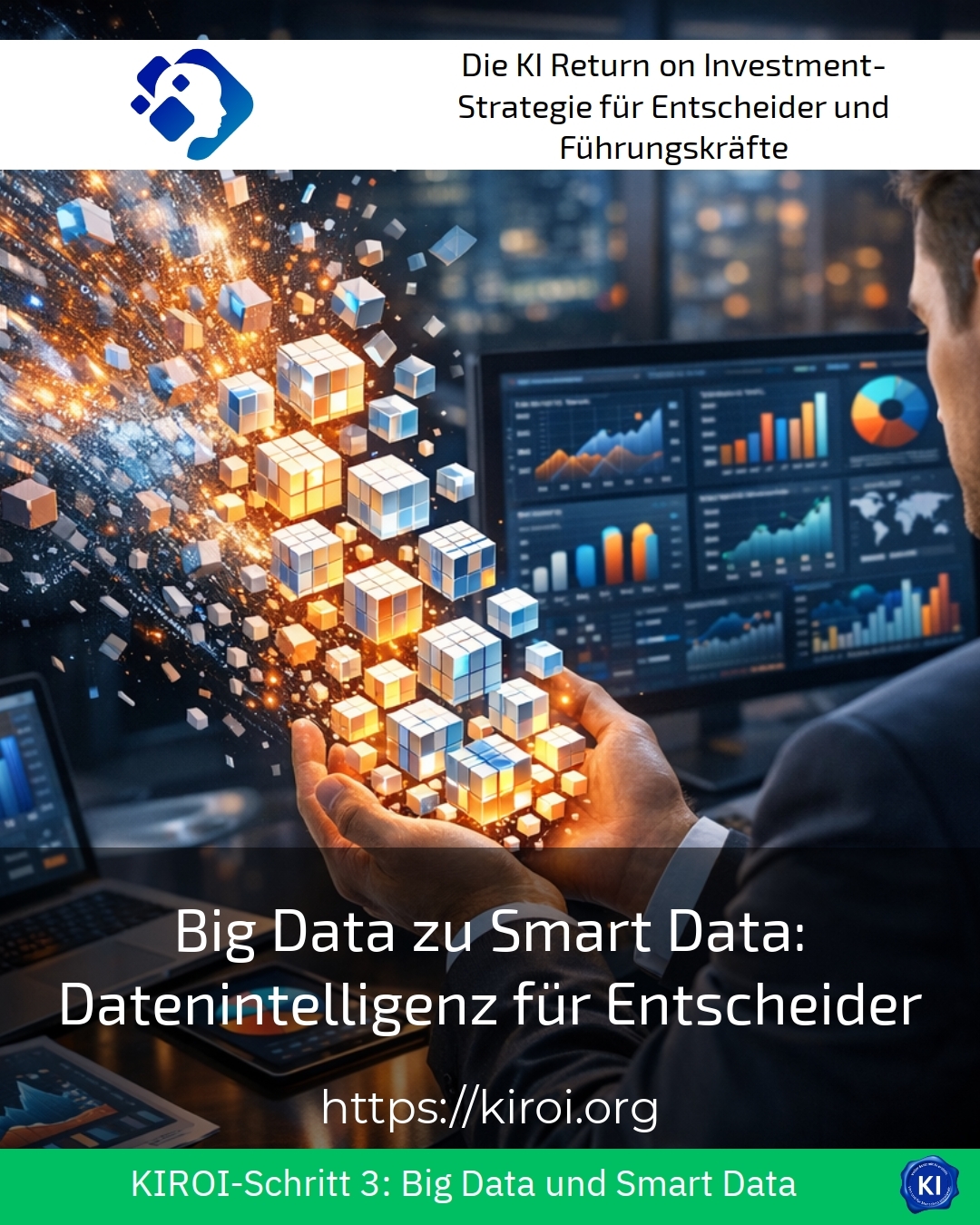
Do you know why many companies are drowning in vast amounts of data but still make decisions in a blind rush? The transformation of big data into smart data is emerging as a central challenge for modern executives who no longer want to drown in piles of numbers. Data intelligence for decision-makers today means much more than simply collecting information. It is rather about the artistic compression of complex data streams into actionable insights. In a time when billions of data points are generated daily, the difference between the good and the bad lies precisely where organizations learn to extract the essentials from the mass of data. Executives face the task of no longer merely possessing data but of using it intelligently and turning it into strategic benefits.
The evolution of data usage: From the masses to the elite
The development of recent years shows a fundamental change in the way companies handle their data. In the past, the motto was: the more data, the better. Today, more and more organizations recognize that quantity alone does not guarantee decision quality. Instead, intelligent processing and contextualization of information take center stage. Companies that adopt this paradigm shift early gain significant competitive advantages. The ability to recognize relevant patterns from unstructured data sets becomes the decisive differentiating factor. Modern analytical tools support decision-makers in identifying trends and connections that would remain hidden to the human eye.
A medium-sized retail company collected customer data for years without a clear strategy. The databases grew, but the insights remained superficial. Only through the introduction of intelligent analysis methods was it possible to identify buying patterns and develop personalized offers. Another example is a logistics company that analyzed sensor data from its vehicle fleet. The sheer volume of information initially overwhelmed all involved parties. However, after implementing smart filter algorithms, maintenance needs could be predicted accurately. Companies are also reporting significant improvements in customer service optimization after intelligently segmenting their communication data.
Big Data to Smart Data: The path to data intelligence for decision-makers
Transforming raw data into actionable insights requires a structured approach. First, relevant data sources must be identified and brought together. Next, quality standards must be defined and cleansing processes established. Only then can advanced analytical methods reach their full potential. Transruptions coaching supports organizations in developing individual data strategies tailored to their specific needs. Clients often report that through this support, they gain entirely new perspectives on their existing data sets.
Best practice with a AIROI customer
An internationally operating manufacturing company faced the challenge of optimizing its production processes without losing track of the complex data flows. The initial situation was characterized by fragmented data silos across different departments and locations. Production data, quality metrics, and supplier information existed side by side, without allowing for a comprehensive analysis. As part of the AIROI project, a comprehensive inventory was first conducted, identifying and categorizing all relevant data sources. Subsequently, the team developed an integration architecture that enabled the connection of real-time data from production with historical quality data. Through the implementation of intelligent dashboards, executives gained a holistic view of their value chain for the first time. The results were impressive: rejection rates decreased significantly, delivery times improved measurably, and employee satisfaction increased because data-based decisions became more comprehensible. The ability to identify quality issues early and proactively counter them before major damage occurred was particularly valuable.
Technological foundations and their practical application
Modern data platforms form the technical foundation for the intelligent utilization of corporate data [1]. Cloud-based solutions enable scalable processing of even large amounts of data. At the same time, advanced algorithms ensure the automated detection of patterns and anomalies. These technological developments support decision-makers in acting faster and more informed. An energy provider used these opportunities to better predict the electricity consumption of its customers. The integration of weather data, historical consumption patterns, and current network load information enabled a significantly more precise capacity planning.
In healthcare, the potential of intelligent data utilization is particularly striking. Hospitals that systematically evaluate their patient data can optimize treatment paths and use resources more efficiently. Insurance companies use similar approaches to better assess risks and adapt their products accordingly. In the education sector, data-driven decision-making is also gaining importance. Universities analyze student progress to identify at-risk students early and provide targeted support [2]. These examples illustrate the diverse applications of intelligent data utilization today.
Data intelligence for decision-makers: Cultural transformation as a success factor
Technology alone is not enough to unlock the full potential of data-driven decision making. Equally important is the development of an appropriate corporate culture. Leaders must learn to complement or question their decisions with data-based insights. This requires openness to new ways of working and a willingness to examine established patterns of thinking. Transruptive coaching provides valuable impulses for cultural transformation. Training is needed for employees at all levels to correctly interpret data and apply it in their daily work.
A financial services provider implemented a comprehensive program to promote data literacy. Workshops and training sessions sensitized employees to the possibilities and limitations of data-based analysis. In another case, the coaching team accompanied a city administration in the implementation of a data-driven management system. Initial skepticism quickly gave way to enthusiasm as the benefits became tangible in the workplace. A media company used similar approaches to more strongly base editorial decisions on user data without neglecting journalistic quality standards.
Best practice with a AIROI customer
A traditional family business in the manufacturing sector recognized the need to base its decision-making processes more strongly on data, but encountered significant cultural resistance in the process. For decades, the management had successfully relied on experience and personal assessments. The idea of incorporating algorithms into strategic decisions initially sparked unease. As part of the AIROI mentoring program, a careful transformation process was initiated that combined the strengths of the established corporate culture with the capabilities of modern data analysis. Crucial was to involve employees as active agents of change and to value their expertise. Through pilot projects in selected areas, early successes were quickly achieved that served as beacons for the entire company. Particularly noteworthy was the development of a proprietary data strategy that linked traditional values with innovative approaches. Today, the company emphasizes that it is precisely the combination of human experience and machine analysis that yields the best results. The company is now regarded in its industry as a pioneer for successfully integrating data culture and traditional knowledge.
Strategic perspectives and sustainable implementation
The long-term embedding of data intelligence requires thoughtful strategic planning. Companies should define clear goals and set measurable KPIs. It is advisable to start with manageable projects and gradually expand them. Regular evaluations help to review progress and adjust as needed [3]. A trading company started with the analysis of cash register data and gradually expanded the system to include additional data sources. This evolutionary approach reduced risks and enabled continuous learning.
In the tourism sector, companies use intelligent data analytics to predict booking trends and optimize capacity utilization. Airlines optimize their pricing through complex algorithms that take into account demand patterns. Hotels personalize their offerings based on individual guest behavior, thereby enhancing customer satisfaction. These examples show the diverse applications of intelligent data utilization in various industries. The key to success lies in the judicious combination of technological capabilities and human judgment.
Big Data to Smart Data in practical implementation
The concrete implementation of data intelligence presents many organizations with challenges. Technical integration, data privacy requirements, and change management all need to be considered simultaneously. External support from experienced partners can significantly accelerate the process and help avoid typical pitfalls. transruptions coaching positions itself as a competent partner in projects related to digital transformation. Clients particularly appreciate the practical approach and the individual adaptation to specific corporate realities.
An automotive supplier integrated real-time data from its production with quality information and customer feedback. The insights derived enabled proactive quality assurance, which significantly reduced complaint rates. A telecommunications provider used similar approaches to identify network problems before customers noticed them. In retail, companies rely on intelligent inventory optimization to anticipate fluctuations in demand and minimize overstocking. These practical applications highlight the vast potential inherent in the intelligent use of existing data.
My AIROI Analysis
The evolution of Big Data into Smart Data marks a crucial turning point in the way organizations use information and make decisions. Data intelligence for decision-makers is not an abstract concept, but a concrete skill that can and must be systematically developed. The numerous examples from various industries vividly demonstrate that success does not depend primarily on technological equipment but on the ability to transform data into actionable insights. Organizations that actively shape this change gain sustainable competitive advantages and are better equipped to meet the challenges of an increasingly data-driven economy. The cultural dimension should not be underestimated, as it is only when the combination of technological innovation and human expertise unleashes the full potential of intelligent data utilization that the full potential of intelligent data use can be realized. Transruptions coaching accompanies companies on this transformation journey and provides valuable insights for the individual design of the process. In conclusion, it can be stated that the future belongs to organizations that understand how to distill the truly relevant insights from the flood of available information and translate them into strategic action.
Further links from the text above:
[1] Bitkom – Information on Big Data and Data Analysis
[2] Federal Ministry for Economic Affairs and Energy – Digitalization Strategies
[3] Gartner – Definitions and concepts regarding Smart Data
For more information and if you have any questions, please contact Contact us or read more blog posts on the topic Artificial intelligence here.








 Deutsch
 English (UK)