
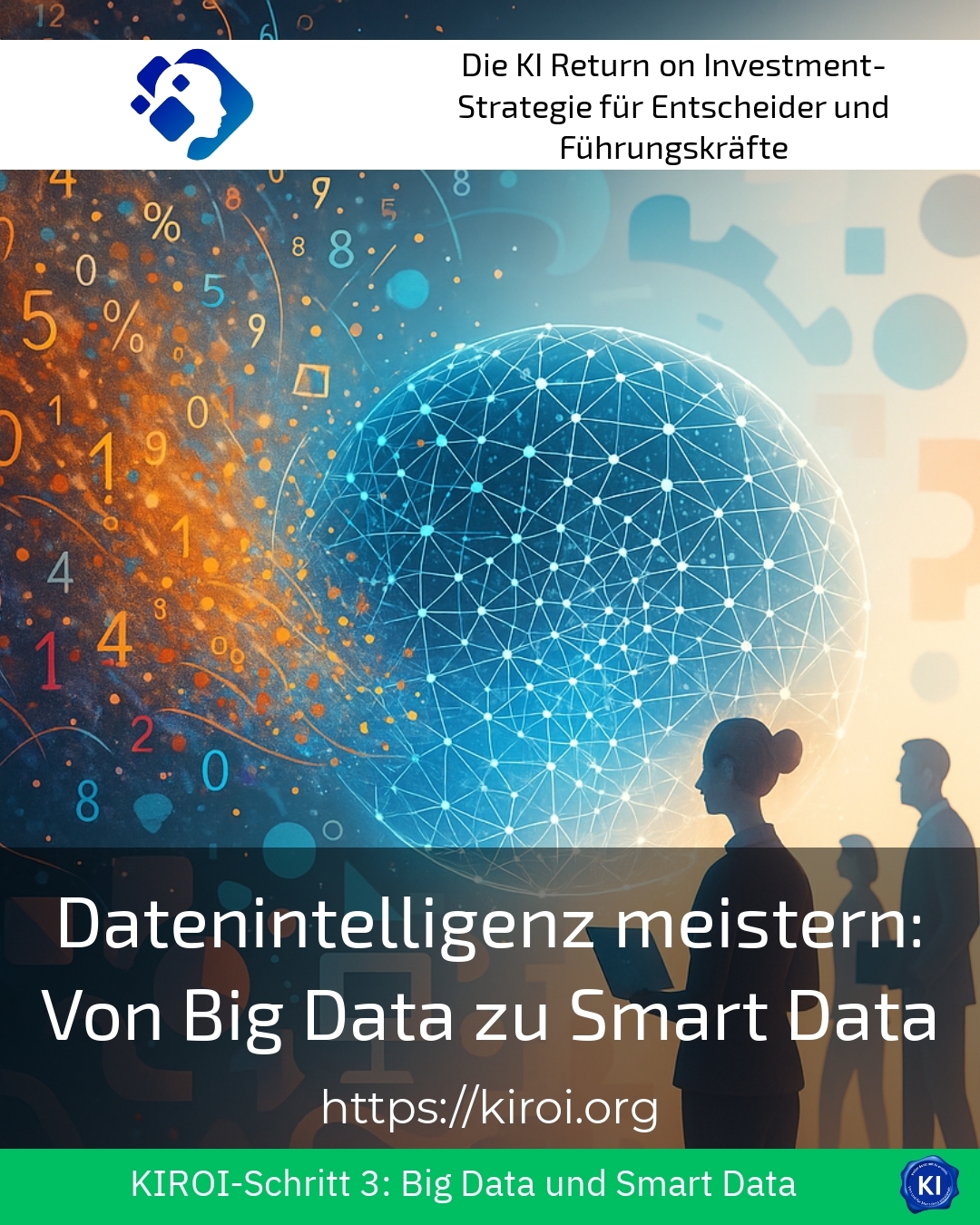
Imagine being able to filter precisely those insights from an overwhelming ocean of information that will truly drive your business forward. Mastering Data Intelligence: From Big Data to Smart Data describes exactly this transformation process, enabling organisations to generate real strategic advantages from the mere mass of data. In an era where unimaginable amounts of digital information are created daily, success is no longer determined by quantity, but exclusively by the quality of the insights gained and their intelligent use for business decisions.
The fundamental challenge of the modern information deluge
Businesses today are facing a paradoxical situation. On the one hand, they possess more data than ever before in the history of business. On the other hand, many organisations struggle to derive actionable insights from this abundance. This discrepancy between data availability and actual value creation represents one of the greatest challenges. For example, manufacturing companies continuously collect sensor data from their production facilities. Logistics service providers meticulously record every transport route and delivery time. Retailers store the complete purchasing behaviour of their customers over many years. Nevertheless, many of these companies effectively use only a fraction of this information.
The causes for this underutilisation are diverse and complex. Often, suitable analysis tools or the necessary expertise within the company are lacking. Sometimes, there are also no clear strategies for how the insights gained are to be integrated into concrete business processes. A car parts supplier may well have comprehensive quality data for its components. However, without intelligent linking and evaluation of this information, its potential remains unexploited. Clients often report feeling overwhelmed by the sheer volume of available information.
Mastering Data Intelligence: From Big Data to Smart Data as a Strategic Shift
The transition from pure data collection to intelligent data utilisation requires a fundamental shift in perspective. It's no longer about hoarding as much information as possible. Instead, the focus shifts to the targeted selection, preparation, and interpretation of relevant data points. This change affects all industries equally. A mechanical engineering company needs different information than a financial service provider. However, the methodology of intelligent data utilisation remains universally applicable.
Transruptions-Coaching supports organisations through this fundamental transformation process on various levels. It assists in asking the right questions and identifying suitable analysis methods. This isn't about pre-made solutions, but rather individual impulses. Every company brings its own prerequisites, data landscapes, and strategic goals. A chemical company works with completely different data structures than a media conglomerate. Guidance from experienced experts helps to find the optimal path.
Best practice with a AIROI customer
A medium-sized mechanical engineering company from southern Germany faced the challenge of optimising its production processes while significantly reducing maintenance costs. The company had extensive sensor data from over two hundred networked manufacturing plants, which had previously only been used for retrospective fault analysis. As part of the AIROI support, the team developed a completely new approach to the existing information. First, the employees, together with the coaches, identified those data points that actually possessed predictive power for potential machine failures. They then implemented an intelligent early warning system that automatically detects and reports anomalies in the operational data. The results of this transformation far exceeded initial expectations. Unplanned downtime was reduced by more than forty percent within eighteen months. At the same time, the costs for reactive maintenance measures decreased significantly, as problems could now be addressed proactively. The company has since expanded this approach to other locations and plans to offer the acquired know-how to its own customers as a service.
Practical approaches to improving the quality of corporate information
The transformation of raw data into actionable insights follows certain best practices. The first step always involves a critical evaluation of the available information sources. Not all data collected is equally valuable or relevant to the respective business objectives. For example, an energy provider collects consumption data from its millions of households. However, for network planning, only certain load profiles and peak consumption times are truly relevant [1]. The intelligent selection of this critical information forms the basis for all further analysis steps.
The second essential aspect concerns data quality and its continuous assurance. Even the most sophisticated analytical methods will not yield usable results if the underlying information is flawed or incomplete. For example, a pharmaceutical company requires absolutely reliable data for its clinical trials. An insurance group can only accurately calculate its risk models if the claims data has been correctly recorded. The establishment of robust processes for data validation and cleansing is therefore among the fundamental prerequisites for successful data strategies.
Thirdly, the contextualisation of information plays a crucial role. Numbers alone do not tell a story and do not enable informed decisions. Only when embedded in the respective business context do data become knowledge. A telecommunications provider can only meaningfully interpret customer churn rates when it links them to competitive activities, price changes, or service quality. This contextualisation requires both technical expertise and a deep understanding of the industry.
Mastering the Technological Foundations of Data Intelligence
Technological infrastructure forms the foundation for any successful data strategy. Modern cloud platforms now give even medium-sized companies access to powerful analysis tools. This democratisation of technology has significantly lowered the barriers to entry. A retail company can today conduct customer analyses that, just a few years ago, were only possible for large corporations [2]. A logistics company can calculate route optimisations in real-time and immediately incorporate them into operational processes.
Machine learning and advanced analytical methods are opening up entirely new possibilities for pattern recognition. These technologies can identify correlations that would remain hidden from human analysts. For example, a steel producer uses such methods to predict quality deviations. A financial institution employs them to detect suspicious transaction patterns. The range of applications is constantly growing, unlocking new potential for companies across all sectors.
Best practice with a AIROI customer
An international food group approached the AIROI team with a specific challenge in demand forecasting. The company produced perishable goods and had for years struggled with significant losses due to overproduction on the one hand and missed sales opportunities due to under-supply on the other. The existing forecasting systems were based on historical sales data and simple seasonal adjustments, which proved to be insufficient. Together with the consultants, the company developed an integrated approach that incorporated and linked additional data sources. Weather data, local event calendars, social media trends, and macroeconomic indicators now flowed into the forecasting models. This enrichment of internal sales data with external contextual information dramatically improved forecasting accuracy. Food waste decreased by more than thirty percent, while at the same time, product availability at sales points noticeably increased. The project impressively demonstrated how the intelligent linking of different information sources can lead to measurable economic benefits while simultaneously making a positive contribution to sustainability.
The human component in the data-driven company
Despite all technological advances, humans remain the crucial factor for the success of data-driven strategies. Technology alone cannot generate added value. It is the employees who must interpret the analysis results and translate them into action. A sales team must be able to incorporate customer analysis insights into improved sales pitches. Product developers need the ability to draw conclusions for future innovations from usage data.
The development of a data-driven corporate culture is therefore one of the most important tasks for the leadership level. This culture is characterised by curiosity, critical thinking and evidence-based decision-making. No matter how advanced the analysis systems an industrial company implements, these investments will remain ineffective without the corresponding acceptance and competence among employees. Experience shows that cultural changes often require more time and attention than technical implementations.
Disruptions coaching provides important impetus for organisational development. It supports companies in building the necessary competencies and overcoming resistance. For example, a construction company might want to benefit from the digitalisation of its project data. Without the active involvement of the site managers on location, this project will fail. A healthcare provider can only make meaningful use of its patient data if the medical staff understand and support the added value.
Mastering Data Intelligence: From Big Data to Smart Data in Various Application Fields
The practical implementation of intelligent data strategies varies considerably across different application areas. In the manufacturing sector, the optimisation of production processes is often the primary focus. Sensor data from production enables predictive maintenance and quality assurance. For example, a textile manufacturer uses image recognition for the automatic quality control of its fabrics [3]. An electronics producer analyses test data to identify manufacturing defects early and systematically eliminate their causes.
In the service sector, the focus is often on improving customer experiences and personalising offerings. A travel company can make individual recommendations by analysing booking patterns. A bank optimises its credit decisions by integrating diverse information sources. A media company personalises its content based on the usage behaviour of its subscribers. The possibilities are virtually limitless and continuously evolving.
In the public sector, the intelligent use of administrative data is becoming increasingly important. Cities are optimising their traffic flow through real-time analysis of movement data. Health authorities are improving their prevention programmes by evaluating epidemiological information. Educational institutions are developing individualised learning paths based on performance data. The societal potential of these developments is immense and far from being fully exploited.
My AIROI Analysis
The transformation from pure data collection to intelligent data utilisation represents one of the most significant shifts of our time. Companies that successfully manage this transition gain considerable competitive advantages. They make sound decisions faster and more precisely than their competitors. They recognise market changes earlier and can react to them more agilely. They understand their customers better and can serve their needs more precisely.
The AIROI methodology offers a structured framework for this complex transformation. It combines technological expertise with a deep understanding of organisational change processes. The focus is not on technology for its own sake, but always on the concrete business benefit. The numerous successful projects across a wide range of industries impressively demonstrate the effectiveness of this approach.
Particularly noteworthy is the importance of the human element in this transformation process. Algorithms and analysis platforms are tools, nothing more and nothing less. Only their competent use by qualified and motivated employees unlocks their full potential. The investment in people and corporate culture is therefore at least as important as the investment in technology. Organisations that consider both dimensions equally achieve the most sustainable successes and create long-term value for all stakeholders.
Further links from the text above:
[1] Digitalisation in the energy industry – BDEW
[2] Big Data Analytics – Bitkom
[3] Artificial Intelligence in Industry – Fraunhofer
For more information and if you have any questions, please contact Contact us or read more blog posts on the topic Artificial intelligence here.









 Deutsch
  English (UK)