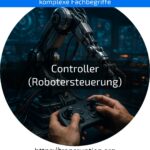
The term controller (robot control) is primarily found in the fields of robotics, automation, and industry and Industry 4.0. It refers to an important component that ensures a robot does exactly what it is intended to do.
A controller is the „brain“ of a robot. It is used to control all movements, processes and tasks. For example, if a robot arm in a car factory is screwing car parts together, the robot controller ensures that the arm adheres precisely to the predetermined movements – repeatedly, accurately, and reliably.
Imagine the controller as a remote control for the robot, but much more intelligent. It allows people to give the robot instructions, upload programmes, or even teach it new tasks. Modern controllers for robot operation are usually computer-controlled and can be flexibly adjusted for different jobs.
In practice, the controller (robot control) helps to automate processes and avoid errors. This makes production processes faster, more accurate, and often cheaper. Precise robot control is particularly indispensable for repetitive tasks.






 Deutsch
  English (UK)