
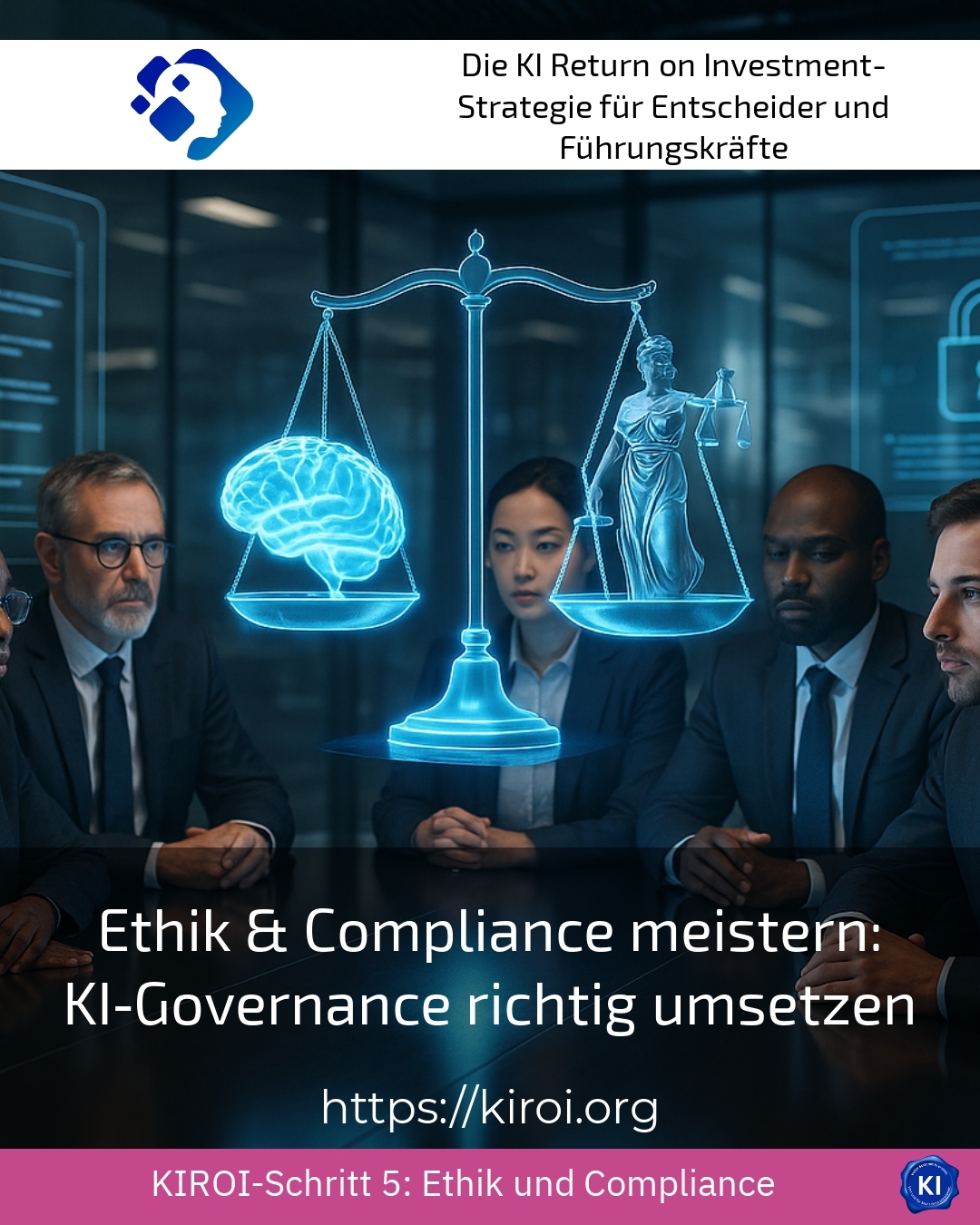
How do leading companies manage to use algorithmic systems responsibly while overlooking neither legal pitfalls nor ethical grey areas? This question is currently occupying boards of directors, compliance officers and technology departments alike, because the integration of intelligent systems into business processes requires far more than technical know-how – it demands a well-thought-out AI governance, which takes account of both moral principles and regulatory requirements. The use of machine learning methods now permeates almost every area of business, from automated customer service to fraud detection, and it is precisely for this reason that the pressure to establish binding frameworks is growing. In this article, you will learn which strategies and structures organisations are implementing to reconcile technological innovation with corporate responsibility, and why right now is the right time to address this complex topic.
Understanding the foundational pillars of effective AI governance
Before companies can even begin to govern intelligent systems responsibly, they must first understand the fundamental elements that make up a robust governance structure. Transparency is of primary importance here, because only when decision-making processes are comprehensibly documented can stakeholders develop trust in the technologies being used. For example, a leading insurance group has introduced an internal register that records all automated decision-making processes and is regularly audited by independent reviewers [1]. Furthermore, accountability plays a crucial role, because without clear responsibilities, no one can be held accountable for erroneous results or discriminatory patterns. A medium-sized retail company has therefore appointed an 'algorithm owner' for every algorithmic system, who is personally responsible for compliance with ethical standards. In addition, continuous monitoring forms another pillar, because even carefully trained models can lose their accuracy over time or develop undesirable biases.
However, the practical implementation of these pillars requires more than theoretical knowledge – it demands concrete processes that must be integrated into everyday business operations. An internationally active logistics service provider has expanded its existing compliance structures and created a dedicated committee that meets monthly to evaluate algorithmic decision-making systems. In the process, not only technical metrics such as accuracy and efficiency are considered, but aspects such as fairness, inclusivity and social impacts are also discussed. The documentation of these meetings serves simultaneously as proof for regulatory authorities and as an internal knowledge repository for future decisions. Such systematic approaches help organisations to successfully navigate the fine line between innovation and responsibility.
Why ethics and compliance are inextricably linked
Many managers still view ethical considerations and legal compliance as separate areas of action, even though in practice these are closely intertwined and mutually dependent. The European regulatory landscape is currently evolving rapidly, and what was voluntary self-regulation yesterday may already be a binding legal requirement tomorrow [2]. A pharmaceutical company recognised this development early on and formulated its ethical guidelines in such a way that they not only meet current regulations, but also anticipate foreseeable regulatory tightening. This forward-looking stance has given the company a significant competitive advantage because adaptations to new laws require only minimal changes. A financial service provider reports similarly positive experiences after developing internal ethical principles that go beyond the legal minimum requirements. As a result, customers gain trust and potential reputational risks are proactively minimized.
Best practice with a AIROI customer
A medium-sized manufacturing company turned to transruptions-Coaching because it faced the challenge of introducing a new system for automated quality control in an ethically justifiable manner. The management had recognised that the implementation without accompanying governance structures would entail considerable risks, both in terms of potential misjudgements and regarding acceptance among employees. Together, we first developed a comprehensive catalogue of criteria that defined which decisions the system was allowed to make autonomously and in which cases human review was strictly necessary. Subsequently, we established a training programme for all affected departments that not only conveyed technical aspects, but also fostered a deep understanding of the ethical implications. The company also set up an internal grievance mechanism through which employees could report concerns regarding algorithmic decisions without fear of disadvantage. After about six months of support by transruptions-Coaching, the organisation had implemented a fully documented governance structure comprising regular audits, feedback loops and continuous improvement processes. Since then, the managers have reported a significantly higher acceptance of the new technology among the workforce as well as measurable efficiency gains in production.
Practical steps for implementing robust AI governance
The theoretical foundations may be plausible, but the real challenge lies in practical implementation, which frequently encounters resistance and requires careful planning. The first step is to carry out a comprehensive inventory of all algorithmic systems already in use, because many organisations are surprised to find out how many automated decision-making processes already exist. During such an inventory, an energy supplier identified over thirty different applications, ranging from grid load forecasting to automated invoicing, some of which had been put into operation without formal approval or documentation. In the second step, companies should carry out a risk assessment of each individual system, taking into account technical as well as ethical and legal dimensions. A retail group has developed a matrix for this purpose that weights factors such as the scope of decisions, potential risks of discrimination and the reversibility of decisions. This systematic assessment enables prioritisation so that resources can initially be concentrated on particularly critical applications.
The third essential step involves the development of binding guidelines and standards that apply to all business areas and are actively supported by executive management. A technology company has adopted an internal code of conduct that describes in detail which principles must be adhered to during the development and deployment of intelligent systems. These guidelines were not created behind closed doors, but rather developed in a participatory process involving representatives from all relevant departments. A telecommunications provider goes a step further by involving external ethics experts in its development process to act in an advisory capacity on critical projects [3]. Such multidisciplinary approaches help organisations to identify blind spots and incorporate diverse perspectives.
Training and awareness as underestimated success factors
Even the most sophisticated governance structures remain ineffective if the people who work with algorithmic systems every day do not understand their significance or do not consistently follow the established processes. An automotive supplier has therefore set up a comprehensive training programme that reaches all levels of hierarchy and offers both foundational knowledge and specialised in-depth modules. Not only are technical skills imparted, but ethical judgement is also fostered by discussing case studies and working through moral dilemmas. A healthcare provider reports that following the introduction of such a programme, the number of reported concerns regarding algorithmic decisions has risen significantly – a sign that employees are now better equipped to identify and address potential issues. In addition, a media company has introduced regular reflection workshops in which teams jointly consider the impacts of their technological decisions.
Challenges and pitfalls during governance implementation
The introduction of a comprehensive governance structure for intelligent systems rarely runs smoothly, and companies face a multitude of obstacles ranging from technical difficulties to cultural resistance. A frequently underestimated problem lies in the lack of availability of high-quality documentation for systems already in use, because many models have evolved historically and no one knows for certain anymore what data they were originally trained on. A consumer goods manufacturer had to discover that some of its forecasting models were based on datasets that contained significant bias and could potentially produce discriminatory results [4]. Remedying such legacy issues requires substantial resources and technical expertise. A financial institution reports difficulties in integrating disparate governance approaches after several incompatible systems had to be merged following takeovers. Cultural resistance poses a further challenge because some development teams perceive additional documentation and auditing obligations as a hindrance to their work.
Best practice with a AIROI customer
An established trading company sought support with transruption coaching after internal attempts to introduce binding governance policies had failed repeatedly. The biggest challenge was that various departments had already established different practices and no one was willing to give up their tried-and-tested processes. We began by documenting all existing approaches and identifying their respective strengths, rather than decreeing a completely new structure from the top down. This appreciative approach helped to reduce resistance and foster a readiness to cooperate. Subsequently, together with representatives from all affected areas, we developed an integrated framework that adopted proven elements from various departments and combined them into a coherent overall approach. Implementation took place gradually over a period of nine months, with regular feedback sessions making it possible to continually refine the framework and adapt it to practical requirements. Today, the company has a unified AI governance structure supported by all departments that ensures both flexibility and binding minimum standards. The executive management emphasises that the participatory approach was crucial to the success.
The role of transruption coaching in complex governance projects
Complex transformation processes, such as the introduction of a comprehensive governance structure for algorithmic systems, often benefit from external support that brings in fresh perspectives and can act as a neutral moderator between different stakeholders. Transruption coaching positions itself clearly as support for projects relating to technological change processes and assists organisations in building sustainable structures rather than implementing short-term solutions. The work typically begins with a thorough analysis of the existing situation, taking into account technical systems as well as organisational processes and cultural factors. Clients frequently report that it is precisely this holistic perspective that provides crucial impetus and helps to identify connections that would be overlooked with a purely technical or purely legal approach. Alongside strategic advice, the support includes practical assistance in developing guidelines, designing training programmes and establishing monitoring processes.
My AIROI Analysis
The examination of numerous practical cases clearly shows that an effective AI governance requires far more than the mere compliance with legal minimum requirements – it demands a profound cultural shift that anchors ethical considerations as an integral part of every technological decision. Companies that establish robust governance structures early on not only secure legal certainty, but also gain strategic advantages in the form of increased customer trust, higher employee satisfaction, and improved innovative capability. The greatest challenge lies not in the technical complexity, but in orchestrating diverse stakeholder interests and consistently enforcing established standards across all hierarchical levels. Organisations that take this issue seriously should therefore plan for sufficient time and resources and understand the implementation as a multi-year transformation process, not a one-off project. The examples presented in this article make it clear that success is achieved above all when participatory approaches are chosen that turn those affected into participants and address resistance early on. External guidance from experienced partners such as transruptions-Coaching can offer valuable support by bringing in expertise, moderating processes, and acting as a critical sparring partner. Ultimately, the way in which companies deal with the ethical challenges of algorithmic decision-making systems today will determine their viability for the future in an increasingly digitised economy.
Further links from the text above:
[1] ISO/IEC 42001 Standard for Artificial Intelligence Management Systems
[2] European Commission – Approach to Artificial Intelligence
[3] Bitkom – Artificial Intelligence Topics Portal
[4] AlgorithmWatch – Research on algorithmic decision-making systems
For more information and if you have any questions, please contact Contact us or read more blog posts on the topic Artificial intelligence here.








 Deutsch
  English (UK)