
Why do over 70 per cent of all transformation projects in traditional industrial sectors fail, even though the technological prerequisites have long been in place?
This question concerns leaders in manufacturing companies worldwide, because the answer rarely lies in a lack of technology or missing budgets. The true bottleneck is hidden in people's minds and in outdated leadership structures that prevent the necessary Mastering AI cultural change complicate. When machines become intelligent and algorithms prepare decisions, the role of humans changes fundamentally. New working realities are emerging on factory floors that question traditional hierarchies and require a completely new understanding of leadership. The transformation does not begin on the production line, but in the boardrooms of executive management.
Understanding the quiet revolution on the factory floor
In modern manufacturing plants, collaborative robots now work side by side with experienced skilled workers. These cobots take over monotonous activities and allow employees to concentrate on more complex tasks. Some time ago, an automotive supplier from southern Germany introduced a system that automates quality inspections. The workforce initially reacted with scepticism and rejection because nobody had communicated the change sufficiently. The works council raised critical questions, and the mood on the production floor deteriorated noticeably.
Engineering companies experience similar situations when introducing predictive maintenance systems. These intelligent maintenance solutions analyse sensor data and forecast breakdowns before they occur. Experienced maintenance technicians often feel threatened in their expertise as a result. At a machine tool plant, three long-standing employees handed in their notice when the management implemented the new technology without involving the staff concerned. A packaging machine manufacturer lost valuable process knowledge because specialists left the company out of uncertainty.
Best practice with a AIROI customer
A medium-sized manufacturer of industrial valves faced the challenge of driving forward digital transformation in its production. The management recognised early on that technological investments alone would not lead to success. As part of a transruption coaching programme, the company developed a comprehensive support strategy for all affected employees. The managers learned to take fears seriously and to actively involve staff in the change process. Together with the works council, a qualification programme was created that offered every employee a perspective. The experienced machine operators became mentors for younger colleagues, who in turn contributed digital skills. Within eighteen months, a culture of mutual learning developed that permeated all levels of hierarchy. Staff turnover fell by more than half, and productivity increased measurably. This example impressively demonstrates how important the human component is in technological change.
Mastering the AI cultural shift through new leadership skills
Traditional leadership styles are reaching their limits in times of disruptive change. The authoritarian boss who makes all decisions alone no longer fits into a world of interconnected systems. Instead, companies need leaders who create spaces for experimentation and view mistakes as learning opportunities. A manufacturer of precision parts trained its entire management team in agile methods. The workshop supervisors in manufacturing learned to delegate responsibility and let teams work in a self-organised way.
In a drive technology company, a completely new understanding of management emerged through the consistent involvement of employees. The production management, together with the workforce, developed criteria for the use of new technologies. At a hydraulic components manufacturer, skilled workers took responsibility for the further development of their workplaces. These examples illustrate that modern management primarily means empowering and supporting people.
The chemical industry is also showing interesting developments in this area. There, companies are increasingly relying on process optimisation through intelligent analysis systems. The challenge lies in combining the implicit knowledge of experienced process engineers with digital insights. A speciality chemicals manufacturer initiated regular exchange formats between IT experts and production employees. These dialogues led to astonishing innovations that none of those involved would have developed alone.
Communication as the Key to Successful Change
Open communication forms the foundation of any successful change in manufacturing companies. Managers who provide transparent information about goals and potential impacts build trust among their employees. A foundry introduced monthly information events where all questions were answered openly. The management reported on progress and setbacks with equal honesty. At an injection-moulded parts manufacturer, information boards were set up in every department. There, employees could track the status of digitisation projects at any time.
The textile industry provides further insightful examples of successful communication strategies. A producer of technical textiles set up a digital platform where employees could exchange views. Anonymous feedback options significantly lowered the threshold for critical feedback. A manufacturer of nonwovens organised workshops in which concerns were systematically gathered and addressed.
Strategically designing qualifications and further training
Technological progress requires continuous learning at all levels of the organisation. Companies that invest in further training at an early stage secure decisive competitive advantages. An electronics manufacturer developed a modular training programme that adapted to varying levels of prior knowledge. Older employees learned at their own pace and without pressure. Younger colleagues took on the role of coaches for digital topics.
In the food industry, hygiene and quality assurance play a central role. Intelligent systems monitor processes and detect deviations in real time. A dairy plant intensively trained its employees in the use of the new analysis tools. As a result, the workers gained a better understanding of which decisions the system makes and why. At a bakery manufacturer, mixed teams of production workers and data analysts were formed.
Best practice with a AIROI customer
A family-run manufacturer of plastic packaging sought guidance with the introduction of intelligent quality control systems. The greatest challenge lay not in the technology, but in the workforce's acceptance. As part of transruption coaching, a concept was created that actively involved employees from the very beginning. The project group first identified the concerns and resistance of the various departments. Together, the team developed approaches to solutions that took both technical and human aspects into account. The experienced quality inspectors were given a central role as knowledge transmitters and process facilitators. Their many years of expertise were incorporated into the calibration of the new systems, making them significantly more precise. The managers learned to regularly gather feedback and make adjustments. After about a year, most employees reported a noticeable improvement in their working conditions. They felt valued and saw their future in the company secured.
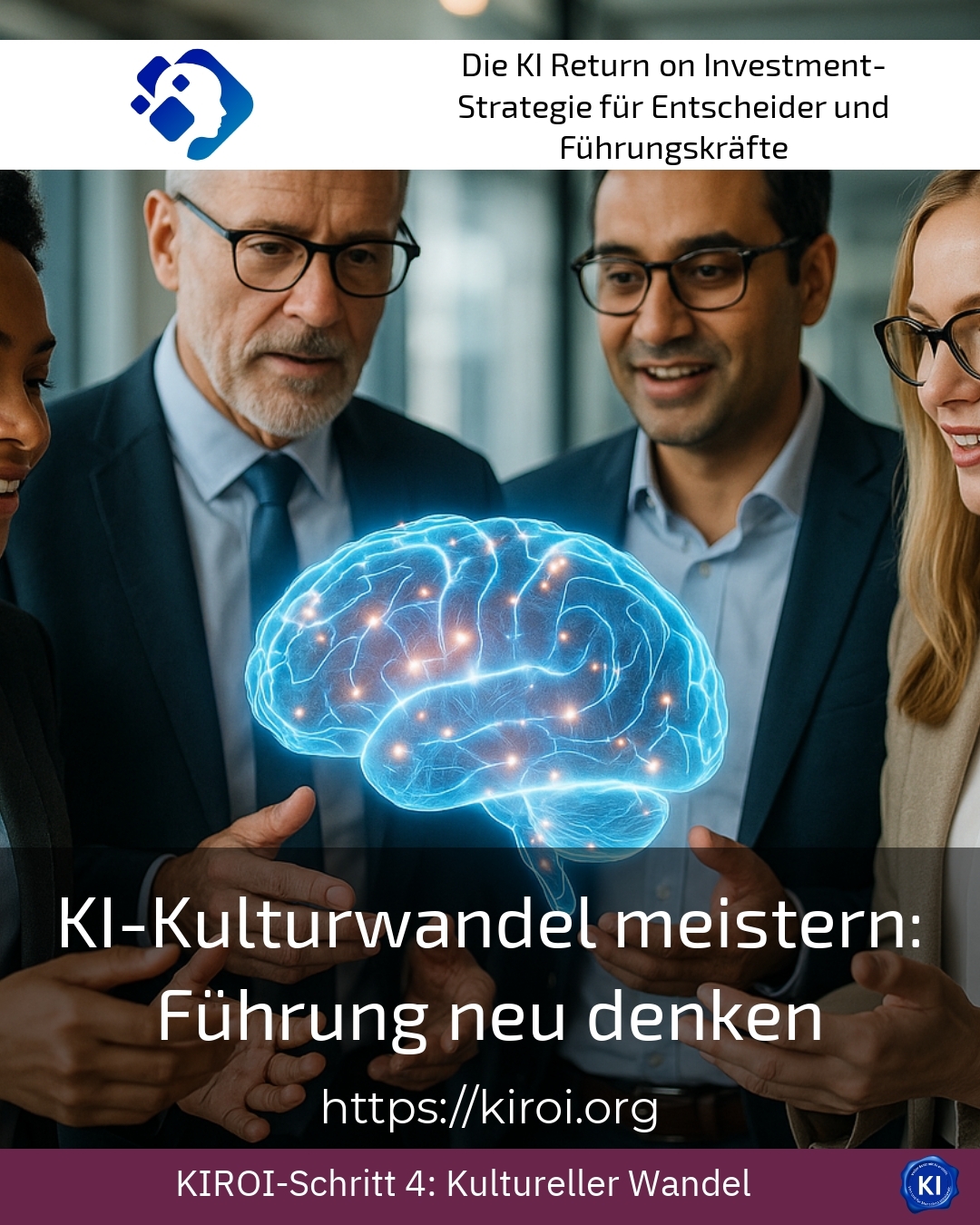
Mastering the cultural shift towards AI means bringing people along with you
Technology alone does not create sustainable change in organisations. True readiness for change only emerges when people understand the purpose and feel involved. A steel processor ran regular future workshops in which employees could contribute their ideas. The best proposals were actually implemented, which significantly increased motivation. At a printing press manufacturer, independent innovation teams were set up in production.
The pharmaceutical industry is a prime example of how strict regulations and digital transformation can be reconciled [1]. There, compliance experts work closely with technology teams to develop secure solutions. A generic drug manufacturer intensively trained its employees in regulatory requirements for digital systems. These combined competencies made the company a pioneer in its industry.
Constructively using resistance and building trust
Resistance to change often contains valuable information about unresolved problems. Wise leaders listen closely and take concerns seriously instead of ignoring them. An industrial gearbox manufacturer installed an anonymous feedback system for critical feedback. The collected objections led to important adjustments in the project plan. At a materials handling equipment manufacturer, a participation committee was established to accompany all major decisions.
The construction industry is currently experiencing massive changes due to digital planning tools and automated manufacturing methods [2]. Prefabricated components are increasingly produced in highly automated plants before being assembled on building sites. A precast manufacturer integrated its blue-collar workers into the digitalisation projects right from the start. The tradespeople contributed practical knowledge that the engineers alone did not have. At a precast concrete manufacturer, innovative solutions emerged through this cross-departmental collaboration.
Mechanical engineering faces unique challenges because it employs highly qualified specialists. These experts possess deep process knowledge that is difficult to replace. A machine tool manufacturer developed a concept that systematically documented the employees' expertise. This knowledge was incorporated into the programming of the intelligent systems. A press manufacturer created hybrid workplaces that optimally combined human and machine capabilities.
My AIROI Analysis
The described examples from various industries show a consistent pattern that runs through all successful transformations. Technological changes only succeed sustainably when managers put people at the centre. The Mastering AI cultural change requires far more than investments in hardware and software, as it touches upon fundamental questions of collaboration. Companies that focus on transparent communication and genuine participation from an early stage avoid costly resistance and delays.
The AIROI methodology provides a structured framework for systematically shaping these complex change processes. It takes into account both the technical requirements and the human factors that determine success or failure. The real-world examples illustrate that transruptions coaching can provide organisations with valuable impetus for their projects. Managers often report a shift in perspective following such coaching programmes. They recognise that their own attitude has the greatest influence on their teams’ willingness to embrace change.
The manufacturing industry is facing enormous challenges that can only be overcome together. Traditional leadership models are no longer sufficient to master the complexity of modern production environments. Companies need new competencies at all levels and the courage to leave well-trodden paths. The good news is: there are proven approaches and experienced guides for this path of transformation.
Further links from the text above:
[1] Digitisation in the pharmaceutical industry – Association of Research-Based Pharmaceutical Companies
[2] Digitalisation in mechanical and plant engineering – VDMA
For more information and if you have any questions, please contact Contact us or read more blog posts on the topic Artificial intelligence here.






 Deutsch
  English (UK)