
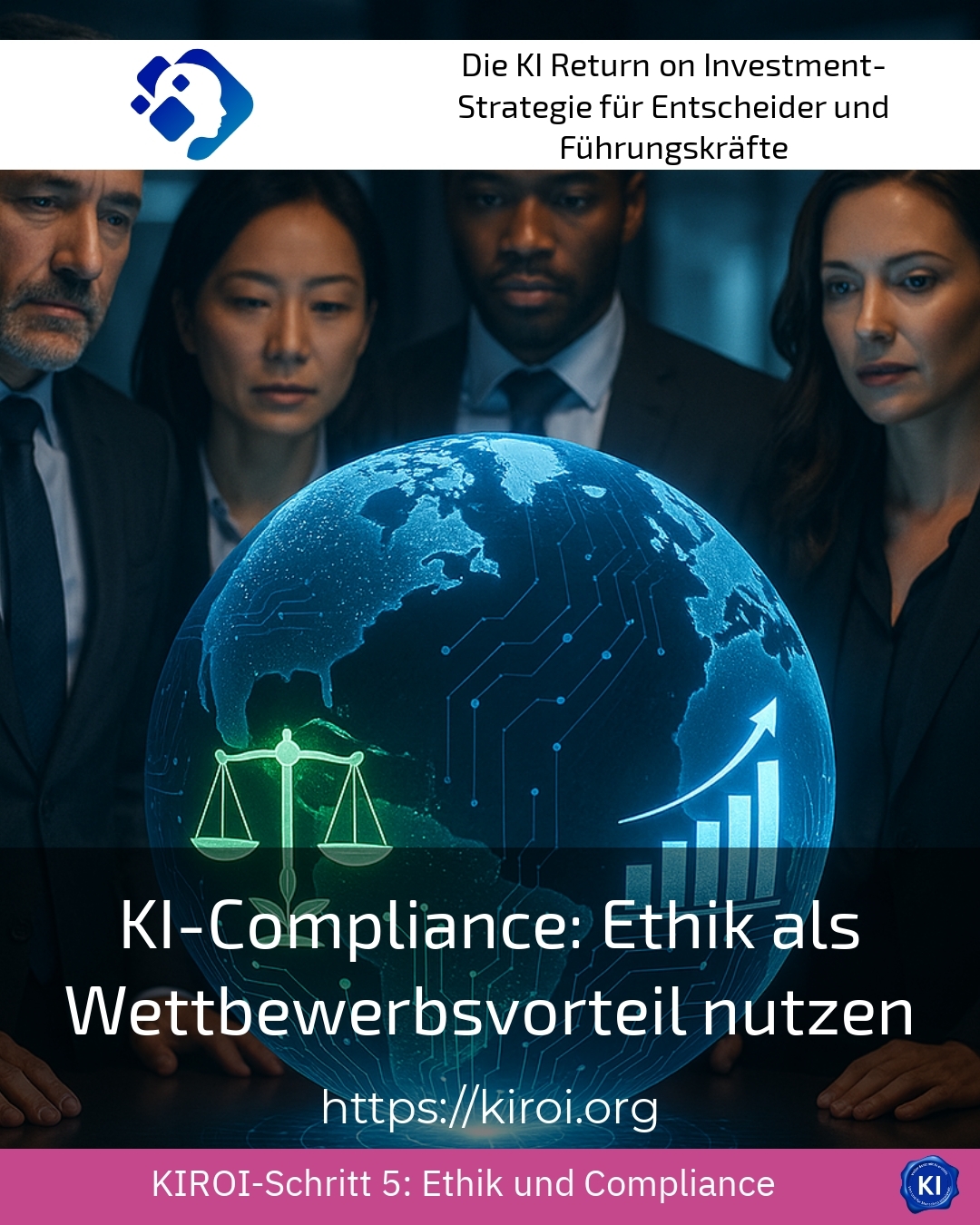
Imagine your company is gaining market share not in spite of strict ethical guidelines, but precisely because of them. The combination of AI Compliance and economic success initially appears to many decision-makers to be a contradiction. However, this assumption is increasingly proving to be a fatal misconception. Companies that consistently anchor ethical principles in the development and deployment of intelligent systems frequently report measurable competitive advantages. These advantages manifest themselves in increased customer trust, improved employee retention and more sustainable innovative strength. The following explanations will show you how you can harness this approach for your business.
Why ethical guardrails are becoming a strategic success factor
The public debate on the responsible use of algorithmic decision-making systems has gained considerable momentum in recent years. Consumers are paying closer attention to how companies handle their data and what decisions automated systems make. This trend affects almost all economic sectors to varying degrees. An insurance company, for example, uses algorithms for risk assessment when concluding contracts. If these systems exhibit discriminatory patterns, not only are there legal consequences, but also significant reputational damage. Banks use intelligent systems for credit scoring and must be able to prove that no unfair disadvantage is being imposed on certain population groups. Telecommunications providers, in turn, analyse customer behaviour for churn prevention and walk a fine line between legitimate business optimisation and questionable surveillance.
The introduction of binding AI ComplianceStructures therefore do not represent a mere formality. Rather, they create the basis for sustainable growth in an increasingly regulated market environment. Companies that invest in appropriate governance structures at an early stage position themselves as trustworthy partners. This positioning has a direct impact on customer relationships. Clients frequently report that their business partners specifically ask for ethical certifications and proof of compliance. The automotive sector, for example, is currently experiencing how suppliers without such proof are excluded from tenders. Pharmaceutical companies must adhere to the highest ethical standards when conducting algorithmic analysis of patient data. Retailers with personalised recommendation systems face the challenge of balancing transparency and trade secrets.
The AIROI approach as a guide to sustainable AI compliance
Transruptions coaching helps companies to view ethical principles not as an obstacle, but as a catalyst for innovation. The AIROI methodology provides a structured framework for this, taking into account sector-specific requirements whilst embedding universal principles. This approach differs fundamentally from reactive compliance measures, which merely respond to regulatory pressure. Instead, ethical considerations are integrated into development processes right from the start. Energy suppliers, for example, can thus develop smart grid management systems that operate both efficiently and fairly in load distribution. Logistics companies optimise their route planning not only on the basis of cost considerations, but also take social factors such as working conditions and environmental impact into account. Media companies design their recommendation algorithms in such a way that they promote diversity of information rather than reinforcing filter bubbles.
Best practice with a AIROI customer
A medium-sized company in the financial services sector faced the challenge of reviewing its existing scoring models for ethical compliance whilst simultaneously improving business efficiency. The existing systems had grown organically over the years, and no one could any longer fully understand which factors were influencing decision-making. As part of the AIROI support programme, a comprehensive review was first carried out, which uncovered hidden potential for discrimination. Certain postcode areas, for example, were systematically disadvantaged, which could have led to legal risks. Interestingly, revising the algorithms in line with ethical principles did not result in any loss of performance; on the contrary, it actually improved the quality of predictions by several percentage points. The more transparent decision-making logic also enabled significantly more efficient communication with customers in the event of rejections, which substantially reduced the complaint rate. The company is now actively utilising this ethical reorientation in its marketing communications and reports increased interest from institutional investors, who are paying ever greater attention to ESG criteria. The entire transformation spanned several months and involved staff from various departments, which further raised internal awareness of the responsible use of technology.
Practical implementation of ethical guidelines into corporate processes
Embedding ethical principles in daily corporate practice requires more than the adoption of guidelines at board level. Rather, concrete mechanisms must be established to ensure that these principles are integrated into operational decisions. Transruption coaching provides valuable impetus here for the gradual transformation of existing structures. In the healthcare sector, for example, hospitals are currently developing systems to support diagnostics while having to meet the highest standards of explainability and traceability. Recruitment agencies use algorithmic pre-selection systems and face the task of technically guaranteeing equal opportunities. Real estate companies utilise valuation algorithms and must be able to document that no systematic biases exist.
A central element of sustainable AI Compliance forming interdisciplinary ethics committees that regularly advise on the deployment of algorithmic systems. These committees should not consist exclusively of technical experts, but should also incorporate legal, philosophical and social science perspectives. The chemical industry, for instance, benefits from such diverse perspectives when developing process optimisation systems that have to take environmental impacts into account. Tourism companies design their pricing algorithms more transparently and thereby avoid the accusation of unfair practices. Educational institutions use adaptive learning systems while paying increased attention to the avoidance of stereotyping.
Measurable benefits through ethical AI compliance strategies
Quantifying ethical benefits presents companies with particular challenges because many positive effects only manifest themselves in the long term and are difficult to isolate from other factors. Nevertheless, numerous case studies now exist that demonstrate the economic added value of responsible technology use [1]. Consumer goods manufacturers report that transparent communication about the use of algorithms in product development strengthens brand loyalty. Insurance companies have recorded lower litigation costs since having their claims settlement systems checked for fairness. Retail companies with ethically aligned personalisation systems frequently experience higher acceptance among privacy-conscious customer groups.
The guidance provided by transruption coaching assists companies in developing suitable metric systems for measuring success. These metrics go beyond traditional financial indicators and capture, for example, the number of ethically motivated decision corrections or employee satisfaction regarding the company's technological orientation. Mechanical engineering companies measure the success of their ethically aligned predictive maintenance systems based on acceptance by maintenance technicians. Broadcasting corporations evaluate their recommendation algorithms according to criteria of diversity of opinion. Municipal transport companies optimise their route planning while taking social justice into account regarding the accessibility of different city districts.
Best practice with a AIROI customer
An internationally active retail company had realised that its dynamic pricing systems were coming under increasing scrutiny, both from customers and from consumer protection organisations. The previous strategy of using these systems as discreetly as possible had proved to be outdated and posed significant reputational risks. As part of the AIROI support programme, a transparent communication strategy was developed which explains how the pricing algorithms work in plain language and defines clear ethical boundaries. Certain practices, such as exploiting people’s distress or discrimination based on device usage, were explicitly ruled out, and this commitment was publicly communicated. The initial fear that this transparency would lead to competitive disadvantages did not materialise; on the contrary, the opposite proved to be the case, with increased customer loyalty and positive media coverage of the company as a pioneer of fair digital trading practices. The company received several awards for responsible business practices, which in turn helped it attract qualified staff, as younger applicants in particular pay greater attention to such factors. The entire initiative has since been extended to other business areas and serves as a blueprint for similar transformations within the group.
Future prospects and regulatory developments
The regulatory landscape in the field of algorithmic systems is developing dynamically and presents companies with the task of both meeting current requirements and being prepared for future tightening [2]. European legislation is playing a pioneering role internationally and is increasingly influencing standards in other economic regions as well. Aviation companies, for example, must adhere to the highest safety and ethical standards when developing autonomous systems and benefit from early compliance investments. The agricultural sector is increasingly relying on data-driven decision support while having to take into account the data sovereignty of farms. Textile companies use algorithms to optimise the sustainability of their supply chains and can use ethical alignment as a differentiating feature.
The expertise of transruption coaching helps companies not only to anticipate regulatory developments, but also to actively help shape them. By participating in consultation processes and contributing practical perspectives, companies can help ensure that regulations are both effective and workable. Technology companies often report that this proactive approach is more cost-effective in the long term than reactive adaptation to already enacted rules. Industry associations in the manufacturing technology sector are developing joint ethical standards for the use of collaborative robotic systems. The food industry is establishing transparency standards for the use of algorithms in quality control. Architecture and planning offices are integrating ethical considerations into their digital planning tools.
My AIROI Analysis
The intensive focus on the combination of ethical principles and economic success in the context of intelligent systems reveals a fundamental shift in the perception of compliance requirements. What was long considered a costly additional overhead is increasingly developing into a strategic differentiator in highly competitive markets. The AI Compliance is no longer viewed in isolation, but is understood as an integral part of a comprehensive corporate strategy that combines sustainability, trust-building and the capacity for innovation [3]. Experience gained from numerous support projects shows that companies which integrate ethical considerations into their development processes at an early stage and consistently do so not only anticipate regulatory requirements but are also able to respond more quickly and cost-effectively to new market demands. The interdisciplinary nature of the AIROI approach proves particularly valuable here, as it combines technical expertise with social science analysis and a business management perspective. For the coming development cycles, it is expected that the demand for ethically sound technological solutions will continue to rise, driven both by stricter regulations and by growing awareness amongst consumers. Companies that position themselves accordingly now will be able to benefit disproportionately from this development. Investment in ethical governance structures often pays for itself more quickly than originally anticipated, particularly when combined with appropriate marketing communications.
Further links from the text above:
[1] Bitkom – Artificial Intelligence and Ethics
[2] European Commission – European Approach to Artificial Intelligence
[3] Plattform Lernende Systeme – Developing AI Responsibly
For more information and if you have any questions, please contact Contact us or read more blog posts on the topic Artificial intelligence here.










 Deutsch
  English (UK)