
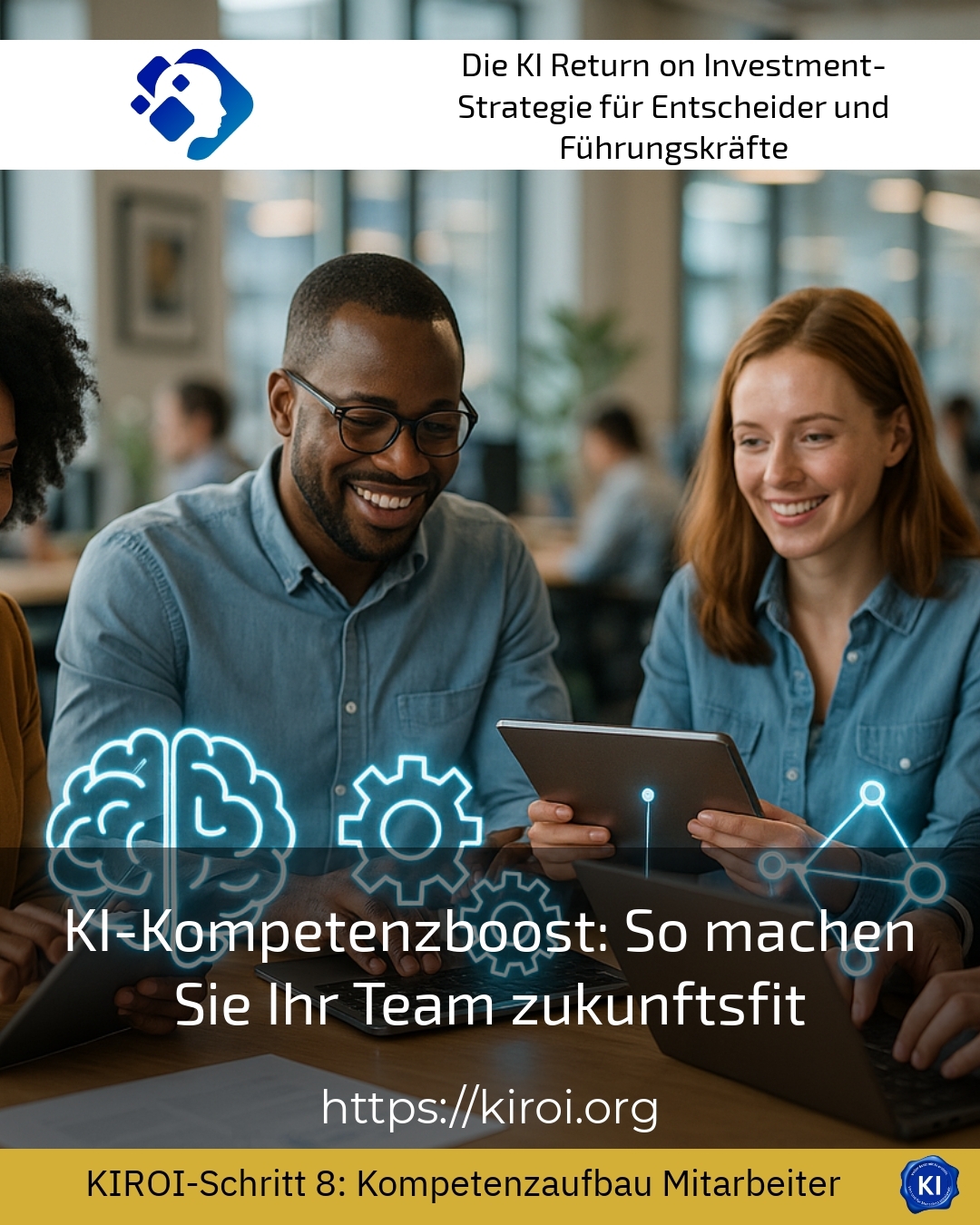
In a world that is changing rapidly, businesses face a crucial question: how do we prepare our employees for the technological disruptions that are already permeating our daily working lives today and will completely transform them tomorrow? The AI Skills Boost is long since no longer an optional extra programme, but a strategic necessity that determines the competitiveness of entire organisations. Many executives come to me with precisely this challenge: they feel the pressure to develop their teams further, but often do not know where to start. The good news is: with the right guidance and a structured approach, the transformation succeeds more sustainably than many initially assume.
Why an AI skills boost is essential today
The integration of intelligent systems into business processes is progressing relentlessly. Companies from a wide variety of sectors frequently report similar experiences. The technology alone brings no added value if the people behind it are not brought along. For example, a medium-sized manufacturing company discovered that the newly introduced machine learning-based quality control initially met with resistance. The employees felt sidelined and feared the loss of their expertise. The tide only turned when management invested in systematic training.
Similar patterns are emerging in the healthcare sector, where diagnostic imaging is increasingly being supplemented by algorithmic support. Radiologists report that, following appropriate further training, they no longer perceive the technology as a threat, but as an asset. They can focus on more complex cases while routine tasks are handled more efficiently. In the financial sector, meanwhile, advisers use intelligent analysis tools to structure client portfolios better. The prerequisite for this: they must understand how these tools work and where their limitations lie.
The AI skills boost as a strategic foundation
Sustainable skills development does not begin with technology, but with people. Transruptions coaching supports organisations in first identifying existing strengths and areas for development. Through this stocktake, a logistics company realised that its dispatchers already possessed implicit knowledge of pattern recognition. This knowledge could be brilliantly combined with new algorithmic approaches. A retail group, in turn, discovered that its buyers intuitively produced similar forecasts to modern prediction systems. Combining both worlds led to significantly better results.
In the recruitment services sector, another example of successful integration is evident. Today, recruiters use intelligent pre-selection systems that analyse application documents. Without appropriate training, however, employees tend to trust the recommendations blindly or ignore them completely. Both lead to suboptimal results. Only the combination of technical understanding and human judgement creates genuine added value.
Best practice with a AIROI customer An international mechanical engineering company faced the challenge of transitioning its service department to predictive maintenance. The existing technicians possessed decades of experience in reactive maintenance. They knew the machines inside out and often identified problems based on subtle noises or vibrations. The introduction of a sensor-based predictive system initially threatened to fail due to their resistance. As part of transruption coaching, we jointly developed a multi-stage qualification programme that took the technicians' existing expertise as a starting point. Instead of treating the employees as passive recipients of new technology, they were actively involved in calibrating and refining the algorithms. Their empirical knowledge fed directly into the development. After six months, the technicians reported that they found their work more valuable than before. The combination of human intuition and machine precision led to a reduction in unplanned breakdowns of more than thirty percent. At the same time, employee satisfaction increased measurably because the team members experienced themselves as shapers rather than subjects of change.
Practical Ways to Develop Competencies
Developing future-relevant skills requires a thoughtful approach. Frequently, clients report failed attempts in which isolated training measures fizzled out. For example, a pharmaceutical company invested substantial sums in external data analysis training. The employees returned to their workplaces motivated, but found no opportunities for application. Within a few weeks, the newly acquired knowledge had faded. This case illustrates a central insight: learning and application must go hand in hand.
In contrast to this is the example of an insurance company that chose an integrated approach. Small pilot projects were defined there, in which employees could immediately put what they had learned into practice. A claims management team, for example, independently developed rules for the automated preliminary check of routine cases. The marketing department experimented with personalising customer communications based on behavioural patterns. In both cases, tangible results emerged that reinforced the learning process.
An energy supplier, in turn, relied on internal multipliers. Selected employees from various departments received in-depth training and subsequently passed on their knowledge to their colleagues. These ambassadors acted as bridge-builders between technical possibilities and practical requirements. They spoke the language of their teams and knew the specific challenges of day-to-day business.
Overcoming obstacles through an AI skills boost
On the way to becoming a future-proof organisation, teams encounter various hurdles. The most common issues managers bring to me revolve around fears and uncertainties. Employees worry about becoming redundant through automation. Taking these concerns seriously is the first step towards overcoming them. A telecommunications company addressed these worries through transparent communication about the planned changes. It was clearly shown which tasks would change and what new opportunities would arise.
A further obstacle is the so-called illusion of competence. Some employees overestimate their ability to handle new technologies, while others systematically underestimate them. A media company therefore carried out structured self-assessments, which were compared against objective assessments. The results formed the basis for individual development plans. In the construction industry, on the other hand, it became apparent that practical experience makes the difference. Project managers who had already worked with BIM software and drone footage more quickly developed a feel for further innovations.
A lack of time is also frequently cited as an obstacle. The daily workload seemingly leaves no room for further training. This is where transruptions coaching provides support in integrating learning formats into existing routines. Micro-learning in the form of short, focused units has proven particularly effective here. An automotive supplier implemented weekly learning sprints of twenty minutes each, which were firmly anchored in the calendar.
Best practice with a AIROI customer A medium-sized food manufacturer wanted to optimise its production planning through intelligent demand forecasting. Previous planning processes were based on the empirical knowledge of long-standing employees and historical sales data in spreadsheets. The first attempt to introduce an external forecasting tool failed due to the planners' lack of trust in the automated recommendations. As part of our joint work, we developed a participatory approach in which the planners first learned to understand the basic principles of the algorithms used. They were empowered to critically question the outputs and reconcile them with their experiential knowledge. In parallel, we introduced regular retrospectives in which deviations between the forecast and actual demand were analysed. These feedback loops not only improved the quality of the predictions, but also strengthened the employees' trust in the system. After about eight months, planning accuracy had improved significantly, and planners reported a noticeable reduction in the burden of routine decisions. They were now able to use their time for more strategic tasks, such as developing seasonal special promotions or analysing new market trends. The project became a model for further digitalisation initiatives within the company.
The role of leadership in change
Leaders significantly shape how teams experience technological changes. Their own attitude acts as a multiplier across the entire organisation. A managing director from the mechanical engineering sector reported that his initial scepticism towards automated decision support systems unconsciously rubbed off on his department heads. Only when he began actively using the tools himself and spoke openly about his learning curve did the others open up too [1]. This role model function cannot be delegated.
A similar pattern can be seen in the management consultancy sector. Partners who experimented with analytical tools themselves built up authentic competence. They were able to advise clients credibly and motivate their own teams of consultants. A retail company, in turn, established so-called reverse mentoring programmes in which younger, tech-savvy employees introduced their superiors to new applications. This reversal of traditional hierarchies promoted the transfer of knowledge in both directions.
Crucial is also the willingness to view mistakes as learning opportunities. A chemical corporation introduced explicit experimentation spaces where teams could try out new approaches without having to deliver results immediately. This psychological safety proved to be a decisive factor for the willingness to innovate [2]. The managers themselves reported on their own failed attempts and thus normalised the handling of setbacks.
Sustainable embedding through the AI skills boost
One-off training measures rarely produce a lasting impact. Instead, what is needed are continuous impulses and structures that make learning ongoing. For example, a credit institution established monthly innovation lunches where employees from different areas presented new use cases. These informal formats promoted cross-departmental exchange and made progress visible.
In the manufacturing sector, so-called competency tandems, in which experienced specialists worked together with digitally affine colleagues, proved their worth. Both sides benefited: one contributed deep process knowledge, the other technical know-how. A textile company successfully used this approach when introducing quality predictions based on sensor data from weaving machines.
Measuring progress also plays an important role. This is not just about technical metrics, but also qualitative aspects such as self-efficacy and willingness to change. One healthcare provider developed a dashboard that integrated regular mood surveys alongside usage figures. This made it possible to identify the need for adjustments at an early stage.
My AIROI Analysis
Accompanying numerous organisations on their path to technological maturity has provided me with important insights. Firstly, it repeatedly becomes apparent that people must be at the centre. Technology is a tool that only unfolds its full impact when the people behind it understand and accept it. Companies that take this principle to heart achieve more sustainable results than those that rely exclusively on technical implementation.
Furthermore, it has been confirmed that change takes time and cannot be forced. Quick wins are possible, but they merely form the prelude to a longer-term development process. Transruption coaching therefore sees itself as guidance that provides impetus and offers direction without imposing ready-made solutions. Every organisation must find its own path that suits its culture and goals.
The importance of leadership cannot be overestimated here. Leaders who lead by example and authentically share their experiences create a climate of openness and curiosity. They encourage their teams to try new things and to learn from mistakes. This cultural dimension is often more decisive than the selection of specific technologies or training formats.
Ultimately, the value of continuous learning is confirmed time and time again. Technological development is advancing relentlessly, and what is relevant today may already be obsolete tomorrow. Organisations that establish a culture of lifelong learning are better equipped for upcoming challenges. They remain agile and adaptable, regardless of what specific innovations the future brings.
Further links from the text above:
[1] Harvard Business Review – Leadership and Change Management
[2] McKinsey – Organisational Performance and Learning Cultures
For more information and if you have any questions, please contact Contact us or read more blog posts on the topic Artificial intelligence here.







 Deutsch
  English (UK)