
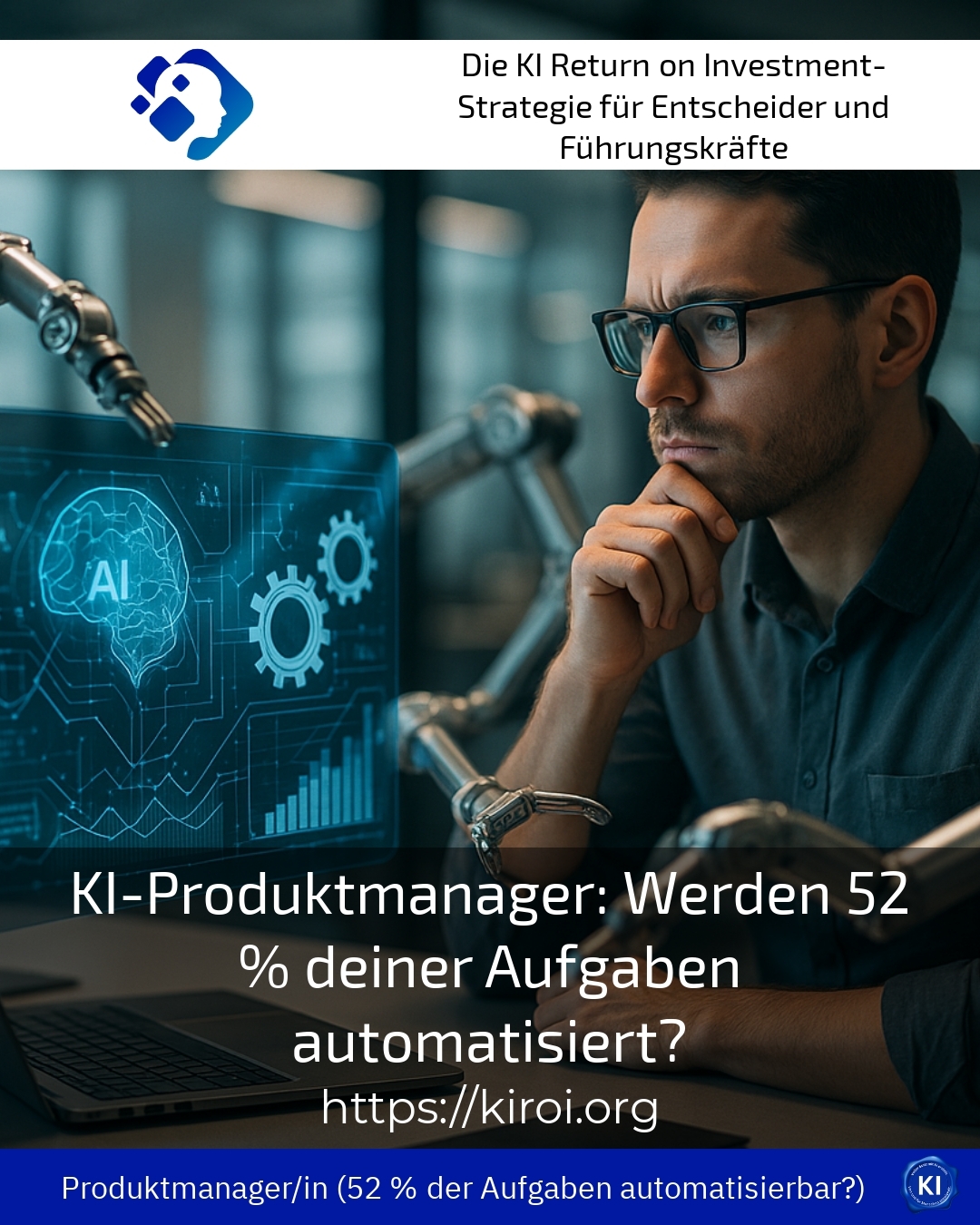
Have you ever wondered whether intelligent systems could soon take over half of your daily work tasks and what that means for your professional future? This question currently concerns countless professionals working in the field of strategic product development and management, because current research shows that approximately 52 percent of typical tasks in this professional field could theoretically be replaced by algorithmic solutions. For the AI Product Manager This results in a paradoxical situation, because the very people who are supposed to integrate intelligent technologies into products could themselves be affected by the automation of their own work processes.
The basis for this assessment is provided, among other things, by the Job Futureometer of the Institute for Employment Research [1]. This interactive tool analyses various job profiles in terms of their potential for automation. The good news for everyone working in this dynamic field is that there is a proven solution to optimally prepare for these changes. The AIROI seminars offer practical strategies and insights to strengthen one's own position. You can find all current dates here https://risawave.org/de/live-events-mit-sanjay-sauldie/ [2]. These events help you to understand technological disruptions not as a threat, but as an opportunity.
Which tasks of the AI product manager are particularly at risk?
The analysis of the automation potential reveals interesting patterns that should make any expert in this field gasp. Routine documentation tasks are among the activities that algorithmic systems can already perform today. Creating status reports, for example, can be significantly accelerated by intelligent tools. The collection and processing of user data is also increasingly automated. Market analyses that used to take weeks now generate modern systems within a few hours. Competitive analysis also benefits from automated monitoring solutions. Price comparisons and functional analyses of competing offers are already running largely autonomously.
Let us take a closer look at specific examples from the daily life of this field of work. An expert working for an e-commerce platform usually spends a lot of time analyzing purchasing behavior. Algorithms are now performing this task more precisely and faster. In the field of software development, intelligent systems automatically analyze user feedback. They categorize complaints, identify patterns, and propose improvements. In the automotive industry, automated processes monitor the telemetry data from connected vehicles. They detect optimization potential even before a human would have noticed it.
Best practice with a AIROI customer A medium-sized technology company from southern Germany faced the challenge of fundamentally modernizing its product development processes. The responsible product strategy specialist initially reported significant fears regarding their own professional future. After attending AIROI several workshops, this perspective fundamentally changed. The person learned to view automated analysis tools as support and not as competition. Within six months, the team implemented a system for automatically analyzing customer reviews. The time gained was now invested by the employees in strategic decisions and creative product innovations. The company recorded an increase in productivity of about 35 percent. At the same time, team work satisfaction improved significantly. The key was the conscious decision to delegate repetitive tasks and focus on value-adding activities.
The indispensable human competencies in modern product management
Despite all technological advances, certain skills remain firmly in human hands. The AI Product Manager The future is characterized by skills that machines cannot replicate. Emotional intelligence is at the forefront of this. Understanding the subtle nuances in customer requests requires human empathy. The ability to read between the lines remains a profoundly human strength. Moderating controversial discussions between development teams and management also requires social competence.
Strategic thinking at the highest level also eludes automation. The decision whether a company should enter a new market requires complex considerations. Cultural factors, political developments, and societal trends play an important role. An example from the consumer goods industry illustrates this impressively. A manufacturer of household appliances wanted to expand its product range with connected kitchen appliances. The data analysis showed promising sales forecasts for the Asian market. However, the relevant expert recognized cultural peculiarities through personal research on the ground. These had doomed the product in its original form to failure. Adjusting the user interface to local eating habits made the difference.
Creativity in product vision remains another human domain. Breakthrough innovations often arise from unexpected connections between different ideas. The development of the smartphone, for example, linked telephony, photography, and mobile internet. No algorithm would have predicted this combination. In the pharmaceutical industry, creative minds bring together therapeutic approaches from completely different disciplines. This leads to novel treatment methods that improve people’s lives.
Why AIROI the strategy is crucial right now
The speed of technological change overwhelms many professionals in this field. Clients often report uncertainty and a sense of being left behind by developments. The AIROI seminars provide the impetus to actively shape this situation. They help participants redefine their own role. Instead of fighting automation, participants learn to use it profitably. The AI Product Manager It thus transforms from a potential victim into the creator of change.
The seminars and workshops offer a structured approach to complex change processes. Practical applicability is the main focus. Theoretical knowledge alone is not enough to transform professional everyday life. Therefore, participants work on concrete projects from their own work environment. An example from the financial sector demonstrates the effectiveness of this approach. A bank wanted to modernize its product range for private customers. The responsible person used AIROI the methodology to develop a step-by-step transformation plan. Automated systems took over the analysis of customer profiles. The professional focused on the emotional design of the customer experience.
Best practice with a AIROI customer An internationally operating logistics service provider recognized the need to fundamentally overhaul its digital services. The product innovation department felt overwhelmed by the multitude of potential technologies. After an analysis using the AIROI-methodology, clear priorities crystallised. The team identified three core areas where automated solutions could immediately create added value. At the same time, they defined areas of responsibility that should remain explicitly in human hands. Negotiation with large customers over individual service packages was part of this. Likewise, the creative development of new logistics concepts for unusual transport goods. Within a year, the company established a new working culture. People and machines now work together in clearly defined roles. Employee satisfaction increased measurably, and the speed of innovation almost doubled. The key to success was the conscious decision as to which tasks should be automated and which should not.
Concrete recommendations for professional realignment
Transforming one’s own professional image requires active action and strategic planning. First, an honest assessment of one’s own activities is recommended. Which tasks repeat themselves regularly and follow clear patterns? These could potentially be automated. The time gained should be consciously invested in value-adding activities. The AI Product Manager The future spends less time collecting data and more time interpreting it.
Networking and industry knowledge are becoming increasingly important. Personal relationships with customers, suppliers, and partners cannot be automated. An example from the media industry illustrates this aspect. A streaming provider used algorithms to analyze viewing habits. However, the decision on the production of new original content remained with creative teams. These relied on their sense of social trends and cultural developments. In the fashion industry, a similar pattern is evident. Automated systems analyze sales data and predict trends. However, the final decision on new collections is still made by a human with aesthetic judgment.
Continuing education represents another success factor. The AIROI technological landscape is rapidly and dynamically changing. Those who are up to date today may already be out of step tomorrow. The lectures and workshops provide regular updates on current developments. They help professionals stay on top of the latest trends. An example from the healthcare industry underscores the importance of this approach. A medical technology company implemented connected diagnostic devices. The relevant expert continuously took part in training courses on new analysis methods. This ensured that, despite all the changes, she remained the central point of contact for strategic product questions.
Contribute actively to the future of the profession
The coming years will show how the occupational profile evolves. Pessimistic forecasts assume that many positions will disappear completely. More optimistic scenarios predict a shift in the focus of activity. The truth probably lies somewhere in between. However, one thing is certain: passivity is not an option. Those who actively shape the changes will benefit from them.
Accompanying experienced coaches and consultants can significantly facilitate this process. transruption coaching clearly positions itself as a partner in projects related to digital transformation. It is not about delivering ready-made solutions, but about developing individual paths. Each company, industry, and individual brings unique prerequisites. An example from the retail sector illustrates this individuality. A traditional department store wanted to expand its product range with digital services. The responsible person developed a customized plan together with advisors. Automated recommendation systems now complement the personal advice provided by trained staff. The result exceeded expectations in multiple respects.
My AIROI Analysis
The question of whether 52 percent of tasks in product management can be automated ultimately misses the point. It focuses on the threat potential and overlooks the enormous opportunities that exist. AI Product Manager You are at a crossroads, and both directions lead into the future. The one path means resistance to technological change and often ends in professional stagnation. The other path involves the conscious integration of automated tools into one’s own work routine. Those who choose this path gain time for the truly important tasks. Strategic decisions, creative visions, and human relationships take center stage. The AIROI strategy provides a structured framework for this transformation. It does not replace independent reflection, but it provides valuable impulses and proven methods. The experiences of numerous participants show that positive changes are possible. However, the key remains the willingness to engage in the process and to question old habits. The future belongs to those who understand technology as a tool and not as a competitor. They will become indispensable interfaces between machine efficiency and human creativity. This position cannot be automated because it is based on unique human abilities.
Further links from the text above:
[1] Job-Futuromat of the Institute for Employment Research
[2] AIROI seminars and live events with Sanjay Sauldie
For more information and if you have any questions, please contact Contact us or read more blog posts on the topic Artificial intelligence here.









 Deutsch
  English (UK)