
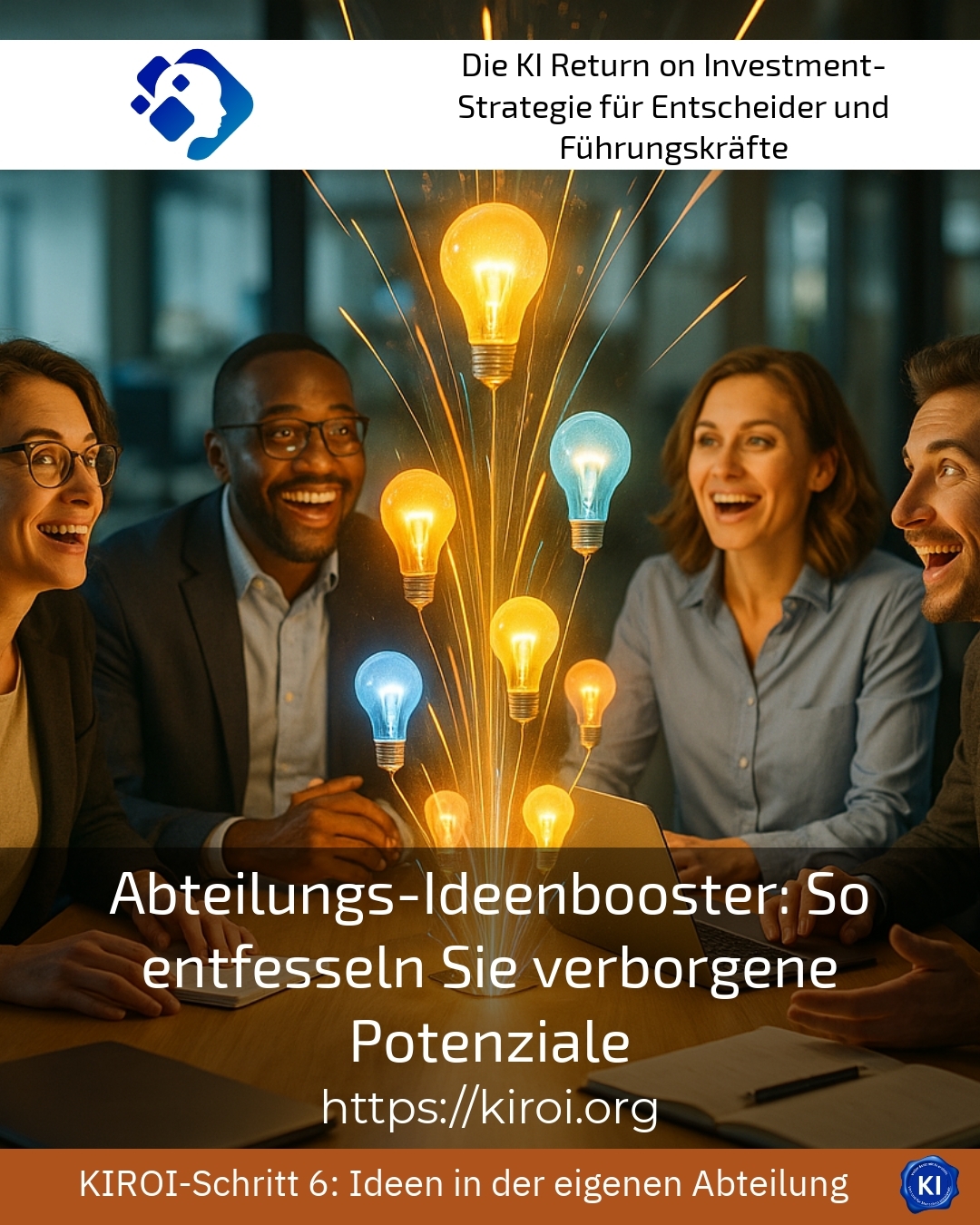
Imagine that in your organisation there are slumbering innovative forces just waiting to be awakened. The Departmental Idea Booster opens up precisely this possibility. Every day, valuable thoughts are lost because they find no space. Employees remain silent even though they harbour ground-breaking concepts in their heads. These untapped resources cost companies not only money, but also market share and competitive advantages. In this article, you will discover how to systematically unlock hidden potential. You will learn about proven methods that have already achieved astonishing results across various industries. In doing so, transruptions-Coaching accompanies organisations in the transformation of their innovation culture.
Why the departmental idea-booster has become indispensable today
The world of work has changed fundamentally. Hierarchical structures are increasingly giving way to agile networks. At the same time, the pressure to react more quickly and creatively to market changes is rising. In this environment, it is no longer enough to dictate ideas from above. Instead, companies must tap into the collective intelligence of all employees. One logistics company, for example, recognised that warehouse workers observed inefficient processes on a daily basis. However, nobody asked them for suggestions for improvement. When management finally introduced systematic idea-sharing sessions, lead times fell by a remarkable twenty percent. Clients from the healthcare sector report similar things. There, nursing staff developed innovative documentation methods that nobody had previously taken seriously. In retail, on the other hand, cashiers discovered patterns in customer behaviour that had completely escaped the marketing department. These examples clearly show that innovation potential often lies in unexpected places.
Understanding and overcoming psychological barriers
Before the Departmental Idea Booster its effect can unfold, certain obstacles must be recognised. Many employees are afraid of making fools of themselves. They fear negative consequences if their suggestions are not well received. These fears are often deeply rooted and based on past negative experiences. An engineering company struggled with precisely this problem for a long time. Engineers held back because previous proposals had been ignored or criticised. It was only through targeted workshops on psychological safety that the situation fundamentally changed. In the financial sector, we observe similar patterns. Analysts hesitate to share unconventional market assessments. They fear for their reputation should they be wrong. In advertising agencies, too, the fear of criticism significantly inhibits creative minds. Yet it is precisely from supposedly crazy ideas that the most successful campaigns often emerge.
Best practice with a AIROI customer
A medium-sized manufacturing company approached us with a specific concern. The management noticed that, despite regular meetings, hardly any new ideas were being generated. The mood in the departments was characterised by resignation. Employees carried out their tasks dutifully, but did not contribute beyond that. As part of our transruptions coaching support, we first conducted confidential one-on-one discussions with team members at all levels. This revealed a worrying picture of past disappointments and unheard voices. Together with the management level, we developed a multi-stage programme for building trust. This programme included anonymous suggestion boxes, moderated brainstorming sessions and recognition rituals for submitted proposals. After six months of intensive support, the culture of innovation had noticeably changed. The number of submitted suggestions for improvement increased fourfold. Some of these ideas led to measurable cost savings in the six-figure range. Particularly remarkable was the changed atmosphere in the weekly team meetings. Suddenly, employees who had remained silent for years spoke up voluntarily.
Creating structures that foster the departmental idea booster
Good intentions alone are not enough. Organisations require concrete structures to foster creativity systematically. This begins with the spatial design of workplaces. For example, a software company set up so-called innovation corners. These areas encourage informal exchange and are deliberately designed differently from normal offices. Colourful furniture, whiteboards and comfortable seating there signal that lateral thinking is desired. In a hospital, on the other hand, similar creative zones were created in the break area. Doctors and nursing staff now regularly use these spaces for spontaneous exchanges of ideas. Even a traditional craft business benefited from such measures. The master craftsmen henceforth met weekly in a redesigned meeting room to discuss process improvements.
Set aside time for creative thinking
Alongside spatial prerequisites, the factor of time plays a crucial role. Employees need protected periods of time in order to look beyond their own noses. A technology corporation therefore introduced so-called innovation Fridays. On these days, staff are allowed to work on their own projects that do not belong to day-to-day business. The results far exceeded all expectations. Several profitable product enhancements emerged from these free time slots. A similar model with slightly adapted rules became established in a management consultancy. There, consultants receive a whole day per month for experiments and further training. A hotel chain, in turn, uses the quiet winter months for intensive creative workshops with all staff. The seasonal fluctuation is thus transformed into a strategic advantage.
Methods and tools for sustainable idea generation
The Departmental Idea Booster only unfolds its full potential through suitable methods. Design Thinking has proven particularly effective in many industries [1]. This approach consistently places the user at the centre of all considerations. An insurance company used it to fundamentally revolutionise its customer service. Employees systematically put themselves in the shoes of frustrated customers and subsequently developed entirely new channels of communication. As a result, the complaints rate fell by almost thirty percent. The method of reverse brainstorming also frequently delivers surprising results. Participants initially ask how a problem could be made worse. They then reverse these negative ideas into positive ones. An automotive supplier successfully used this technique to improve its quality processes. The unusual perspective brought to light weaknesses that no-one had previously noticed.
Use digital platforms as innovation accelerators
Modern technologies significantly support brainstorming and further development. Digital innovation platforms enable collaboration across departmental and geographical boundaries [2]. A globally active pharmaceutical company introduced such a platform with great success. Scientists from various countries network there and combine their expertise in new ways. Several promising research approaches have already emerged from these virtual encounters. In the banking sector, innovative institutions use similar tools for their product development. Customer advisors from the branch communicate directly with IT specialists from headquarters. These short channels enormously accelerate the implementation of new service ideas. Even traditional craft businesses now benefit from digital idea platforms. A bakery business with multiple branches uses it to collect recipe ideas and process improvements from all locations.
Best practice with a AIROI customer
A service company with over five hundred employees was looking for ways to boost its innovative strength. Previous attempts with traditional suggestion schemes had failed and had brought frustration rather than progress. As part of our transruption coaching, we first analysed the existing communication structures within the company. It became apparent that there were virtually no horizontal connections between the various specialist departments. Marketing and sales worked in isolation from one another, as did IT and customer service. We recommended the introduction of interdisciplinary innovation circles to meet monthly on set topics. In addition, we implemented a digital platform for the continuous exchange of ideas between meetings. The platform offered features such as comments, ratings, and the ability to form teams for promising projects. After a year, the implemented measures showed an impressive record. Over two hundred ideas were submitted, fifteen of which resulted in concrete projects. The estimated added value of these projects significantly exceeded the investment.
The role of leaders in unlocking potential
Without committed leaders, even the best structures remain ineffective. Managers must actively act as role models for innovative thinking [3]. This means first of all openly sharing their own ideas and making themselves vulnerable. The managing director of a media company recently told me about his experience with this. He began deliberately expressing half-baked thoughts in meetings as well. This vulnerability encouraged his team to communicate more openly as well. In a law firm, a partner established a similar culture of shared thinking. Lawyers there regularly discuss unconventional legal constructions without having to fear criticism. A construction company, in turn, promotes innovation through targeted recognition of creative proposals. The owner honours the best idea every month and acknowledges it in front of the assembled team.
Use feedback as fuel for the department ideas booster
Constructive feedback forms the heart of any vibrant culture of innovation. Employees need to know what has happened to their suggestions. Silence is more demotivating than even a polite refusal with a comprehensible rationale. An energy supplier therefore introduced a transparent tracking system for all submitted ideas. Every suggester can track the status of their submission there and receives regular updates on it. In the event of a rejection, a personal explanation is given with concrete reasons for the decision. A fashion company goes a step further in its feedback culture. There, even rejected ideas are archived and acknowledged in a public database. Sometimes teams return to these suggestions later when the framework conditions have changed. A food manufacturer uses quarterly innovation reports to inform the workforce about the status of all projects.
My AIROI Analysis
After years of guiding organisations on their innovation journey, I draw several key conclusions. The success of an idea-generation programme depends less on individual methods than on the overall culture. Companies that create genuine psychological safety reap the richest rewards of creative collaboration. In this context, the attitude of the management team plays an absolutely central role in ensuring success. If superiors merely preach innovation without living it, every initiative remains superficial and fizzles out ineffectively. Equally important is the willingness to value even imperfect ideas and view them as a starting point for further development. Transruption coaching helps organisations to anchor these cultural changes sustainably and maintain them over the long term. We accompany companies on the often stony path from initial insight to lived practice. Time and again, this shows that patience and perseverance represent decisive success factors. There are no quick fixes, but continuous improvement is achievable for every organisation. Investment in a vibrant innovation culture always pays off in the medium term. Employees feel valued, staff turnover falls, and competitiveness increases sustainably. I encourage all decision-makers to take the first step and systematically unlock hidden potential.
Further links from the text above:
[1] IDEO Design Thinking – Fundamentals and Methods
[2] Harvard Business Review – Insights on Innovation Management
[3] McKinsey studies on innovation leadership
For more information and if you have any questions, please contact Contact us or read more blog posts on the topic Artificial intelligence here.









 Deutsch
 English (UK)