
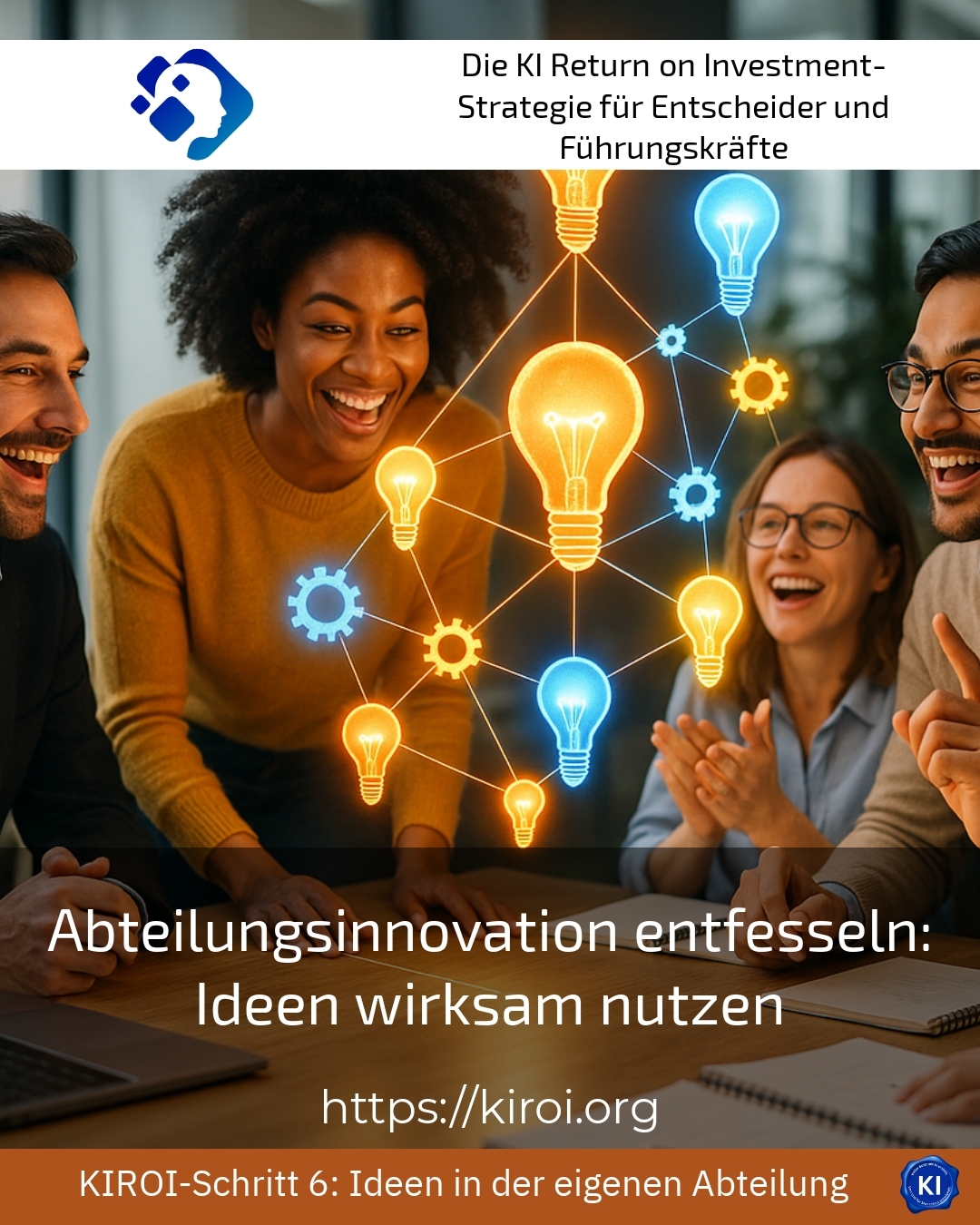
Imagine your company has thousands of undiscovered ideas lying dormant, just waiting to be unleashed. This is precisely where the concept Unleashing departmental innovation: making ideas work Many managers completely underestimate the creative potential of their teams. Yet, the most groundbreaking improvements often arise directly from the grassroots. Employees know the daily challenges better than any external consultancy. They know exactly where processes are faltering and which solutions could work. However, without the right structures, these valuable impulses get lost in the day-to-day. This article shows you tried-and-tested ways to systematically unlock the hidden innovation potential of your departments.
Why traditional idea management systems often fail
Many organisations have been running traditional suggestion schemes for decades with moderate success. The reasons for failure are diverse and often structural in nature. Firstly, there is frequently a lack of rapid feedback for the submitters. Those who wait months for a response lose the motivation for further involvement. Additionally, rigid evaluation criteria often deter creative minds. The bureaucratic hurdles appear insurmountable to many employees. This creates a vicious cycle of a lack of participation and dashed expectations.
Another problem lies in the lack of networking of ideas across departmental boundaries. A production manager might develop a solution that could also work in logistics. Without suitable platforms, this transfer potential remains unused. Similarly, there is often a lack of the necessary culture of error for experimental approaches. Employees shy away from the risk of standing out with unconventional suggestions. The fear of negative consequences outweighs the desire for improvement. A fundamental cultural change is needed here throughout the entire organisation.
Furthermore, many initiatives fail due to a lack of implementation capability after the idea generation phase. A brilliant idea without an implementation strategy remains ineffective. Leaders often underestimate the resource requirements for the realisation phase. Budgets are not released and time contingencies are not planned. This leads to the creation of idea graveyards, which sustainably damage the workforce's trust. The consequence is a gradual decline in the willingness to innovate throughout the entire company.
Unleashing Departmental Innovation: Creating Structures for Success
The key to sustainable innovation success lies in the intelligent design of frameworks. Firstly, teams need dedicated time slots for creative thinking away from day-to-day business. Some companies conduct so-called innovation sprints, where departments intensely focus on improvement topics. Others establish regular creative workshops with changing thematic priorities. The methodology in this case is less crucial than consistent implementation. The clear message from leadership that idea development is desired and valuable is important.
Another factor for success is the creation of low-risk experimentation spaces. Pilot projects in delimited areas allow for testing new approaches without endangering the core business. Teams can gain experience here and iteratively refine their ideas. The insights then feed into larger implementation projects. This step-by-step approach reduces resistance and increases acceptance among all stakeholders. At the same time, valuable learning effects are generated for the entire organisation.
Best practice with a KIROI customer
A medium-sized manufacturing company faced the challenge that valuable suggestions for improvement from the production department regularly got lost in the day-to-day business. Employees on the machines knew the weaknesses of the processes precisely, but their voices went unheard. As part of a transruption coaching process, the company developed a completely new format for structured idea generation. Every Friday morning, small teams met for thirty minutes for so-called improvement rounds. A trained moderator documented all suggestions digitally and categorised them according to urgency and implementation effort. Within just six months, over two hundred concrete improvement suggestions from all production areas were generated. More than sixty percent of these were actually implemented within the first year. Productivity in the affected lines increased measurably by almost twelve percent. Particularly noteworthy was the increased employee satisfaction, which was reflected in significantly reduced absenteeism. Managers reported a noticeable improvement in cooperation between shifts. The transruption coaching supported the entire transformation process with regular reflection sessions and methodological impulses.
The digital networking of idea generators across departmental boundaries opens up additional potential. Modern collaboration platforms enable exchange between teams that rarely meet in everyday life. A sales representative can share their customer feedback directly with the development department. Production planning gains insights into current market trends first-hand. This creates synergies that would be impossible with traditional silo thinking. Technology acts as a catalyst for human creativity in this process.
Developing leaders as innovation enablers
The role of a leader is fundamentally changing in innovation-oriented companies. Instead of giving instructions, leaders are becoming coaches and enablers for their teams [1]. They create the conditions under which creativity can flourish. This requires a rethink at all hierarchical levels of the organisation. Many leaders first need to learn to relinquish control and build trust. This learning process takes time and professional support from experienced coaches.
A crucial aspect is the ability to establish psychological safety within the team. Employees need to feel that even half-baked ideas are welcome. Mistakes are understood as learning opportunities and are not punished. This attitude must be genuinely modelled by the leader. Only then will the necessary trust for a real innovation culture emerge. The transformation always begins at the top of the organisation.
At the same time, leaders must learn to ask the right questions instead of providing ready-made answers. A well-formulated question can achieve more than a hundred instructions. It stimulates thought and activates the creative potential of employees. Techniques such as Socratic questioning or the "Five Whys" method support this process [2]. Transruption coaching offers valuable impetus here for the further development of leadership skills.
Practical methods for effectively using ideas in daily work
The theoretical foundations must be translated into concrete tools that work in day-to-day business. A tried-and-tested method is the so-called idea journal, which every employee can keep. Spontaneous ideas and observations are recorded here before they are forgotten. Regular exchange rounds then bring these individual notes into the team context. This way, well-thought-out suggestions for improvement emerge from individual fragments of thought. The low barrier to entry significantly increases participation.
Another effective technique is the systematic process walk-through with a fresh perspective. Teams analyse their own workflows as if they were seeing them for the first time. This shift in perspective often uncovers inefficiencies that are overlooked in day-to-day operations. External facilitators or colleagues from other departments can make valuable contributions. The external view exposes ingrained routines that no one questions anymore, thus making blind spots visible and addressable.
Best practice with a KIROI customer
A service company with multiple locations was struggling with significant variations in service quality between its branches. Best practices from one location often remained unknown to others. As part of the transruptive coaching process, a systematic knowledge transfer programme was developed. Each month, selected employees visited a different location for intensive experience sharing. They documented their observations in a standardised format and presented their findings to their home teams. In addition, a digital knowledge base was created, making successful practices accessible to everyone. The platform also allowed direct inquiries to the original initiators. Within a year, the variance in customer satisfaction scores between locations decreased by almost forty percent. At the same time, employee engagement increased measurably. Many reported a stronger sense of belonging to the organisation as a whole. Due to its great success, the programme was extended to other business areas. The coaches supported the ongoing development of the format and provided methodological impetus for optimisation.
Involving customers and suppliers in the innovation process significantly expands the pool of ideas [3]. External stakeholders bring perspectives that are often missing internally. Joint workshops or regular feedback loops create the necessary basis of trust. This leads to innovations that are precisely tailored to market needs. The success rate of subsequent market launches therefore increases considerably.
Unleashing departmental innovation through digital tools
Modern technologies can support and accelerate the innovation process in a variety of ways. For example, artificial intelligence analyses large quantities of suggestions and identifies patterns and connections. Chatbots are available around the clock as the first point of contact for submitting ideas. Automated workflows ensure quick feedback and transparent processing statuses. The technology relieves human resources for truly creative tasks. At the same time, the satisfaction of idea generators increases significantly due to shorter response times.
Virtual collaboration spaces enable cooperation across geographical boundaries. Teams in different locations can work together on innovation projects. Digital whiteboards and mind-mapping tools visualise the creative process for all participants. Video conferences with interactive elements can completely replace physical workshops where necessary. The pandemic has massively accelerated this development and set new standards. Hybrid working models are becoming the norm and require appropriate digital infrastructures.
Gamification elements can further boost motivation for idea submission. Point systems, leaderboards, and virtual badges appeal to the playful drive of many people. Competitions between departments foster creative ambition and a sense of teamwork equally. It is important to strike a balance between playful and serious elements. Intrinsic motivation should always take centre stage. External incentives can merely supplement and reinforce this fundamental motivation.
Overcoming resistance and winning over sceptics
Every change initiative encounters resistance that needs to be addressed constructively. Innovators often face the argument that there is no time for creative work. Demonstrating concrete efficiency gains from improvements already implemented is helpful here. Another typical objection concerns the worry of increased workload without corresponding recognition. Transparent appreciation systems and fair participation models can dispel these concerns. Communicating success stories from within one's own organisation is often more convincing than external examples.
Some employees fear that their ideas could be appropriated by others or implemented without attribution. Clear rules on authorship and transparent documentation can help to resolve this. Concerns about negative consequences for unsuccessful proposals must also be taken seriously. An explicit error culture, which is also modelled by senior management, reduces these anxieties. Transruptions coaching supports organisations in this sensitive cultural change with proven methods.
It is particularly important to involve informal opinion leaders within the company. These individuals are trusted by their colleagues and can act as multipliers. If they are convinced of the value of the innovation initiative, this will resonate throughout the entire workforce. Their critical questions should be understood as valuable feedback and answered constructively. This is how potential opponents become valuable allies in the change process. Investing in this relationship-building work pays off many times over in the long term.
My KIROI Analysis
Following intensive consideration of the topic of systematic idea utilisation in organisations, a clear picture emerges for the coming years. Competitive pressure will continue to increase and force companies to make continuous improvements. Those organisations that consistently unlock the creative potential of their employees will be one step ahead. The mere introduction of idea management software is far from sufficient for this. A holistic approach is needed that intelligently combines culture, structure, and technology. Unleashing departmental innovation: making ideas work must become an integral part of the company strategy.
The role of professional support from experienced coaches is becoming increasingly important in this regard. Complex transformation processes can overwhelm many organisations if they have to manage them alone. Transruption coaching offers valuable support with tried-and-tested methods and fresh perspectives. It's not about delivering ready-made solutions, but about empowering the organisation to help itself. The coaches provide impetus, ask the right questions, and guide through difficult phases. This leads to sustainable changes that endure even after the coaching engagement has ended.
My experience shows that the success of innovation initiatives is significantly dependent on the seriousness of top management. Lip service without genuine commitment is quickly seen through by the workforce. It requires visible investment in time, money, and attention. Top management must regularly put the topic on the agenda and personally drive it forward. Only then is the necessary credibility created for a sustainable cultural change. The transformation into an innovative organisation is not a sprint, but a marathon with many stages.
Further links from the text above:
[1] Harvard Business Review – Leadership and Management
[2] MindTools – The 5 Whys Method
[3] McKinsey – Building an Innovation Portfolio
For more information and if you have any questions, please contact Contact us or read more blog posts on the topic Artificial intelligence here.











 Deutsch
  English (UK)