
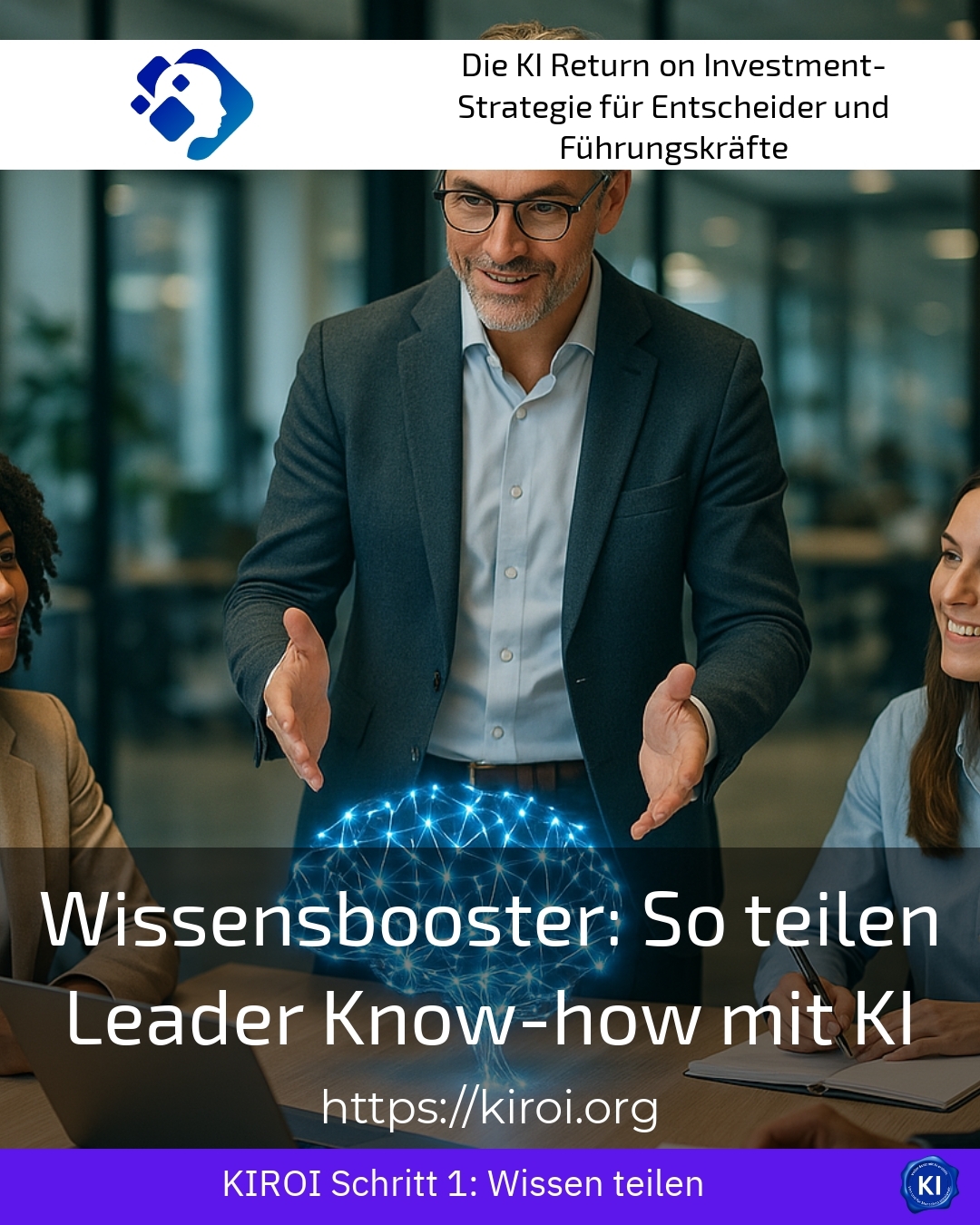
The digital transformation is fundamentally changing how leaders impart and organise their valuable knowledge. Imagine if the entire experiential knowledge of your best leaders was accessible at all times. Precisely this Knowledge booster Modern intelligent systems already make this possible in numerous companies today. Leaders face a fascinating challenge: How do leaders share know-how with AI and thus create a sustainable competitive advantage? The combination of human expertise and machine learning opens up entirely new perspectives for knowledge transfer in organisations. This paradigm shift affects all industries and company sizes equally.
The fundamental change in knowledge management in modern organisations
Traditional methods of knowledge transfer are increasingly reaching their natural limits. Mentoring programmes only reach a limited number of employees. Documentation quickly becomes outdated and is rarely maintained consistently. Meetings tie up valuable time resources and often create redundant information loops. Intelligent systems offer a completely new approach to solving these challenges.
In the automotive industry, development managers are already using learning algorithms to document complex decision-making processes. These systems capture not only explicit knowledge but also the contexts and reasoning behind strategic decisions. This allows a production manager to systematically record their experience and knowledge regarding quality issues. The system independently learns to recognise the correlations between various factors.
The pharmaceutical industry also shows impressive examples of how this new form of knowledge transfer can be applied. Research heads feed their findings from decades of laboratory experience into intelligent databases. Junior scientists access this structured knowledge and avoid costly repetitions of experiments already carried out. This makes the acceleration of development cycles tangible and measurable.
In the financial sector, algorithmic assistants are revolutionising the communication of investment strategies and risk assessments between experienced portfolio managers and their junior colleagues.
Best practice with a KIROI customer
A medium-sized engineering company faced a critical challenge in knowledge management. Several experienced engineers were set to retire within the next few years, and their specialist knowledge of bespoke customisations and technical problem-solving was in danger of being lost forever. Transruption coaching supported the company for eight months in implementing an intelligent knowledge system. During this time, managers learned to document their expertise through structured dialogues with the system. The system was trained on the company's specific technical terminology and was soon able to grasp complex technical interrelationships independently. Today, over one hundred employees use the system daily for solving technical challenges. The onboarding time for new engineers has demonstrably been reduced by more than forty percent. Particularly noteworthy was the high level of acceptance among the older skilled workers, who now see their legacy immortalised digitally and actively participate in knowledge documentation.
Knowledge Booster: How Leaders Share Know-how with AI in Practice
The practical implementation of these innovative knowledge transfer methods requires a systematic approach and a willingness to change established processes. Managers must first understand which forms of their knowledge are particularly well-suited for digital capture. Not every experience can be equally well structured and transferred into learning systems.
In the logistics industry, experienced dispatchers document their decision logic when planning complex routes. The system learns to recognise patterns that were not even apparent to the experts. A freight forwarding manager reported how the system revealed hidden optimisation potential in his own decisions. The combination of human intuition and machine analysis creates real added value.
Retail companies use similar approaches for disseminating sales strategies and customer psychology. Experienced store managers share their knowledge of difficult sales situations using digital training systems. New employees can thus train on realistic scenarios without annoying real customers. The quality of customer advice increases measurably, and staff turnover during the onboarding phase decreases significantly.
The energy sector provides a particularly impressive example of how technical specialist knowledge in power plant control and grid operation can be digitally secured. Engineers nearing retirement are transferring their troubleshooting knowledge into intelligent diagnostic assistants.
Methods for Effective Knowledge Transfer between Human and Machine
The quality of knowledge transfer depends crucially on the chosen methodology and the tools used. Structured interviews with managers often form the starting point for knowledge extraction. These discussions are conducted by specialised facilitators who understand both the technical content and the technical requirements.
In the insurance industry, claims experts documented their assessment criteria in dialogue-oriented sessions. The system specifically asked about borderline cases and exceptions to general rules. This resulted in a differentiated model of expert decisions that goes far beyond simple rule sets [1].
Telecommunications companies are focusing on continuous feedback between customer service managers and learning systems. Every corrected response from the system feeds into its further development. This way, managers actively participate in how their expertise is passed on.
In healthcare, experienced doctors document their diagnostic considerations for complex cases for training purposes. The system learns not only the diagnoses themselves, but also the thought processes and differential diagnoses that lead to the decisions [2].
Cultural prerequisites for a successful digital knowledge booster
Technology alone is not enough to establish sustainable knowledge transfer. Corporate culture must actively promote and value knowledge sharing. Leaders must understand that their willingness to share knowledge does not jeopardise, but rather strengthens, their status. This cultural transformation requires time, patience, and continuous communication.
The construction industry shows interesting examples of this cultural change in traditional sectors. Foremen and site managers, who for decades considered their knowledge a power base, are now experiencing the benefits of structured knowledge exchange. Their expertise becomes visible and recognised, rather than disappearing unnoticed when they retire.
Media companies have recognised that editorial expertise and journalistic judgment are valuable resources that can be systematically captured. Editors-in-chief share their assessments of news values and ethical decisions with subsequent generations of journalists.
The chemical industry is increasingly focusing on safety culture transfer through intelligent documentation systems. Experienced laboratory managers are imparting their intuition for hazardous situations to algorithmic warning systems.
Best practice with a KIROI customer
An international food group approached us with a specific product development challenge. Their most experienced recipe developers possessed invaluable knowledge of flavour combinations and texture optimisation that was undocumented. Transruption coaching guided the project team over several months in developing a strategy for systematic knowledge capture. Together with the management, relevant knowledge domains were first identified and prioritised. In weekly sessions, the experts extensively documented their sensory assessments and the reasons for specific recipe adjustments. The intelligent system was trained to recognise and store connections between ingredients, processing methods and flavour profiles. Today, the system supports product developers in creating new recipes with concrete suggestions based on the experts' experiential knowledge. Time-to-market for new products was reduced by approximately thirty percent, and the success rate in product tests increased significantly. Particularly pleasing was the positive feedback from the senior experts, who felt affirmed in their importance to the company through the project.
Strategically implement and sustainably embed knowledge boosters
The strategic implementation requires a clear roadmap and defined milestones for all stakeholders. Pilot projects should begin with particularly motivated leaders who can act as ambassadors for the initiative. The gradual rollout allows for continuous learning and adaptation to specific needs.
Automotive suppliers have successfully begun documenting their quality management expertise. From there, they systematically expanded into areas such as production optimisation and supplier management.
Banks initially implement knowledge transfer systems in the area of credit risk assessment before involving other departments. Successful use cases are more convincing to sceptical colleagues than theoretical arguments [3].
Tourism companies use the destination expertise of their most experienced travel consultants for intelligent recommendation systems, measurably improving the customer experience.
Challenges and ethical considerations of digital knowledge transfer
The digital capture of management knowledge raises important questions about how to handle personal expertise and intellectual property. Who owns the documented knowledge after a manager leaves the company? How can it be ensured that sensitive knowledge is not misused? These questions require careful legal and ethical considerations.
In the consulting industry, partners are intensely discussing the limits of knowledge digitisation and its impact on their business model. The personal relationship with the client remains a crucial success factor that cannot be fully digitised.
Advertising agencies are experiencing similar debates about the digitalisation of creative processes and idea generation. Creative directors emphasise that inspiration and cultural sensitivity cannot be captured by algorithms.
The legal sector particularly clearly demonstrates the boundaries between documentable expertise and non-formalizable judgment in complex client situations [4].
My KIROI Analysis
The systematic connection of leadership expertise and intelligent systems marks a turning point in the knowledge management of modern organisations. Observations from numerous projects clearly show that the success of these initiatives primarily depends on human factors. Technology alone does not create a sustainable knowledge booster for companies. Leaders must be intrinsically motivated to share their knowledge and actively participate in shaping the systems.
Companies that do not view knowledge transfer as a one-off project but understand it as a continuous process are particularly successful. Regular updating and refinement of documented expertise ensure its long-term relevance. Organisations should allocate sufficient resources for the maintenance of these knowledge systems and define dedicated responsibilities.
Transruption coaching can offer valuable support for such projects by addressing both the technical and cultural dimensions of change. Clients often report that it is only through an external perspective that hidden resistance and potential become visible. Investing in professional support typically pays off through faster implementation and higher acceptance.
For the coming years, I expect an acceleration of this development in almost all sectors. Companies that start with systematic knowledge transfer today will gain a significant competitive advantage. The generation of experienced baby boomers is increasingly leaving companies, and their knowledge must urgently be secured. The technology is mature, the methods are proven, and the need for action is obvious.
Further links from the text above:
[1] McKinsey – The State of AI
[2] WHO – Ethics and Governance of Artificial Intelligence for Health
[3] Gartner – What's New in Artificial Intelligence
[4] World Economic Forum – AI and the Future of Work
For more information and if you have any questions, please contact Contact us or read more blog posts on the topic Artificial intelligence here.











 Deutsch
  English (UK)