
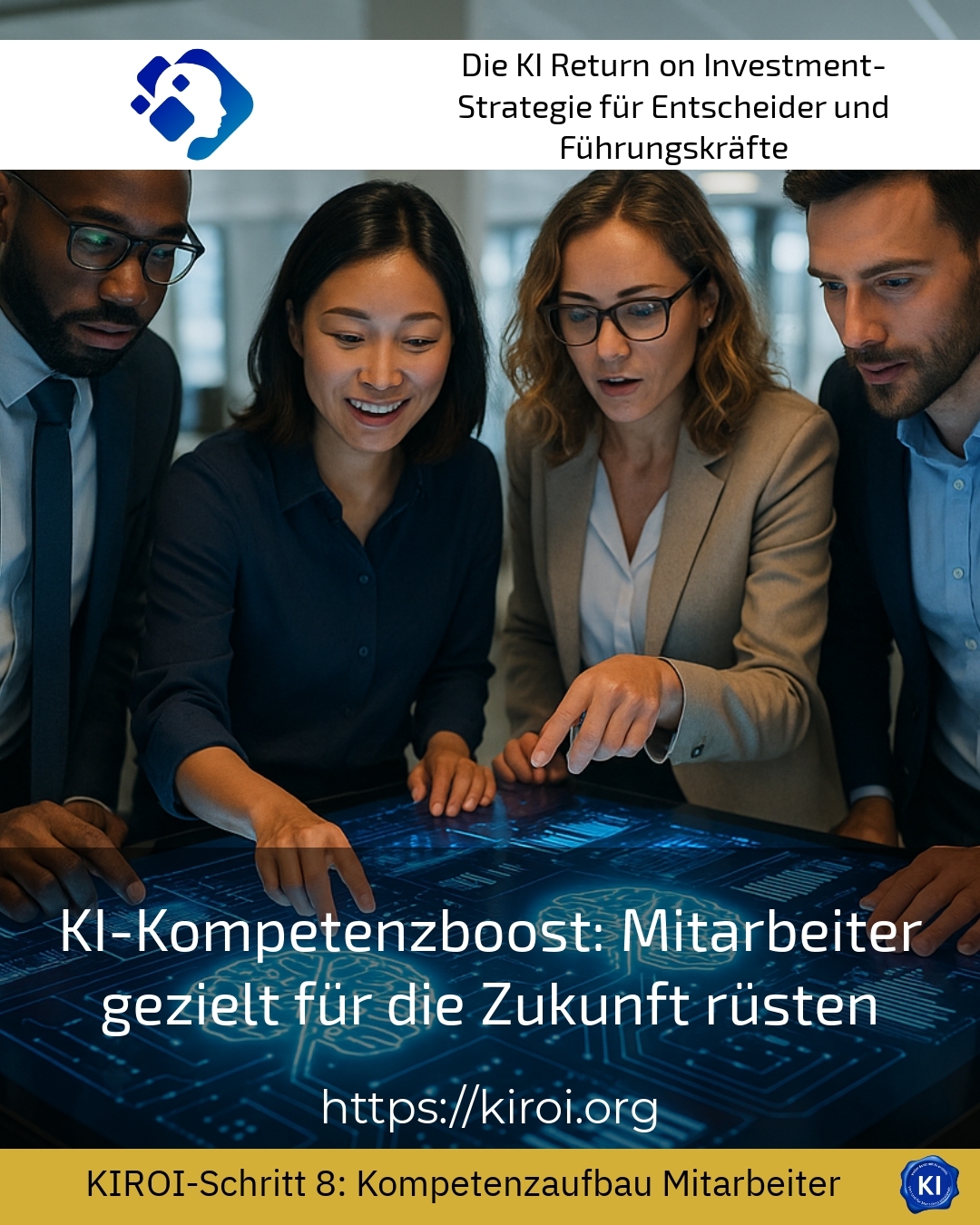
Imagine if your entire workforce navigates the digital transformation with confidence, using cutting-edge technologies with a natural ease that would have been unthinkable just a few years ago. AI Competency Boost: Equipping Employees Specifically for the Future is at the top of the agenda for forward-thinking companies today because the rapid development of intelligent systems is affecting every industry and fundamentally changing the requirements for human skills. The question is no longer whether organisations should empower their teams, but how they can do so most effectively to remain competitive while unlocking the full potential of their employees.
Why the AI skills boost has become indispensable now
The technological revolution is advancing at a pace that regularly surprises and challenges even seasoned leaders and technology experts. Companies frequently report a growing discrepancy between the existing capabilities of their workforce and the demands of modern workplaces [1]. This skills gap manifests in a variety of areas. It ranges from the basic operation of intelligent tools to strategic decision-making involving algorithmic recommendations. This challenge is particularly evident in the manufacturing sector. Here, skilled workers suddenly have to interact with predictive maintenance systems. Quality inspectors collaborate with image recognition algorithms. Production planners use complex simulation models for their daily decisions.
A medium-sized mechanical engineering company from southern Germany experienced this transformation particularly intensely. Its service technicians had to learn to interpret remote diagnostic systems and work with automated error analyses. The designers integrated generative design tools into their development processes. Sales used intelligent analyses to identify customer needs. All these changes required systematic employee enablement. They needed not only technical knowledge but also new ways of thinking. The willingness for continuous further development became a basic prerequisite.
Best practice with a KIROI customer
A family-run company with a long tradition in metal processing, employing around four hundred people, approached our transruption coaching team because management observed significant resistance to the introduction of intelligent manufacturing systems and was unsure how to constructively resolve the situation. Employees expressed concerns about their future roles within the company and showed little willingness to adopt new working methods, leading to delays in important modernisation projects. Together, we developed a three-stage empowerment programme. The first stage addressed fears and reservations, offering employees a safe space to articulate their worries. In the second phase, we imparted practical skills through workshops directly on the new machinery. Employees learned to operate and interpret the systems step by step. The third phase established a mentoring programme, where tech-savvy colleagues served as internal multipliers. Within nine months, initial scepticism transformed into palpable enthusiasm. Productivity increased by twelve percent, while the error rate significantly decreased. Particularly noteworthy was that several experienced senior workers became enthusiastic advocates for the new technologies, now able to profitably combine their decades of experience with the modern tools.
Understanding the strategic dimension of the AI skills boost
The development of future-relevant skills extends far beyond technical training. It touches upon fundamental aspects of corporate culture and leadership philosophy [2]. Organisations that successfully equip their employees for upcoming challenges simultaneously invest in psychological safety and tolerance for error. They create spaces for experimentation where new approaches can be tested. They foster a culture of lifelong learning. In the logistics industry, for example, we observe warehouse staff learning to cooperate with autonomous transport systems, thereby developing entirely new competency profiles. Hauliers are integrating route optimisation algorithms into their daily work. Schedulers are making decisions based on complex forecasting models. All these changes require not only technical understanding. They also demand the ability for critical reflection on automated recommendations.
A logistics provider with a European network implemented a comprehensive transformation programme for its workforce. Drivers received training on interpreting telematics data. Warehouse staff learned to collaborate with picking robots. Office employees acquired skills in using predictive analytics. Particularly important was the imparting of a fundamental understanding of how these systems work. The employees should be able to comprehend how recommendations are generated. They should be able to identify and correct obvious errors.
Individual learning paths as the key to sustainable competence development
Standardised training formats often reach their limits because they cannot sufficiently take into account the participants' differing starting points and learning needs. Successful empowerment programmes therefore rely on individualised learning paths. These take into account both existing competencies and personal development goals [3]. This necessity is particularly evident in healthcare. Nurses require different skills than administrative staff. Doctors have different needs than medical-technical assistants. A clinic in northern Germany therefore developed role-specific qualification modules. Nursing staff learned how to use intelligent documentation systems. Radiologists deepened their understanding of imaging analyses. The administration acquired competencies in using automated billing processes.
The financial sector provides further clear examples of the necessity for differentiated upskilling strategies. Customer advisors must understand how creditworthiness forecasts are generated and which factors are taken into account. Analysts use intelligent systems to identify market trends and risks. Compliance officers work with automated monitoring tools to detect suspicious transactions. Each of these roles requires specific competencies and a tailored training concept.
Practical Implementation: Boosting AI Skills in Everyday Work
Integrating new skills into the daily workflow presents many organisations with significant challenges. Employees frequently report time pressure and a lack of opportunities to apply what they have learned. Therefore, transruptions-coaching recommends a close integration of learning and working. Training should take place as closely as possible to real tasks and projects. In retail, we are observing promising approaches of this kind. Sales assistants learn to use intelligent consulting systems directly during customer interactions. Branch managers are trained in interpreting automated inventory analyses. Buyers practice collaborating with predictive demand forecasts based on current assortment decisions. This hands-on approach significantly accelerates the transfer of skills.
A grocery retailer with several hundred branches implemented a particularly innovative concept. Employees received weekly microlearning units, each lasting ten to fifteen minutes. These short bursts focused on specific practical applications from their daily work. Additionally, monthly practical workshops were held. Here, experiences were exchanged and more complex topics were explored in greater depth. This format enabled continuous learning without excessively burdening day-to-day operations.
Best practice with a KIROI customer
A medium-sized insurance company asked us to support them in introducing intelligent claims processing systems, as previous technology projects had failed due to a lack of acceptance from claims handlers and management wanted to take a different approach this time, involving employees from the outset and taking their concerns seriously. Our transruption coaching approach began with in-depth discussions across all affected departments to develop a deep understanding of the workforce's concerns and expectations. Many claims handlers feared that their many years of expertise would be devalued and that they would only be executors of automated decisions, leading to considerable frustration and hidden resistance. We therefore designed the empowerment programme to explicitly position human expertise as an indispensable complement to the technical systems, and trained employees to use their experience to critically review and refine automated recommendations. This reorientation fundamentally changed perceptions, and the claims handlers began to see the new tools as support rather than a threat, which significantly accelerated implementation and led to much better results than comparable projects by other companies in the industry that had focused on purely technical training without cultural support.
Leaders as multipliers and role models
The role of leadership in successfully empowering teams can hardly be overstated. Leaders significantly shape their organisations' learning culture through their own behaviour. When supervisors themselves experiment openly with new technologies and admit their own uncertainties, they create a safe space for their employees' development [4]. In the construction industry, we observe interesting dynamics in this regard. Site managers who themselves work with digital planning tools motivate their teams more strongly to use these systems. Project managers who use intelligent scheduling convey their value more convincingly. Managing directors who use data analyses for strategic decisions establish a data-driven corporate culture.
A construction company with a focus on commercial real estate therefore initially invested heavily in the development of its management. The project managers underwent a multi-month programme in digital leadership skills. They didn't just learn about the technical tools. They also developed skills in change management and employee motivation. Only after this foundation was laid did the broad qualification of the workforce begin. This sequential approach proved to be extremely effective.
Challenges and approaches to employee empowerment
Despite the best of intentions, many qualification initiatives fail due to recurring hurdles. Lack of time, insufficient resources, and unclear responsibilities hinder sustainable skill development in numerous companies. Furthermore, managers often report difficulties in measuring learning success and transferring new skills to daily work. We encounter these problems regularly in the energy sector. Grid operators must qualify their employees to handle smart grid controls. Energy providers enable their customer advisors to use automated consumption analyses. Maintenance teams learn to work with predictive maintenance systems. All these initiatives compete with ongoing daily business for attention and time.
A regional energy provider developed a pragmatic solution to this dilemma. The company defined clear learning objectives for each role and department. It reserved fixed time slots for qualification activities. It established a system for measuring success with concrete indicators. In addition, incentive systems were adapted to give greater recognition to learning and development. This systematic approach led to measurable improvements in competence development.
The pharmaceutical industry provides further insightful examples. Research teams are integrating intelligent analytics into their work processes. Quality assurance uses automated testing procedures. Production employees work with self-optimating systems. Each of these applications requires specific competencies and training formats. The industry's regulatory requirements further increase the complexity.
My KIROI Analysis
Following intensive consideration of current developments and many years of experience in supporting transformation projects, several key insights are emerging that are crucial for successfully building future-relevant competencies. AI Competency Boost: Equipping Employees Specifically for the Future is not a one-off initiative, but a continuous process. It requires long-term commitment from management and adequate resources. The technical dimension of empowerment is important, but not sufficient. Cultural and psychological aspects such as building trust, tolerance for errors, and creating spaces for experimentation are equally crucial. Organisations that adopt this holistic perspective achieve more sustainable results.
The KIROI methodology supports companies in systematically developing and implementing their enablement strategy. It offers a structured framework for analysing competence needs. It helps in prioritising qualification measures. It enables success measurement and continuous improvement. In doing so, people always remain at the centre of all considerations. Technology should complement and enhance human capabilities, not replace them. This perspective shapes all our consulting and coaching activities and distinguishes our approach from purely technology-driven concepts, which often fail due to human realities. The coming years will show which companies have successfully enabled their workforce and which have fallen behind. The time to act is now.
Further links from the text above:
[1] McKinsey: Closing the Capability Gap
[2] World Economic Forum: Future of Jobs Report
[3] Gartner: Future of Work Trends
[4] Harvard Business Review: Leadership in the Digital Age
For more information and if you have any questions, please contact Contact us or read more blog posts on the topic Artificial intelligence here.











 Deutsch
  English (UK)