
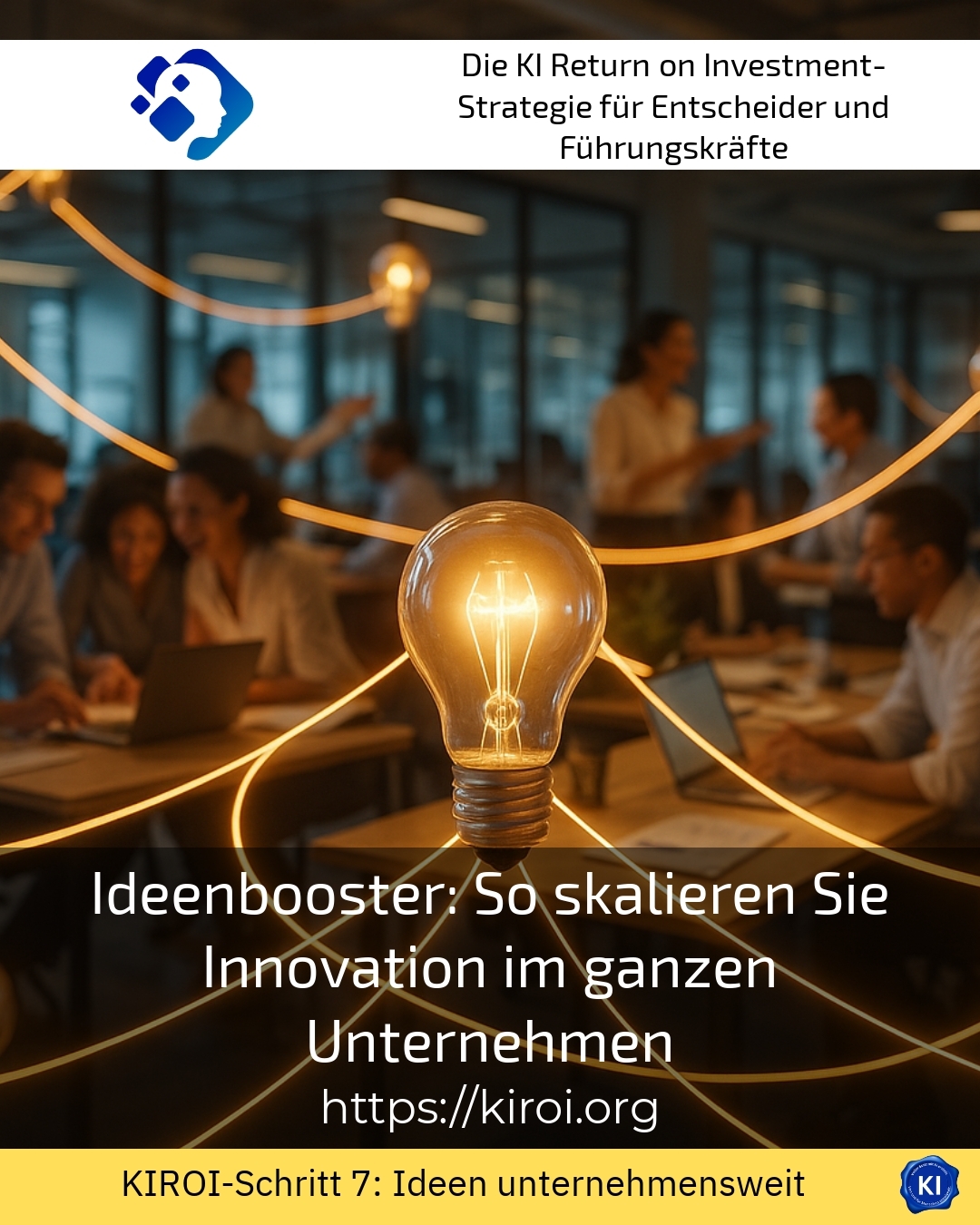
Imagine every single employee in your company carrying groundbreaking ideas within them every day, yet these treasures wither unheard in departmental silos and dusty inboxes. This is precisely where Idea Booster: How to Scale Innovation Throughout the Company as it transforms sporadic flashes of inspiration into systematic value creation. This article shows you how to unleash and sustainably utilise creative potential.
Why traditional innovation processes often fail
Many organisations still rely on isolated workshops or annual strategy off-sites. However, these approaches fall short because they treat innovation as a project rather than a culture. Leaders often report frustration when promising concepts get lost in bureaucratic red tape. This leads to innovation bottlenecks that cause companies to fall behind in the competition.
A manufacturing company in the mechanical engineering sector only recognised this dilemma late on. The development department worked in isolation from sales and customer service. Consequently, valuable market insights never reached the engineers in time. It was only a cross-functional program that brought about the necessary interconnectedness.
A logistics provider experienced something similar, whose drivers collected optimisation ideas daily. However, these suggestions ended up in anonymous letterboxes with no feedback. Motivation rapidly declined, and the company lost important momentum. A digital feedback system finally changed everything fundamentally.
Even a medium-sized retail company struggled with this problem. Branch managers observed customer wishes firsthand. However, their observations remained regionally limited and did not reach headquarters. A structured idea channel remedied this and measurably increased customer satisfaction.
The Idea Booster: How to Systematically Scale Innovation Throughout the Company
A real Idea-booster only works sustainably if it is anchored in the company's DNA. This requires clear structures, transparent processes, and above all, a culture of appreciation. Employees must feel that their contributions are heard and taken seriously. Only then can the full creative potential of an organisation be unleashed.
A technology group therefore set up a monthly innovation forum with a rotating chair. Each department took turns to present its most promising ideas. The best proposals were allocated resources for pilot projects. This fostered healthy competition that spurred on all departments.
One financial services provider went a step further and introduced innovation budgets at the team level. Each team had its own funds for experiments and prototypes. This decentralisation significantly accelerated implementation. At the same time, it strengthened entrepreneurial thinking at all levels.
A healthcare company combined digital platforms with in-person innovation clinics. Employees could submit ideas online or discuss them directly with mentors. This hybrid structure also reached colleagues who were less digitally savvy. The participation rate increased by more than forty percent as a result.
Best practice with a KIROI customer
An internationally active family-owned business in the consumer goods sector faced the challenge of coordinating its innovative capabilities across thirteen national subsidiaries whilst preserving local creativity. The transruptions coaching programme supported the company in developing a multi-tiered innovation ecosystem that facilitated both centralised control and decentralised autonomy. First, we jointly analysed the existing flow of ideas and identified bottlenecks in communication between subsidiaries and headquarters. We then implemented a digital collaboration platform that bridged language barriers through automatic translation functions and took cultural differences into account. Regional champions received specialised training and acted as bridge-builders between local teams and the global innovation strategy. Within eighteen months, the number of ideas submitted doubled, and the implementation rate rose from twelve to thirty-seven per cent. Particularly noteworthy was the emergence of cross-border project teams, which would previously have been unthinkable. Employee satisfaction regarding recognition and participation improved significantly, a trend that was also reflected in external employer reviews.
Cultural prerequisites for sustainable innovation success
Technical systems alone cannot create a culture of innovation, as the human factor remains crucial. Managers must actively demonstrate that mistakes are seen as opportunities to learn, rather than career-ending setbacks. Psychological safety forms the foundation on which a creative willingness to take risks can flourish. Without this trust, even the best platforms will remain unused.
An automotive supplier came to realise this truth through a painful experience. Following the introduction of an expensive idea management system, the contributions remained alarmingly superficial. An anonymous survey revealed deep-seated fears of negative consequences for critical suggestions. It was only through intensive leadership development that this barrier was gradually broken down.
A pharmaceutical corporation therefore established regular "Failure Festivals" where failed projects were celebrated. Employees presented their failures and the lessons learned from them to the assembled workforce. This transparency normalised failure as part of the innovation process. The willingness to undertake bold experiments subsequently increased significantly.
An energy supplier introduced a reverse mentoring programme in which young employees coached senior managers. This reversal of traditional hierarchies greatly encouraged intergenerational dialogue. Experienced managers gained fresh perspectives on digital trends and new ways of working. At the same time, young talent felt taken seriously and more involved.
Digital tools as catalysts for the idea generator
Modern technologies can significantly accelerate innovation processes if used correctly. Artificial intelligence today enables the analysis of large volumes of ideas and recognises patterns and connections. Collaboration platforms seamlessly connect teams across locations and time zones. However, technology always remains a means to an end and never replaces human creativity.
A telecommunications company used machine learning to categorise submitted ideas according to their feasibility and strategic relevance. The system also automatically identified thematically related proposals from different departments. This created synergies that would never have been discovered manually. The processing time for evaluating ideas fell by more than sixty per cent.
An insurance group implemented a gamified innovation platform featuring a points system and leaderboards. Employees earned points for submitting ideas, posting comments and successfully implementing solutions. These playful elements significantly boosted engagement, particularly among younger staff. Critics, however, warned that this risked prioritising superficial quantity over genuine quality.
A construction company used virtual reality to make construction project ideas tangible in three dimensions. Architects and tradespeople could wander through virtual building models together and discuss improvements. This immersive experience fostered lasting mutual understanding between different trades. Planning errors were identified earlier and corrected cost-effectively.
The Idea Booster: How to scale innovation across your organisation with the right support
Transformation rarely succeeds on its own, which is why external support often makes all the difference. transruptions coaching clearly positions itself as a partner in projects centred on scaling innovation and cultural change. It is not about ready-made solutions, but about jointly developing tailor-made approaches. Every company has its own unique circumstances and challenges.
Clients often come to us with similar questions, such as how they can effectively engage their staff in the long term. Others tell us of failed attempts and are looking for fresh ideas to give it another go. Some wish to evaluate and further develop existing programmes. transruptions coaching provides inspiration and supports the change process in a professional and empathetic manner.
A media company used this support to accelerate its content innovation. For the first time, editors and technical experts worked together in cross-functional teams. External facilitation helped to break down entrenched ways of thinking. The result was a range of completely new format ideas that boosted reach and engagement.
Best practice with a KIROI customer
A long-established retail company with over a hundred branches faced the challenge of transforming its brick-and-mortar business model for the digital future. The management recognised that the best ideas for this lay dormant among the on-site staff, who had daily contact with customers and experienced market changes first-hand. transruptions coaching supported the company in developing a multi-stage innovation programme that intelligently linked branch level and head office. We started with regional innovation circles, in which staff from neighbouring branches met regularly to share observations. The most promising ideas were then further developed in a digital incubator, with support from experts in purchasing, marketing and IT. A specially created innovation council decided on a quarterly basis which ideas would be piloted in selected test markets. Successful concepts were systematically documented and then rolled out gradually across all locations. Particularly noteworthy is the development of a click-and-collect service, which originated entirely from a branch manager’s idea and now contributes significantly to turnover. At the same time, staff turnover fell by fifteen per cent because colleagues felt more valued and saw genuine opportunities to make a difference.
Measurability and continuous improvement of innovation programmes
What isn’t measured cannot be improved; this principle also applies to innovation management [1]. The key lies in using the right metrics, as the sheer volume of ideas is of little significance. More relevant are implementation rates, time-to-market and the economic contribution of innovations that have been successfully implemented. Qualitative indicators such as employee engagement provide a useful complement to the picture.
A chemical company introduced a balanced innovation scorecard system that combined quantitative and qualitative metrics. Monthly reviews involving all stakeholders ensured transparency and enabled rapid course corrections. Departments shared best practices and learned from one another. Continuous improvement was thus institutionalised and gradually became self-sustaining.
A sports equipment manufacturer systematically analysed the correlation between innovation activities and business performance [2]. The findings were incorporated into the strategic allocation of resources. Areas with high returns on innovation were allocated additional funding and attention. Less productive programmes were adjusted or discontinued.
A service company used regular pulse surveys to measure its culture of innovation. The results served as an early warning system for cultural erosion or emerging resistance. This enabled managers to take proactive action before problems escalated. In the long term, this preventive approach saved the company significant transformation costs.
My KIROI Analysis
Scaling innovation systematically across the entire organisation is proving to be one of the most challenging management tasks of our time, as it requires taking technical, cultural and organisational dimensions into account simultaneously. My experience in transruption coaching consistently shows that the Idea Booster: How to Scale Innovation Throughout the Company ...only works if managers are genuinely committed to the change. Technical platforms can support this process, but can never replace it.
The case studies presented here illustrate that there is no one-size-fits-all solution; instead, every organisation must find its own path. What matters most is a willingness to learn continuously and adapt approaches. Successful companies do not view innovation as a project with a clear beginning and end, but as an ongoing journey. They create structures that channel creativity without stifling it.
Particularly noteworthy is the growing importance of psychological safety as the foundation for a true culture of innovation. Without this basis, even the most sophisticated systems remain ineffective. Leaders must lead the way here, demonstrating vulnerability as a strength. Only then will employees dare to express unconventional ideas and take calculated risks.
Bringing in external support often proves to be a valuable catalyst for transformation processes [3]. Neutral perspectives help to identify blind spots and break through entrenched patterns. Transruptions coaching does not see itself as a provider of solutions, but rather as a catalyst and process facilitator. Together with our clients, we develop bespoke approaches that fit the respective corporate culture.
Further links from the text above:
[1] Harvard Business Review – Innovation Management
[2] McKinsey – The Eight Essentials of Innovation
[3] Boston Consulting Group – Innovation Strategy
For more information and if you have any questions, please contact Contact us or read more blog posts on the topic Artificial intelligence here.











 Deutsch
  English (UK)