
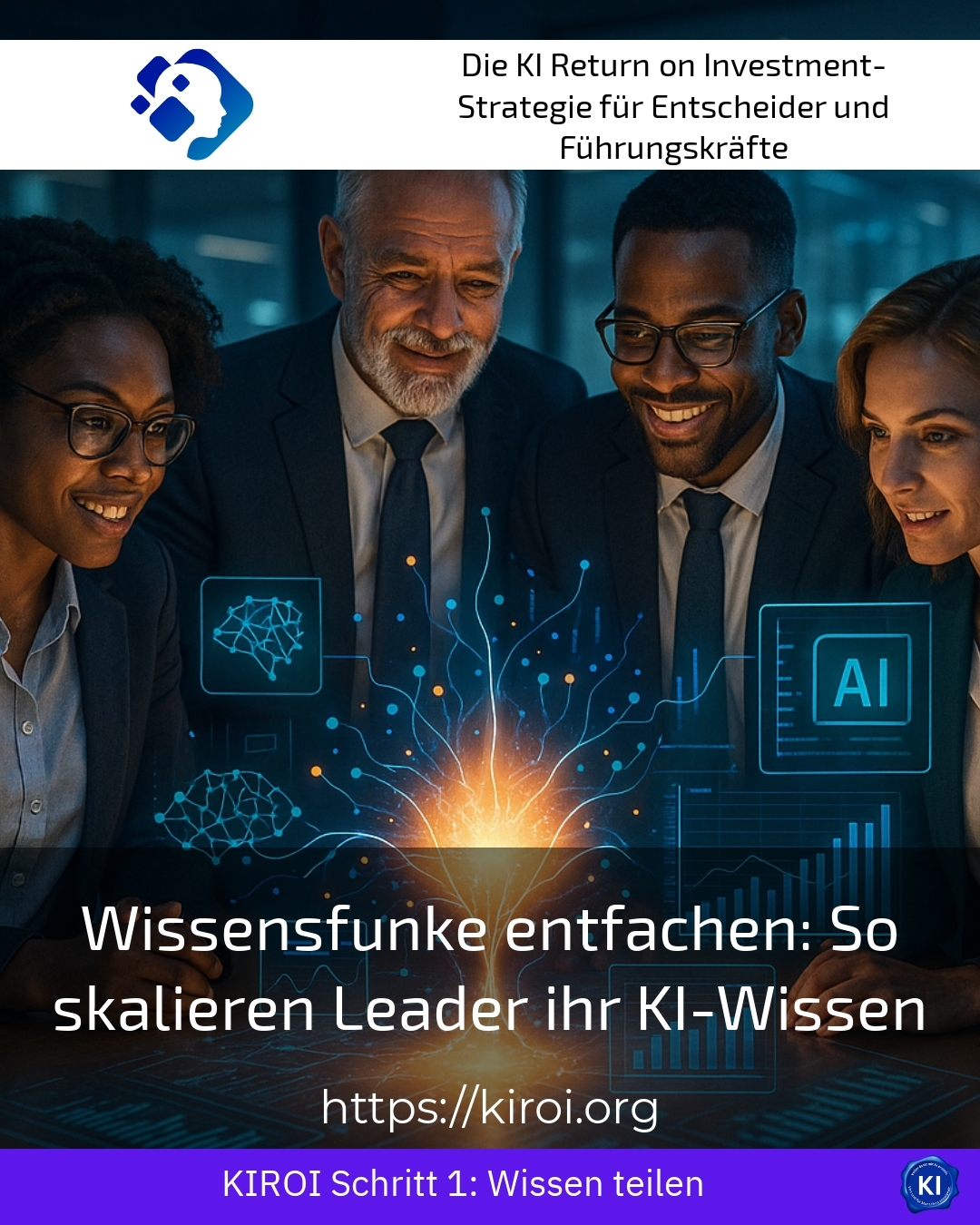
Imagine being able to elevate the collective knowledge of your entire leadership team to a completely new level within a matter of months. This is precisely the transformation that companies are currently experiencing, adopting the Spark of knowledge and systematically invest in the development of their leaders' expertise. The rapid advancement of intelligent systems is not only transforming operational processes but also demanding a fundamental new understanding of data-driven technologies from decision-makers. Those who do not act today risk losing their competitive edge tomorrow. This is no longer just about technical understanding. Instead, the focus is on the ability to make strategic decisions based on intelligent analyses and to lead teams through change processes.
The Strategic Imperative: Why Leaders Must Act Now
The business landscape is changing with unprecedented speed, and leaders face the challenge of navigating their organisations through this transformation. For example, a medium-sized manufacturing company recognised that its senior management had little understanding of predictive maintenance systems. This knowledge gap led to poor investment planning decisions and delayed critical modernisation projects by several quarters. In the financial sector, executives frequently reported an incomplete understanding of automated risk assessment systems, preventing them from fully harnessing their potential [1]. Similar patterns are emerging in healthcare, where diagnostic support systems often remain underutilised because medical leaders are unable to assess their functionality and limitations.
Transruption coaching supports leaders in precisely these kinds of transformation projects, helping to systematically close knowledge gaps. Many clients report that they initially come to us feeling overwhelmed and uncertain. They feel the pressure to understand technological developments without neglecting their core leadership responsibilities. This ambivalence is entirely understandable and often forms the starting point for a sustainable learning journey.
Igniting the spark of knowledge through structured learning architectures
Successful scaling of technological expertise requires more than isolated training sessions or sporadic workshops. It demands a well-thought-out learning architecture that connects various elements and enables continuous growth. For instance, a logistics company implemented a peer-learning programme where experienced managers shared their knowledge of route optimisation algorithms with colleagues. This horizontal knowledge transfer proved significantly more effective than traditional top-down training. In retail, companies are experimenting with mentoring tandems, where tech-savvy junior employees guide senior staff in exploring customer analytics tools. Pharmaceutical companies are also increasingly relying on so-called learning circles, where managers collaboratively work through and discuss case studies on molecular design applications.
Best practice with a AIROI customer
An internationally active mechanical engineering company with over three thousand employees faced the challenge of bringing its forty managers up to a uniform level of competence in intelligent manufacturing systems. The initial situation was characterised by considerable knowledge gaps between generations and departments. While some managers already had experience with predictive maintenance solutions, others only knew of these technologies by hearsay. As part of the transruption coaching, we jointly developed a modular learning programme that spanned six months and combined various learning formats. Participants first underwent a self-assessment of their competencies and defined individual learning goals. They then completed online modules on the basics, which they could work through at their own pace. In addition, monthly in-person workshops were held to analyse specific use cases from their own company. The formation of learning partnerships, where two managers with different levels of knowledge worked together, proved particularly effective. After the programme concluded, evaluations showed a significant increase in confidence in dealing with intelligent systems. Several participants independently initiated pilot projects in their areas, underscoring the lasting impact of the approach.
Overcoming barriers: Psychological and organisational hurdles
The path to technological competence is rarely straightforward, and numerous obstacles can slow progress. Many leaders struggle with imposter syndrome, fearing that their knowledge gaps could undermine their authority. A board member of an energy utility confessed in a confidential coaching session that they often felt uncomfortable during technical discussions and avoided asking questions to avoid appearing incompetent. In the media sector, leaders frequently report time pressures that make continuous learning difficult, even though they recognise its necessity. Insurance companies, in turn, grapple with the challenge that their leaders are heavily tied up in regulatory requirements and find little capacity for additional learning activities [2].
These hurdles are real but surmountable if organisations create the right framework. Impulses can help to adopt new perspectives and question blocking thought patterns. Transruption coaching supports leaders in identifying their individual learning blockades and developing constructive coping strategies. The focus here is not on imparting technical details, but on strengthening self-efficacy in dealing with complex technological topics.
Practical methods to ignite the spark of knowledge
The scaling of technological knowledge is best achieved through practical methods that establish immediate relevance to application. For example, an automotive supplier conducted so-called technology safaris, where executives visited start-ups and learned about innovative applications in the field of quality control. These experience-based formats often leave a deeper impression than theoretical training. In the banking sector, simulation games have proven effective, in which executives make decisions based on algorithm recommendations and experience the consequences immediately. The chemical industry is also experimenting with virtual laboratory environments where executives can understand material research processes without needing chemical expertise themselves [3].
The Teaching-to-Learn method, where leaders have to pass on what they have learned themselves, is particularly effective. A telecommunications company asked its leaders to give a short presentation to their teams after each learning module. This commitment to sharing significantly enhanced their own processing. In retail, companies rely on reverse mentoring programmes, where digitally savvy junior employees coach leaders. The aviation industry uses Crew Resource Management techniques to train leadership teams in constructively dealing with algorithmic decision-making aids.
Cultural transformation as a foundation for sustainable competence development
Individual learning only fully unfolds its potential within the context of a learning-supportive organisational culture. Companies that wish to ignite the spark of knowledge must therefore also work on their cultural foundations. For example, a consumer goods manufacturer established so-called Fail-Forward sessions in which managers openly discussed failed technology projects and jointly drew lessons. This openness reduced the fear of mistakes and promoted experimental learning. In the real estate sector, companies report positive experiences with learning communities, in which managers regularly exchange views on new developments in building automation. Law firms are also increasingly recognising that they must involve their partners in a culture of continuous learning in order to remain competitive.
Best practice with a AIROI customer
A medium-sized food producer with regional roots and ambitious growth plans approached us with a specific requirement familiar to many companies in a similar situation. Management had recognised that intelligent systems for quality assurance, demand forecasting, and supply chain optimisation offered enormous potential. At the same time, there was considerable scepticism towards these technologies among the twelve-person management team. Some managers feared becoming obsolete through automation, while others simply didn't know where to begin learning. The transruption coaching addressed these fears and uncertainties and initially created a safe space for open discussions. Through moderated dialogues, the managers were able to voice their concerns and learned that they were not alone in their feelings. We then jointly developed a vision of how intelligent systems could support their work rather than replace it. Practical workshops on specific applications in the food industry helped to make abstract concepts tangible. After nine months of intensive support, the management team's attitude had fundamentally changed, and several pilot projects were initiated on their own initiative.
Measurability and continuous development of the Wissensfunke programme
Sustainable competence development requires regular progress reviews and adjustments to the learning programme. For example, a technology group implemented quarterly competence assessments, where managers evaluated their own progress and compared it with peer feedback. These reflection loops helped to identify and address learning gaps early on. In the field of management consulting, companies rely on project reviews to analyse how well managers have integrated technological aspects into their advisory services. Pharmaceutical companies use case study competitions where management teams can develop solution proposals for real-world challenges and demonstrate their technological competence [4].
However, the measurement of learning success should not only focus on individual competence but also capture organisational impacts. For example, a trading company found that following its leadership programme, the number of submitted technology-related innovation proposals had increased by over seventy percent. In the insurance sector, participation in competence programmes correlated with faster adoption of new underwriting tools. In the construction industry, too, measurable effects are observed when managers have a better understanding and can utilise Building Information Modelling systems.
My AIROI Analysis
Following intensive engagement with the topic of leadership competence development in the technology sector, several key insights are emerging. Firstly, it is apparent that igniting the spark of knowledge cannot be a one-off action but rather represents a continuous process that requires organisational anchoring. Leaders who learn in isolation quickly fall behind, whereas those in learning-conducive environments grow sustainably. Secondly, many organisations underestimate the emotional dimension of technological change. Fear of loss of status and being overwhelmed often blocks learning processes more than a lack of time or resources. Thirdly, the approach of understanding technological competence not as purely technical knowledge, but as the ability for strategic positioning and organisational leadership, is proving its worth. Fourthly, practice shows that peer learning and experience-based formats are significantly superior to traditional frontal training. Fifthly, it is becoming clear that companies that invest early and systematically in the competence development of their leadership level build competitive advantages that are difficult to catch up. Transruption coaching has proven to be an effective support in this context because it connects individual needs with organisational goals and addresses both professional and personal development. The coming years will show which companies successfully shape this transformation and which will lose ground.
Further links from the text above:
[1] McKinsey Digital: The State of AI
[2] Harvard Business Review: Leadership Development
[3] World Economic Forum: Artificial Intelligence Insights
[4] Gartner: Artificial Intelligence Research
For more information and if you have any questions, please contact Contact us or read more blog posts on the topic Artificial intelligence here.







 Deutsch
  English (UK)