
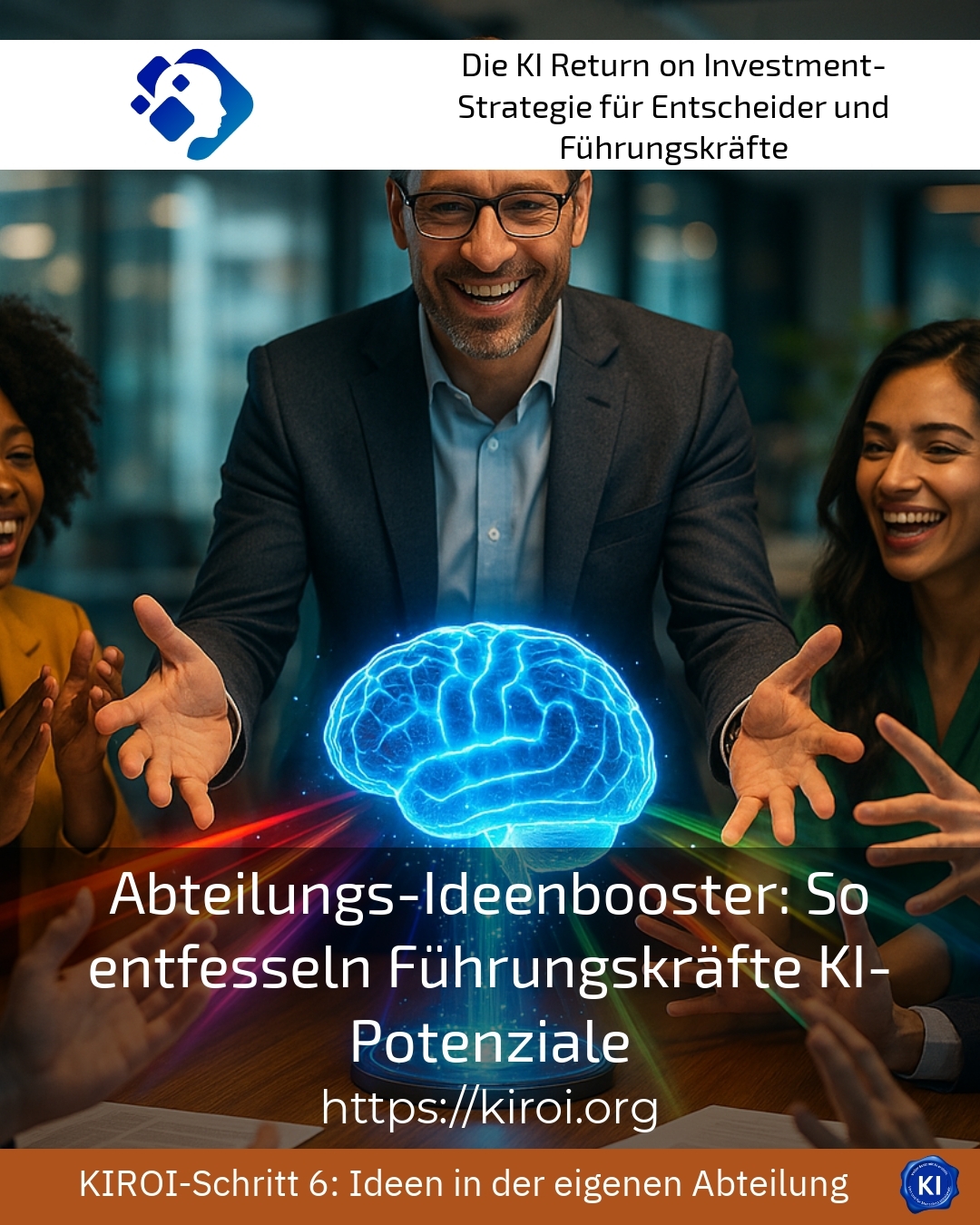
Imagine your department suddenly starts producing ideas that previously seemed unthinkable. The Departmental Idea Booster fundamentally changes how teams collaborate and develop innovative solutions. Leaders today face a fascinating challenge because they must recognise the potential of intelligent technologies. At the same time, many lack the knowledge of how to use these tools specifically. This article shows you practical ways that will transform your department.
Why the Department Ideas Booster is indispensable today
The world of work is changing at a breathtaking pace. Leaders frequently report increasing pressure to innovate in their areas. Traditional brainstorming methods are reaching their limits [1]. Teams need new impetus to achieve creative breakthroughs. Intelligent systems can offer valuable support here. They analyse large amounts of data and recognise patterns faster. This generates ideas that people would not develop on their own.
For example, a marketing team can understand customer behaviour more profoundly. The technology identifies hidden connections in purchasing decisions. This results in more precise campaign ideas with a higher probability of success. At the same time, the team saves valuable time on research. This saved time flows directly into creative concept work.
In the HR department, intelligent assistants support the development of new recruitment strategies. They suggest innovative approaches for employer branding. HR teams frequently report fresh perspectives through this collaboration. The combination of human experience and technological analysis creates synergies. These synergies lead to better results for everyone involved.
The department's idea booster in product management
Product managers face particular challenges when it comes to generating ideas. They must identify and react to market trends. Intelligent systems systematically search through competitor analyses and customer feedback [2]. This results in product improvement suggestions with genuine added value. A consumer goods company discovered a market gap in this way. The new product became a bestseller within a few months.
In the financial sector, controllers use intelligent assistants for forecasting models. These models consider more variables than traditional calculations. This measurably increases the accuracy of predictions. Financial teams use this as a basis for more innovative budgeting approaches. They can allocate resources more precisely to promising projects.
Best practice with a KIROI customer
A medium-sized company in the logistics sector approached our transruption coaching team with a specific query. The manager of the planning department wanted to fundamentally rethink route optimisation. As part of our support, we implemented a structured process for integrating intelligent analysis tools. The team initially learned to identify and prepare relevant data sources. Subsequently, the employees developed new planning approaches together with the system. The results significantly exceeded expectations, as delivery times decreased by an average of twenty percent. At the same time, employee satisfaction improved, as repetitive planning tasks were automated. This freed up time for the department to focus on strategic project work and creative problem-solving. The company reports a new innovation culture that is spreading to other areas. Our transruption coaching accompanied the entire transformation process over a period of six months.
Practical Implementation of the Departmental Idea Booster
Successful implementation requires a well-thought-out approach. Leaders should first analyse the specific needs of their department. Each area has its own requirements for creative support. Sales focuses on customer engagement and proposal development. In development, technical innovation takes precedence [3].
A sales team used intelligent assistants for personalised customer outreach. The system analysed previous interactions and suggested individual conversation approaches. The closing rate improved significantly within weeks. Sales staff reported increased confidence in customer conversations. They felt better prepared and could react more flexibly.
Intelligent systems support process optimisation in quality management. They recognise patterns in error reports and suggest improvements. An automotive supplier significantly reduced its scrap rate through such initiatives. The quality department developed entirely new testing procedures with technological support. This innovation secured the company a significant competitive advantage.
Integration into existing team structures
Introducing new tools requires sensitive change management. Employees must be able to understand and experience the benefits. Our transruption coaching supports teams through this important transition phase. We have frequently observed initial scepticism quickly turning into enthusiasm. A low-threshold entry with quick successes is crucial here.
A design team started with simple research queries to an intelligent system. After a short time, they were using it for concept development and idea validation. The designers report an expansion of their creative capabilities. They see the technology as an inspiring sparring partner for their work. This positive attitude is spreading to other departments within the company.
Intelligent assistants support procurement in supplier negotiations. They analyse market prices and suggest optimal negotiation strategies. One industrial company achieved better terms with key suppliers as a result. The procurement department developed innovative partnerships with strategic suppliers. These collaborations led to joint product developments.
Best practice with a KIROI customer
A marketing department at a retail company was seeking support with campaign development. The executive approached us with the issue of stagnant creativity within the team. Together, we analysed the existing work processes and identified areas for optimisation. As part of our 'transruption' coaching, we conducted structured workshops for the integration of intelligent tools. The team learned to gain customer insights more quickly and translate them into campaign ideas. The combination of data analysis and creative brainstorming proved particularly effective. Within three months, the department developed twice as many campaign concepts as before. The quality of the ideas improved measurably because they were based on more robust insights. Employees reported higher job satisfaction and increased motivation. The company is now planning to expand the approach to other marketing areas.
Mastering challenges with the department idea booster
Naturally, there are also hurdles in implementation. Privacy concerns are among the most frequent topics in our consultations. Managers ask about secure ways to use sensitive information [4]. We recommend clear guidelines and regular training for all team members. The responsible use of technology is always the priority.
A pharmaceutical company developed specific usage guidelines for its research team. These guidelines protect sensitive data while enabling innovation. Scientists utilise intelligent assistants for literature reviews and hypothesis generation. The research process accelerated significantly as a result, with no security risks. The company is now considered a pioneer in responsible technology use.
Intelligent systems assist in handling complex queries within customer service. They suggest solutions that employees can then individually adapt. A telecommunications company significantly improved its first-contact resolution rate as a result. Customers report faster and more satisfactory responses to their concerns. The service department continuously develops new approaches for better customer care.
Culture change as the key to success
Technology alone does not create innovation. The corporate culture must foster a spirit of experimentation and a willingness to learn. Leaders play a crucial role in setting an example for their teams. They must be open to new tools and methods themselves [5].
A managing director began to use smart assistants personally. He openly shared his experiences with the management team. This transparency encouraged other leaders to experiment themselves. Within a year, a new culture of innovation spread throughout the company. Cross-departmental idea projects emerged from this positive dynamic.
In the IT sector, development teams are using intelligent assistants for code reviews and architectural decisions. They report higher quality solutions through this support. One software company significantly reduced its error rate through systematic use. Developers find collaboration with intelligent systems to be enriching.
My KIROI Analysis
Following intensive observation of numerous companies, a clear picture emerges. Leaders who intelligently combine technology with human creativity achieve better results. The key lies in systematic integration into existing work processes. We must never underestimate or neglect the human component.
Our transruption coaching supports companies in this important transformation. We provide impetus for the individual design of idea processes. Clients often report surprising breakthroughs after just a few weeks. The combination of structured methodology and a readiness for open experimentation is powerful.
The future belongs to departments that combine human strengths with technological possibilities. Creativity, empathy and strategic thinking remain indispensably important. Intelligent tools impressively enhance these human capabilities. Leaders should experiment boldly and support their teams in doing so. The right time to get started is now, not sometime later.
The role of corporate culture seems particularly important to me. Without psychological safety, teams will not be able to exploit new opportunities. Leaders must create space for experimentation and view mistakes as learning opportunities. This is the only way to generate the innovative strength that makes companies successful in the long term.
Further links from the text above:
[1] Harvard Business Review – Innovation Topics
[2] McKinsey Digital Insights
[3] Gartner Research Insights
[4] Bitkom – Germany's Digital Association
[5] Forbes Innovation
For more information and if you have any questions, please contact Contact us or read more blog posts on the topic Artificial intelligence here.











 Deutsch
  English (UK)