
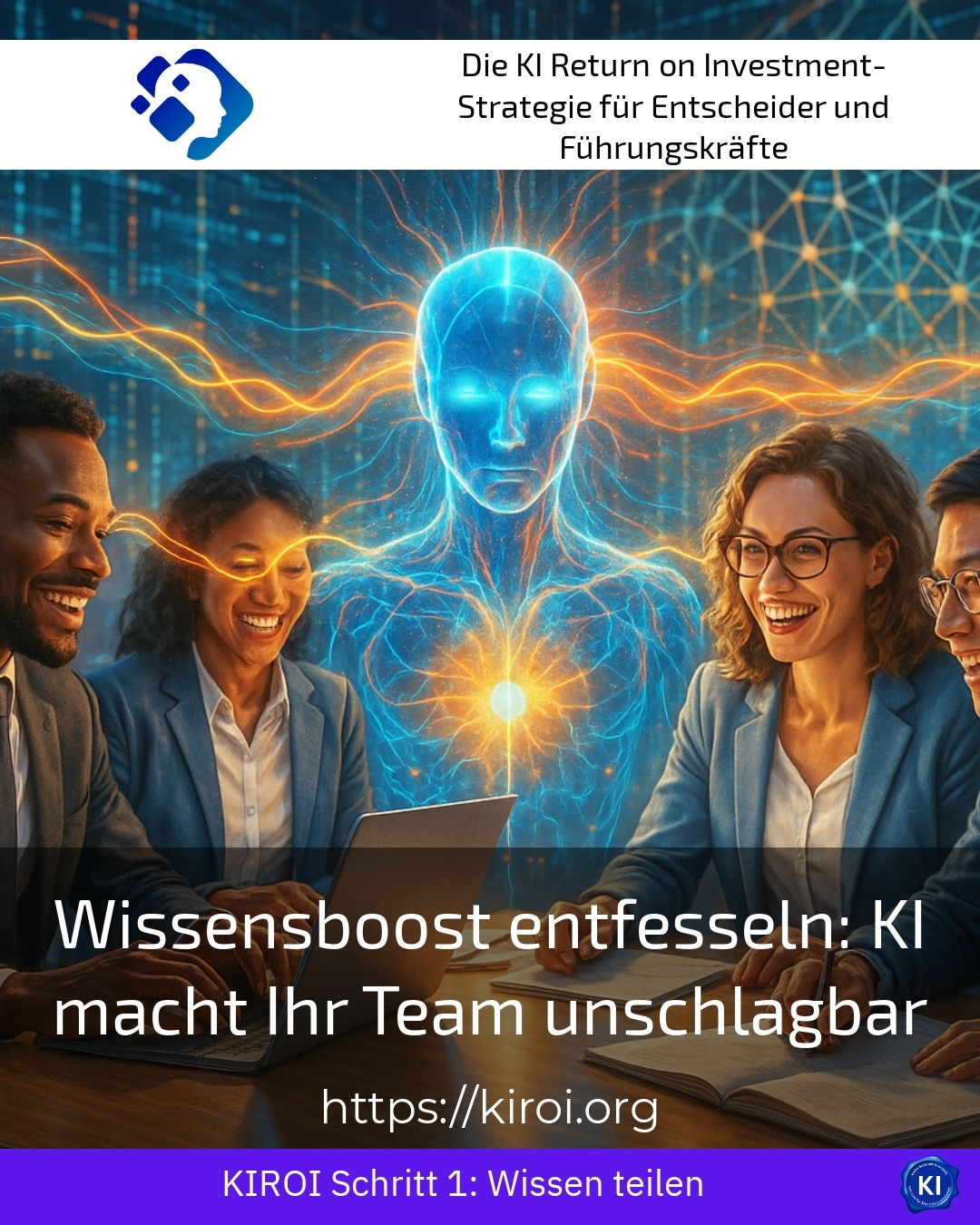
Imagine your team could access the entire company's knowledge in seconds, while also gaining completely new insights. Unleash your knowledge boost: AI makes your team unbeatable is no longer a vision of the future, but a tangible reality that is already transforming numerous organisations today. In a world where information is growing exponentially and becoming outdated ever faster, the ability to intelligently utilise knowledge determines success or failure. But how can these enormous potentials be truly unlocked? The answer lies in the clever combination of human expertise with machine intelligence. This is not about replacing people. Rather, entirely new opportunities for collaboration and knowledge processing are emerging.
Unearthing the hidden treasures within a company
Every organisation possesses vast amounts of implicit knowledge that lies dormant in the minds of its employees. This knowledge has been accumulated over years and decades. It's contained within emails, minutes, project reports, and countless documents. However, the majority of it remains unused because nobody knows exactly where it is. Intelligent systems can now, for the first time, systematically unlock and make this treasure trove of knowledge accessible.
A medium-sized mechanical engineering company faced exactly this challenge. The experienced engineers knew all the tricks of the trade when it came to solving complex technical problems. However, this knowledge was nowhere to be found in documented form. New employees needed years to acquire this know-how. By implementing intelligent assistance systems, it was possible to capture the experiential knowledge of the experts and make it accessible to everyone. This significantly reduced the onboarding time for new colleagues. At the same time, experienced employees were also able to benefit from the insights of their colleagues.
A similar pattern emerged in a logistics company. Here, valuable knowledge about customer relationships and supplier networks was lost when long-serving employees left the company. The implementation of an intelligent knowledge management system enabled this critical information to be preserved. New team members were able to access a wealth of experience immediately. The company therefore not only gained efficiency but also resilience against personnel changes.
Best practice with a KIROI customer
An internationally active automotive supplier approached transruptions coaching with a specific challenge. The company had over thirty production sites worldwide and struggled with fragmented knowledge. Each site had developed its own solutions for similar problems, and there was very little systematic knowledge sharing between the different plants. As part of the coaching, a comprehensive inventory was first carried out. This revealed that the same mistakes were repeatedly made at various sites. transruptions coaching supported the design of a cross-site knowledge network. Intelligent systems now continuously analysed production data and identified best practices. These were automatically processed and made available to the relevant teams. Employees proactively received information on problems that had already been solved at other sites. Within a few months, teams reported significantly shorter problem-solving times. Quality metrics improved noticeably. It was particularly gratifying that employees perceived the system as genuine support and actively used it.
Unleashing a knowledge boost through intelligent networking
The true strength of intelligent systems is demonstrated in their ability for pattern recognition and networking. They can identify connections that remain hidden from the human eye. This capability truly makes teams unbeatable in competition. Because suddenly insights emerge that were previously simply not possible.
A pharmaceutical company used these opportunities for research and development. The scientists worked on various projects and regularly published their findings. However, the connections between the different research strands often remained undiscovered. An intelligent system now analysed all internal and external publications. It identified surprising cross-connections between seemingly unrelated projects [1]. These insights led to entirely new research approaches and significantly accelerated development.
Intelligent knowledge networking is also having a big impact in the financial sector. An investment company relied on systems that continuously analysed market data, news and internal analyses. This gave portfolio managers insights that would previously have required days of research. They were able to make faster, more informed decisions. The team was not replaced, but its performance was massively strengthened.
A management consultancy integrated similar systems into its project work. Consultants were now able to access the entire body of knowledge from hundreds of past projects. For new mandates, they automatically received relevant case studies and proven solution approaches. This noticeably increased the quality of the consulting service. At the same time, it enabled junior consultants to take on complex tasks more quickly.
Don't forget the human dimension
Despite all enthusiasm for technological possibilities, one aspect must not be overlooked. Unleashing the knowledge boost will only succeed if people are brought along. Technology alone does not create sustainable change. It requires a culture of sharing and openness to new things. Clients often report that precisely here lie the greatest challenges.
The introduction of intelligent systems in a traditional industrial company was met with initial scepticism. Experienced specialists feared their knowledge might be devalued, seeing themselves as experts and not wanting to lose this role. It was only through intensive communication and involvement that these resistances were overcome. The employees realised that their expertise was not replaced by the new systems, but rather augmented. They remained indispensable as quality assurance specialists and creative problem-solvers.
An insurance company had similar experiences when transforming its customer advisory services. Claims handlers now received support from intelligent assistants, which provided relevant information and recommended courses of action in real time. Initially, many employees perceived this as being monitored. Through transparent communication and training, this perception changed. The advisors recognised the added value and actively used the systems, leading to a measurable increase in customer satisfaction.
Best practice with a KIROI customer
An energy provider sought support with the transformation of its technical departments. The challenge was to modernise working methods that had evolved over decades. Many employees had been with the company for years and were sceptical of change. Transruption coaching supported the project from the outset with a participatory approach. Initially, employees' concerns and worries were systematically identified and taken seriously. In workshops, teams collaboratively worked out how intelligent systems could support their work. Employees were actively involved in shaping the new processes. They themselves defined which tasks they wanted to delegate to systems and which they did not. This approach built trust and acceptance. The technicians quickly recognised the practical benefits of the new tools. Significant improvements were particularly evident in diagnostics and maintenance planning. Employees reported less stress and more time for demanding tasks. The project is now considered an internal benchmark for successful transformation. The key to success clearly lay in the consistent involvement of the people concerned.
Strategic impulses for implementation
The successful implementation of intelligent knowledge systems requires a well-thought-out strategy. It is not enough to simply purchase technology and hope for the best. Rather, it requires a clear vision and a realistic implementation plan. External consultants can provide valuable impetus and help avoid pitfalls.
A trading company began its transformation with a focused pilot project. Instead of revamping the entire company at once, the team concentrated on one area. Customer service was chosen because quick wins seemed possible here. Service employees were given intelligent assistants to help with customer enquiries. The system analysed incoming requests and suggested suitable answers. Employees could adopt, adapt, or reject these. Response times improved significantly. The positive experiences then created the foundation for a broader rollout.
A media organisation chose a different approach for knowledge boosting. Here, networking between the various editorial teams was the main focus. Journalists from different departments often worked on similar topics, but they were unaware of each other. An intelligent system now analysed all research and articles [2]. It identified overlaps and suggested collaborations. Editorial quality noticeably improved as a result. At the same time, duplication of work was avoided and resources were conserved.
The healthcare sector shows particularly impressive application possibilities. A hospital network implemented systems that processed medical knowledge for doctors and nursing staff. In complex cases, the practitioners received hints about similar cases and their outcomes. The systems supported diagnosis and suggested evidence-based treatment options. The decision-making authority always remained with the medical staff. The technology served as a tool, not a replacement for human expertise.
Making teams unbeatable through continuous learning
A key aspect of intelligent knowledge systems is their ability to learn. They become better and more useful over time. Every interaction contributes to their improvement. This continuous development is what truly differentiates them from conventional systems.
This characteristic was used strategically by the technology company for product development. The development teams documented their decisions and their justifications in an intelligent system. Over time, this created a comprehensive knowledge network. New team members could understand the thought processes of their predecessors. For similar challenges, the system automatically suggested proven solutions. This significantly shortened the development cycles.
Learning systems are also having a significant impact in the field of education. One university relied on intelligent tutors to support students with their studies. These systems identified individual strengths and weaknesses, adapted the learning content accordingly, and made personalised recommendations. Examination results improved measurably. At the same time, lecturers had more time for in-depth discussions and personal support.
A construction company implemented learning systems for project management. These analysed past projects and identified success factors and risks. For new projects, project managers automatically received warning notifications. The system learned from each completed project and became steadily more accurate. Project managers reported significantly fewer surprises and improved predictability.
My KIROI Analysis
The transformation to intelligent knowledge systems is not a sprint, but a marathon. Technology offers enormous opportunities, but its success depends on many factors. My experience from numerous accompanying projects shows that the human dimension is usually underestimated. Companies invest millions in systems, but forget the people who are supposed to work with them. This mistake inevitably backfires through a lack of acceptance and utilisation.
The most successful projects are characterised by three features. Firstly, there is a clear vision that is credibly championed by leadership. Secondly, the employees affected are involved from the outset and taken seriously. Thirdly, the implementation is gradual, with room for learning and adaptation. Organisations that heed these principles achieve sustainable success.
The role of transruption coaching is to guide this transformation holistically. It's not just about technical issues, but about cultural change. Often, organisations approach with specific technical requests. As the coaching progresses, it becomes apparent that the real challenges lie deeper. The ability to share knowledge and learn together often needs to be developed first. Technology can support this, but it cannot replace this ability.
Unleashing the knowledge boost ultimately means optimally combining the potential of people and technology. This connection truly makes teams unbeatable. It creates competitive advantages that are difficult to replicate, as they are based on the unique combination of organisation-specific knowledge and intelligent technology. Those who embark on this journey today will be able to reap the rewards tomorrow.
Further links from the text above:
[1] McKinsey: The economic potential of generative AI
[2] Harvard Business Review: How to become an AI-powered organisation
For more information and if you have any questions, please contact Contact us or read more blog posts on the topic Artificial intelligence here.











 Deutsch
  English (UK)