
Employee competence development is an essential component of modern corporate strategies. It helps companies systematically foster their employees' skills and thus secure sustainable competitive advantages. Decision-makers are faced with the challenge of identifying and specifically implementing suitable measures to unlock potential. Accompanying implementation can provide impetus, as can be impressively seen from a variety of examples from different industries.
Why Employee Competence Development is Crucial for Decision-Makers
Decision-makers play a key role in planning and driving the continued development of employees. Employee competency development helps to align strategic goals with individual skills. This benefits companies through improved efficiency and increased innovative strength. In the automotive industry, for example, it has been common practice for years to equip employees with technical training to prepare them for new drive technologies. At the same time, IT companies regularly rely on agile training programmes to increase the adaptability of teams to new software development methods. In healthcare, professionals attend targeted seminars to improve communication and empathy skills, which significantly enhances patient care.
These examples show that employee competence development is essential, among other things, for the technological and methodological adaptation of companies. Decision-makers should therefore create the right framework conditions and actively support development steps.
Methods for Employee Competency Development: Practical Approaches for Decision-Makers
Employee competency development is best achieved with a combination of different methods. Decision-makers weigh up which approaches are most effective in their company.
Job rotation and project work as practice-oriented learning formats
In manufacturing companies, managers frequently use job rotation to deploy employees flexibly and broaden their skillsets. For example, a manufacturing specialist might learn about planning in controlling. Similarly, project assignments in the consulting industry support the development of project management and teamwork skills through practical application.
Coaching and mentoring as individual development tools
Individual coaching is often used in the financial sector to support executives during change processes. Through coaching, they receive targeted feedback and learn to make better use of their strengths. Mentoring programmes are also popular in the IT industry to ensure knowledge transfer between experienced employees and emerging talent.
Blended Learning and digital learning formats for flexible further training
Many companies, for example in retail, are integrating eLearning offerings that combine theory and practice. These allow employees to learn flexibly and specifically close existing knowledge gaps. Interactive webinars or simulations support the application of new knowledge in realistic scenarios.
BEST PRACTICE with one customer (name hidden due to NDA contract) A medium-sized industrial company introduced a blended learning programme that combined technical training with accompanying practical projects. Employees reported increased motivation and better application of what they had learned in production processes.
Success factors for sustainable employee competence development
For decision-makers, it is important to view employee competency development as a continuous and coordinated process. The following aspects are helpful in this regard:
- Clear target definition aligned with company strategy
- Early employee involvement and targeted potential analysis
- Integration of practical phases for the application of newly acquired knowledge
- Promoting an open feedback culture for reflection and improvement
- Support from external coaches or experts for quality assurance
For example, telecommunications companies have increased employee retention through regular feedback meetings and development plans. Similarly, service firms report that a mix of training and coaching accelerates individual development and strengthens team spirit.
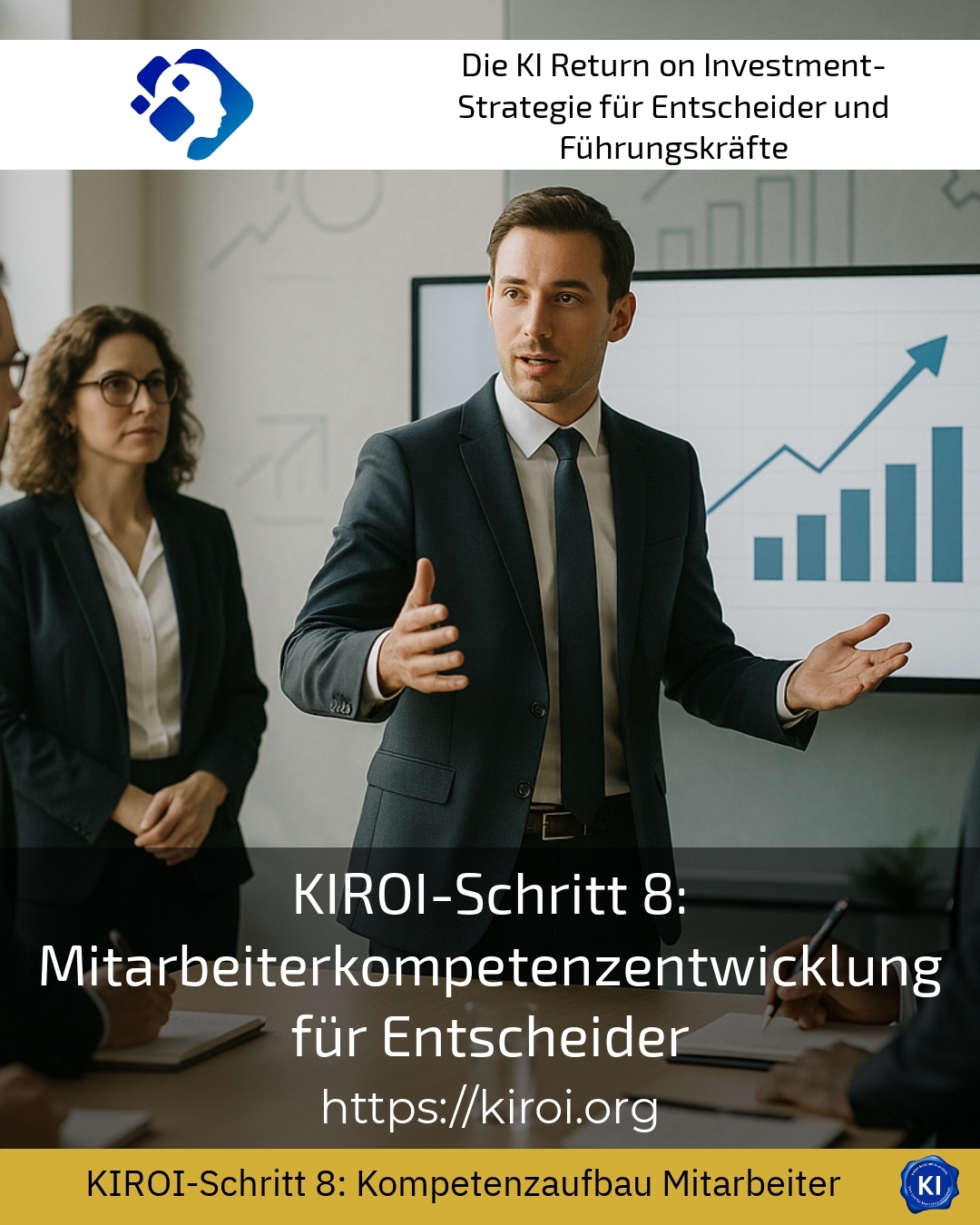
KIROI Step 8 as Support for Decision-Making Processes
The targeted development of employee competencies within projects such as KIROI supports decision-makers in the structured implementation of development measures. This involves not only the transfer of knowledge but also the strengthening of self-organisation and a sense of responsibility. The coaching concept from transruptions-Coaching supports companies in developing tailor-made strategies and actively shaping the change process.
This provides decision-makers with concrete tools and stimuli to support them in managing competency development processes. Furthermore, the sustainability and effectiveness of measures are increased by involving employees as active shapers of their learning process.
My analysis
Employee skills development is not a one-off event but an ongoing process that significantly contributes to a company's success. Decision-makers are faced with the task of selecting suitable methods and actively supporting their employees. Practical formats such as job rotation, individual coaching, and digital learning offers make a valuable contribution here. Accompanying concepts such as KIROI Step 8 provide structured support to make skills development systematic and effective. In this way, companies sustainably promote the performance and motivation of their employees.
Further links from the text above:
Competence Development: Definition + Successful Examples
Methods of Employee Development & Benefits
Popular methods for developing the skills of company employees
Successful Competence Development: 9 Tips and 3 Levels
Skills development: importance and methods
For more information and if you have any questions, please contact Contact us or read more blog posts on the topic Artificial intelligence return on investment here.











 Deutsch
  English (UK)