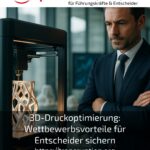
3D printing optimisation opens up diverse opportunities for companies to sustainably secure competitive advantages. Targeted measures can make processes more efficient, reduce costs, and bring products to market faster. Decision-makers benefit from increased flexibility and optimised resource utilisation, which is becoming increasingly important, especially in demanding industries.
Flexibility and efficiency at the core of 3D printing optimization
Additive manufacturing offers crucial advantages because it makes production faster and more cost-effective. Companies use this flexibility to manufacture individually tailored products in small quantities. For example, manufacturers in the medical technology sector quickly produce custom-fit prosthetics that are precisely tailored to the patient. In mechanical engineering, 3D-printed spare parts enable just-in-time production directly at the point of need. And in the consumer goods industry, personalised jewellery or limited collector's items are created, strengthening customer loyalty and sales.
This allows production lines to respond more flexibly to customer requests while simultaneously reducing warehousing and logistics costs. 3D printing optimisation supports these developments through process adjustments and intelligent software solutions that minimise material expenditure and production time.
Topology optimisation as the key to material and cost savings
One of the most effective methods for 3D printing optimisation is topology optimisation. It enables the production of components that contain only the necessary material, yet are still stable and functional. In aerospace, it is used for comprehensive weight reduction, which saves fuel and improves the environmental footprint. In automotive manufacturing, too, manufacturers benefit from lighter components that are simultaneously resilient and meet high demands.
Companies often report significant cost savings due to reduced material consumption and shorter printing times. This increases manufacturing efficiency while simultaneously reducing the ecological footprint. This sustainable production method is becoming increasingly important in industries ranging from mechanical engineering to jewellery manufacturing.
BEST PRACTICE at the customer (name hidden due to NDA contract) A medium-sized manufacturer from the automotive sector integrated topology optimisation into its component development. The result was a 30 percent weight reduction with consistent stability, combined with shorter production times and lower material costs. This allowed the company to significantly strengthen its competitive position.
Rapid Prototyping: Fast Innovations through 3D Printing Optimisation
An important effect of 3D printing optimisation is the acceleration of development processes. Rapid prototyping allows companies to quickly turn design ideas into physical models and test them. This enables very short feedback cycles and iterative improvements. Start-ups and SMEs benefit particularly because they can rapidly develop market-ready products with a small budget.
Architectural firms, for example, use 3D printing to create scale models of their designs, allowing developers and planners to identify optimisation potential early on. In the transport sector too, on-demand production of spare parts saves time and costs by making warehouse stock redundant.
BEST PRACTICE at the customer (name hidden due to NDA contract) A mechanical engineer reduced the development time for his prototypes by several weeks by using additive manufacturing. This enabled faster market launches and flexible responses to customer feedback.
Sustainability and resource conservation through innovative production
Sustainability is gaining importance worldwide. 3D printing optimisation supports this by specifically reducing material usage and waste. This allows companies to reduce their ecological footprint while simultaneously achieving economic advantages. This is a crucial factor for future success, particularly in industries such as aerospace, automotive, and medical technology.
Additive manufacturing enables products to be designed in such a way that material is only used where static requirements dictate. This not only reduces costs but also leads to lighter and more efficient components. At the same time, the entire manufacturing process can be localised, thus simplifying the supply chain.
Practical coaching for 3D printing optimisation
Many companies are seeking support to fully exploit the potential of 3D printing optimisation. Experienced coaching accompanies them in integrating the technology into existing workflows. Both technical questions and organisational challenges are addressed.
The consultation focuses on practical examples, process optimisation, and digital tools that increase efficiency. This creates impetus to help implement projects with purpose and strengthen competitiveness.
BEST PRACTICE at the customer (name hidden due to NDA contract) A manufacturing company used transruption coaching to optimise the internal use of 3D printing systems. This led to shorter delivery times and reduced production costs. Through targeted training, employees were able to take on operational tasks more independently.
My analysis
3D printing optimisation offers decision-makers significant competitive advantages by combining flexibility, cost-efficiency, and sustainability in production. The diverse application examples show that companies can accelerate and individualise their processes through targeted measures. Particularly the combination of topology optimisation, rapid prototyping, and lean manufacturing ensures strategic added value. Those who accompany and implement these impulses significantly strengthen their market position and meet future challenges with innovative solutions.
Further links from the text above:
Topology optimisation for 3D printing
3D Printing Methods: Competitive Advantages for Decision Makers
Shape the future: 3D printing in companies
3D Printing: How Leaders Can Secure Competitive Advantages Now
10 reasons you should use 3D printing
For more information and if you have any questions, please contact Contact us or read more blog posts on the topic TRANSRUPTION here.






 Deutsch
  English (UK)